

Arts & Entertainment
At The Movies
Director
Tim Burton's
"Corpse Bride"
has Jewish bones.
NAOMI PFEFFERMAN
Jewish Journal of Greater Los Angeles
0
nce upon a time, a bride-
groom jokingly recited his
marriage vows over a skeletal
finger protruding from the earth. After
placing his ring on the bone, his mirth
turned to horror when a grasping
hand burst forth, followed by a corpse
in a tattered shroud, her dead eyes
staring as she proclaimed, "My hus-
band!"
This chilling Jewish folk tale hails
from a cycle of stories about the great
16th-century mystic, Rabbi Isaac
Luria of Safed, in what is now north-
ern Israel, said Howard Schwartz, a
top Jewish folklorist and professor at
the University of Missouri-St. Louis.
It also apparently inspired Tim
Burton's charmingly ghoulish animat-
ed film, Corpse Bride. Yes, the film fea-
tures a bridegroom who accidentally
weds a cadaver. But the feature
eschews the folk tale's grotesquerie for
romanticized gloom and Halloweeny
fun — a trademark of Burton fare
such as Edward Scissorhands and The
Nightmare Before Christmas.
Corpse Bride is among more than a
dozen fantasy films slated to open this
year, including Peter Jackson's King
Kong, which some analysts attribute to
the yen for escapist cinema during
wartime.
'Bride revolves around a shy, bum-
bling groom, Victor (voiced by Johnny
Depp), who is practicing the wedding
ceremony when he impulsively slides
his ring on what he assumes is a stick.
The corpse who emerges (voiced by
Burton's real-life fiancee Helena
Bonham Carter) is not a hideously
disintegrating cadaver, but a lovely, if
unearthly, heroine.
"When she gently takes off her veil
and we see her for the first time, it
becomes a glamour-girl shot," cine-
matographer Pete Kozachik said.
The cadaver claims her husband,
but does not emit bloodcurdling
shrieks or insist upon the consumma-
tion of the marriage, like her folk-tale
counterpart. Her mild flaws include a
tendency toward petulance and an
understandable proclivity for dropping
a limb or having her eyeball pop out.
OR these occasions, a maggot pal
pops out of her exposed eye socket.
This damsel-past-distress whisks
Victor off to the Land of the Dead, a
lively place where skeletons party, forc-
ing Victor to leave his living fiancee
(voiced by Emily Watson) bereft.
Not So Scary
So why did Burton — who is known
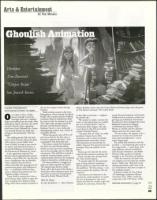
Helena Bonham Carter voices the Corpse Bride and Johnny Depp voices the groom
in Tim Burton's animated "The Corpse Bride."
to dress like a mortician — brighten
the Jewish tale?
"We wanted to make a version that
wasn't so disturbing that you couldn't
put it in a family movie," said co-
screenwriter John August, who also
wrote Burton's Big Fish and Charlie
and the Chocolate Factory.
"The parts that are 'scary' are really
parodies of classic horror-film
moments, such as when our bride's
detached hand crawls after Victor."
The characters are non-Jewish, he
added, "because Tim gravitates toward
universal, fairy-tale qualities in his
films."
Burton got the idea for the movie
when his late executive producer, Joe
Ranft, brought him excerpts from
the 16th-century legend.
"It seemed right for this particular
type of [stop-motion] animation,"
Burton said in an interview with stu-
dio publicists. "It's like casting — you
want to marry the medium with the
material."
The director saw elements in the
tale that he could tiansform to match
his love of protagonists who seem
bizarre but who are actually tragic and
isolated. In interviews, Burton has
traced this preoccupation to his lonely
childhood as an eccentric, artistic boy
growing up in Burbank. No wonder
his characters have included the titular
disfigured innocent in Edward
Scissorhands, the reclusive Willy
Wonka in Charlie and the Chocolate
Factory and now the corpse bride.
"On the surface, she appears to be a
monster but in fact she is kind and
sweet and misunderstood," screen-
writer August said.
The Jewish folk obsession with the
macabre — encompassing tales such as
the corpse bride — comes from strik-
ingly different cultural sensibilities
than Burton's obsessions, said Rabbi
Pinchas Giller, professor of Jewish
thought at the University of Judaism.
"Over the centuries, the Jews were
very helpless and very beset by outside
forces," Giller said. "Bad luck could
always come about, and it was a real
act of Providence that bore a couple to
the wedding canopy."
Schwartz, author of Tree of Souls:
The Mythology of Judaism (Oxford
University Press, 2004), retells the
corpse tale in his 1987 book, Lilith's
GOULISH ANIMATION on page 64
314
9/22
2005
63