

World
Time Not Standing Still
Observant Jews resist a change of the clock that would alter the hour of prayer.
SHELLI LIEBMAN DORFMAN
StaffWriter
A
all
9/22
2005
40
rea rabbis are speaking out
about the ramifications of a
proposal that would bring a
four-week-long extension to daylight
savings time, affecting times of daily
prayer and the end of Shabbat.
On July 21, Congress approved an
amendment to the Energy Policy Act
that will extend daylight savings time
by three weeks in March and one in
November, beginning in the spring of
2007.
The amendment, introduced by
Reps. Edward Markey (D-Mass.)
and Fred Upton (R-Mich.) in April,
originally called for a two-month
extension, but was scaled back due
to heavy opposition.
"The beauty of daylight savings
time is that it just makes everyone
feel sunnier," Markey said in explain-
ing his support for the measure. "In
addition to the benefits of energy
saving, less crime, fewer traffic fatali-
ties, more recreation time and
increased economic activity, day light
saving just brings a smile to every-
body's faces."
Jewish groups aren't smiling.
Both the United Synagogue of
Conservative Judaism and the
Orthodox Union's Institute for
Public Affairs have spoken out in
opposition to the proposal.
Posted on the USCJ Web site is a
letter from public policy director,
Mark Waldman, stating: "The pro-
posed change in daylight savings
time would result in a later sunrise
that will produce an undue hardship
on religious Jews." His letter went
on to explain how the 30-40 minute
daily morning service cannot begin
until after sunrise, which if it occurs an
hour later than usual, will make it dif-
ficult to complete in time for many to
get to the workplace by 9 a.m.
The OU has asked its members to
oppose the plan through letters to sen-
ators and members of Congress.
between our faith and our livelihood."
"Detroit really doesn't even belong in
the Eastern time zone anyway, so
everything, by definition, is already
late," said Rabbi Reuven Spolter of
Young Israel of Oak Park. "It would
just add insult to injury to add another
hour."
Some will still be able to complete
the service in time to get to work if
they eliminate the travel time necessary
to get to the synagogue. But that
would prevent them from participating
in a communal service, where their
presence may be necessary during
prayers — like the Kaddish
which
require a minyan (quorum of 10 wor-
shippers) to be recited.
In addition to the concerns at the
start of the day are those at the end.
"We in Michigan, being close to the
western end of the time zone, are used
—
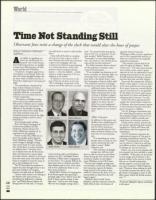
Rabbi Dobrusin
Rabbi Pachter
Rabbi Berkun
to late-starting seders and Shabbatot
ending very late," said Rabbi Robert
Dobrusin of Beth Israel Congregation
in Ann Arbor. "It is already difficult for
those who wish to celebrate simchahs
after Shabbat ends to wait. Now, there
will be four additional weeks to con-
front these problems."
Rabbi Elliot Pachter of Congregation
B'nai Moshe agrees that planning a
Saturday. night event "will be more dif-
ficult if these months change to day-
light time." And he isn't even happy
with the way daylight savings time is
now "I'm annoyed when leaving for
shul at 6:45 a.m. to find that it's still
dark outside," Rabbi Pachter said.
"Personally, I've never liked daylight
time. [It] results in a lot of dark morn-
ings and far too late sundowns."
But Rabbi Jonathan Berkun doesn't
see the proposal as causing a major
concern for party-goers.
"If our members are planning to cel-
ebrate a simchah on Saturday night, we
encourage them to respect Shabbat
[and observe the dietary laws]," said
the Congregation Shaarey Zedek rabbi.
"The proposed extension of daylight
savings time would mean that for four
additional weeks, these tradi-
tional celebrations could not
begin until much later in the
evening. If Shabbat is impor-
tant to us and the traditional
rhythm of Jewish life is mean-
ingful to us, then I do not
think four more lengthened
Shabbat afternoons will have a
major impact on our commu-
nity."
Other Concerns
In addition to the prayer and
Shabbat-time ramifications of
the proposal, both the OU
and the USCJ statements
express apprehension for the
safety of school children in the
extra hour of morning dark-
ness.
"It is something we notice
already when our kids are leav-
ing for school and this will
make it worse," Rabbi
Dobrusin said.
"The extension of daylight
savings time will force chil-
dren to walk to school in pitch black
streets during the time of year when
inclement weather is more likely,"
wrote Waldman in his USCJ letter.
"The last time daylight savings time
was extended, in the early 1970s, there
were numerous reports of children
being injured in the streets as they
walked to school in the dark. It is not
unreasonable to think that this will
happen again."
Markey's chief of staff, David
Moulton, said the concerns voiced by
Rabbi Abba Cohen, the director of
Agudath Israel of America's
Washington office, played a significant
part in the congressmen's decision to
slash one month from the originally
proposed amendment.
"Our primary concern had to do
with the safety of children," Rabbi
Cohen said. "The other issue, pertain-
ing to prayer times, wasn't a prayer
issue per se, but an employment issue,"
placing observant Jews in the uncom-
fortable position of having to choose
between their jobs and their religion.
Even with the compromise solution,
Rabbi Cohen added, "I can't say that it
won't cause problems for some people.
But it goes a long way towards alleviat-
ing our concerns and we are gratified
by the degree of concern and coopera-
tion shown by Upton and Markey in
addressing those concerns," he said.
Others who have- opposed the bill
include the United States Conference
of Bishops, who joined parents' groups
in their resistance because of the dan-
gers it may pose to children.
The Air Transport Association said
that scheduling disruptions caused by
the proposed changes could cost U.S.
airlines $147 million annually and
wreak havoc on American travelers.
Citing various reasons, private utili-
ties, groups representing such comput-
ing giants as Oracle and Yahoo and
dairy farmers also have opposed the
amendment.
The OU statement maintains the
organization's support of "the goal of
an energy independent America," but
added, "This proposal is the wrong
way to achieve it. Each of us will sup-
port efforts to lessen our dependence
on foreign oil, just not this one."
Others, too, may not be pleased with
the proposal, but have decided to make
it workable. "If this plan can be proven
to save energy and contribute to the
general welfare of the country, I think
that we, as a Jewish community,
should support it and just deal with
our issues ourselves," Rabbi Dobrusin
said. "However, those making the poli-
cy shouldn't assume that this is a sim-
ple matter of changing a clock. It will
affect many within the Jewish commu-
The Jewish Telegraphic Agency contributed
to this report.