

World
Analysis
Sharon Showdown
Likud leadership battle is looming ever larger.
LESLIE SUSSER
Jewish Telegraphic Agency
Jerusalem
fter weeks of bitter sparring,
what could be the decisive first
round of the big fight between
Ariel Sharon and Benjamin Netanyahu
for leadership of the Likud Party and
Israel is set to take place.
If pollsters are to be believed, Sharon
will struggle to hold onto power in the
party in next week's key showdown.
The images of settlers being evacuat-
ed from their homes in Gaza and the
northern West Bank did not play well
in the Likud. And though the prime
minister has been fighting back, he still
trails Netanyahu, who resigned last
month as Sharon's finance minister, in
the Likud's Central Committee.
Sharon's fate — and the future shape
of Israeli politics — could be decided
on a seemingly minor procedural issue.
On Sept. 26, the 3,000 members of the
Central Committee will determine
whether to hold a party leadership pri-
mary in November or next April.
A
Sharon's main rivals for the top spot,
Netanyahu and the leader of the hawk-
ish "Likud rebels," Uzi Landau, both
want the earlier date, hoping to exploit
the post-Gaza backlash in the Likud
against Sharon. He wants more time to
consolidate his support, and is present-
ing the early primary as an attempt to
expel" a serving prime minister.
Deputy Prime Minister Ehud
Olmert, one of Sharon's closest political
allies, describes the impending vote as
"the most important by a party-political
body in Israel in a decade." The out-
come could determine who the next
prime minister will be, whether Likud
remains the party of power or splits in
two, whether a totally new Israeli polit-
ical map emerges and whether there is a
follow-up to the Gaza withdrawal.
Latest polls show the Netanyahu-
Landau axis leading by 2-6 percent.
Sharon's Sept. 15 speech at the
United Nations General Assembly in
New York, in which he indicated readi-
ness for further concessions, did not
help his cause in the Likud.
"The Palestinians will always be our
"
Sharon's U.N. Speech
The following are excerpts from Israel
Prime Minister Ariel Sharon speech to
the United Nations General Assembly
on Sept. 15:
I, as someone whose path of life led
him to be a fighter and commander in
all Israel's wars, reach out today to our
Palestinian neighbors in a call for recon-
ciliation and compromise to end the
bloody conflict, and embark on the
path which leads to peace and under-
standing between our peoples.
The right of the Jewish people to the
Land of Israel does not mean disregard-
ing the rights of others in the land. The
Palestinians will always be our neigh-
bors. We respect them and have no
aspirations to rule over them. They are
also entitled to freedom and to a
national, sovereign existence.
This week, the last Israeli soldier left
the Gaza Strip, and military law there
was ended. The State of Israel proved
9/22
2005
38
that it is ready to make painful conces-
sions in order to resolve the conflict.
The decision to disengage was very
difficult for me, and involves a heavy
personal price. However, it is the
absolute recognition that it is the right
path for the future of Israel that guided
me.
Israeli society is undergoing a difficult
crisis as a result of the disengagement,
and now needs to heal the rifts. Now it
is the Palestinians' turn to prove their
desire for peace. The end of Israeli con-
trol over and responsibility for the Gaza
Strip allows the Palestinians, if they so
wish, to develop their economy and
build a peace-seeking society that is
developed, free, law-abiding, transpar-
ent, and which adheres to democratic
principles.
The most important test the
Palestinian leadership will face is in ful-
filling their commitment to put an end
neighbors. We
respect them and
have no aspira-
tions to rule over
them. They are
also entitled to
liberty and to a
sovereign national
existence in a state
of their own," he
declared.
Some pundits
argued that the
speech showed
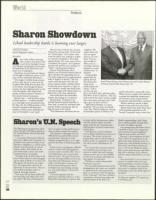
Israel Prime Minister Ariel Sharon met with United Nations
that Sharon has
Secretary-General Kofi Annan Sept. 18.
made up his
mind to leave the
Likud. "This is
not the way peo-
aimed exclusively at center-left voters.
ple in the Likud talk," political analyst
There was not a single word calculated
Aluf Benn wrote in Ha'aretz. "This way to please his traditional constituency:
leads toward the center, toward a public the members of the Likud Central
that wants peace and quiet and is will-
Committee and Likud Party members."
ing to give up more territory."
Sharon, however, says he is deter-
Yediot's Sever Plotzker, in a piece
mined to stay and win in the Likud.
headlined "Divorce from the Likud,"
Sharon knows that that's what many
wrote that "Sharon's balanced, moving
of his potential supporters in the
and excellent speech in Hebrew was
Central Committee want to hear. But
to terror and its infrastructures, elimi-
nate the anarchic regime of armed
gangs, and cease the incitement and
indoctrination of hatred toward Israel
and the Jews.
Until they do so, Israel will know
how to defend itself from the horrors of
terrorism. This is why we built the
security fence, and we will continue to
build it until it is completed, as would
any other country defending its citi-
zens.
The security fence prevents terrorists
and murderers from arriving in city
centers on a daily basis and targeting
citizens on their way to work, children
on their way to school and families sit-
ting together in restaurants.
This fence is vitally indispensable.
This fence saves lives!
The successful implementation of the
disengagement plan opens up a window
of opportunity for advancing toward
peace, in accordance with the sequence
of the "road map." The State of Israel is
committed to the road map and to the
implementation of the Sharm El-
Sheikh understandings. And I hope
that it will be possible, through them,
to renew the political process.
I am among those who believe that it
is possible to reach a fair compromise
and coexistence in good neighborly
relations between Jews and Arabs.
However, I must emphasize one fact:
There will be no compromise on the
right of the State of Israel to exist as a
Jewish state, with defensible borders, in
full security and without threats and
terror. I call on the Palestinian leader-
ship to show determination and leader-
ship and to eliminate terror, violence
and the culture of hatred from our rela-
tions.
I am certain that it is in our power to
present our peoples with a new and
promising horizon, a horizon of hope.
My fellow colleagues and representa-
tives, peace is a supreme value in the
Jewish legacy, and is the desired goal of
our policy.
For Sharon's complete UN speech, go
to JNOnline.com.