

1
Not Quite Cary Grant
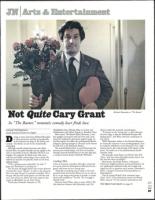
Michael Showalter as "The Baxter "
In "The Baxter," romantic comedy loser finds love.
NAOMI PFEFFERMAN
Jewish Journal of Greater Los Angeles
D
uring a recent interview, Michael Showalter
at times seemed as socially uncomfortable
as the character he plays in his frothy new
comedy, The Baxter, an ode to the romantically
challenged.
Although casually dressed in jeans and a blue
knitted shirt, he spoke formally and sat rigidly in his
chair in the lobby of the Le Meridien Hotel in Los
Angeles. He squeezed the black straw that came
with his iced coffee, pulverizing it into a lump. He
rubbed his temples and placed a hand on his chest,
sighing deeply.
"If I'm coming across awkwardly," he said, "I
guess my `Baxterness' is coming out."
The 35-year-old single Jewish actor-writer-director
invented the word, "Baxter," to refer to the character
who never gets the girl in romantic comedies. He is
the guy who has few social graces, two left feet and
not a clue of how to deliver the witty repartee that
comes so effortlessly to, say, Cary Grant.
Think John Howard's character in The
Philadelphia Story, Woody Allen in Crimes and
Misdemeanors and Albert Brooks in Broadcast News.
Now comes The Baxter's Elliot Sherman, a nice
but uptight accountant with hay fever and a pen-
chant for reading the dictionary, page by page. As
the film begins, he suffers the quintessential Baxter
indignity: getting dumped at the altar by his beauti-
ful wife not-to-be (Elizabeth Banks).
The comedy flashes back to reveal Sherman's dis-
astrous prior relationships, and how he bumbles
through assorted humiliations to win the right girl,
a winsome female Baxter (Michelle Williams).
Leading Man
A fan of romantic comedies, Showalter conceived
the movie when he developed an affection for the
genre's odd-man-out as a young man.
"Typically, everything comes easily to the male
romantic lead, but for the Baxter it's not so easy to
fit in, to get along with groups of people, to exude
charm and confidence," he said. "It's a struggle I
identify with."
Director David Wain, who co-wrote 2001's Wet
Hot American Summer with Showalter, said The
Baxter tweaks the romantic comedy genre.
"It focuses on the 'wrong' guy — gives that guy
his own stage, so that he ultimately becomes the
leading man," said Wain, who has a small part in
the movie.
While Showalter relates to the fictional Sherman,
he insists the character is not autobiographical. Sure,
he could be withdrawn at his Princeton, N.J., high
school, but he also took the girl of his choice to the
prom. He made out at his predominantly Jewish
summer camp.
His long-ago camp flame, he told the New York
Times, "was way more physically mature than I was.
She was like twice my height."
Back home, his Jewish mother, a Princeton
University English professor, promoted feminist val-
ues, challenged traditional male role models and
urged her son to question social norms. (Showalter's
father, a Rutger's University French professor, is
Episcopalian.)
One of young Michael's first cinematic loves
(that's "love" in the admiration sense) was Woody
Allen, because "he was neurotic and insecure and
NOT QUIET CARY GRANT
on page 43
9/15
2005
37