

-
s
figures and narrative," he explains. "I
was interested in the human condi-
tion. I tried creating the human form
in sculpture, and did a few pieces for
installations, but they seemed isolated
and otherworldly. I wanted my work
to define a place.
He has developed a lushly rendered
body of Illusionist, or Realist, works
— 52 of which will be on view at the
Meadow Brook exhibition, which
spans his entire career as a painter.
"But there's nothing 'real' about it,"
he notes. "It's the illusion of space,
completely two-dimensional. It's an
illusion. Even the paint itself is an
illusion. I'm really just pushing dirt
around a canvas."
However it might be labeled,
Schefman's paintings push a viewer to
ask questions, even if subconsciously.
To achieve this, he chooses a familiar
painting by an old master such as
Botticelli or Vermeer, or a classic scene
from mythology, like Antigone or
Scamandrius. But he firmly establishes
it, sometimes disturbingly so, in con-
temporary everyday life by dressing
his subjects in current clothing, props
and situations and rendering them
with an almost photographic quality
(though he does often work from
photographs, as "holding up a photo
for seven weeks is a lot cheaper than
paying a model for seven weeks," he is
quick to point out that he is not a
Photorealist).
Schefman is far from taking himself
too seriously. "I'm not trying to be the
Old Masters," he explains. "I'm just
having a little fun referencing 'pre-
cious' images. I want you to take a
second look, so I put a face on it. I
want you to say 'Wait a minute,
what's going on here?'
"The first question I ask my stu-
dents when we talk about history is,
`What is history?' It's documented
truth. Someone wrote this down. But
whose side are they on? People can
never be objective. So I'm referencing
famous works, but doing it from
someone else's point of view."
In a case of life imitating art imitat-
ing life, in 1997 Schefman found
himself at the center of a controversy,
although, he says, "It wasn't a contro-
versy for me." Tapped to create a
mural for Detroit. Country Day
School in Beverly Hills, it was decided
jointly that he should portray
Antigone, which is assigned reading
for the school's students. However, the
16-foot painting — which depicted
students on a stage, performing a
scene in the play where a girl kneels
over her dead brother — was installed
!
two months after the shootings at
Columbine High School in Colorado,
and some parents were concerned that
it referred to school violence.
"There's nothing controversial about
kids doing a play; it was more about
what was happening at the time. It
was a knee-jerk reaction," says
Schefman.
Contrary to published accounts at
the time, the artist was not asked by
the school to replace the piece. "Don't
believe everything you read," he says.
The painting was removed, and
Schefman told the school that he
would give them their money back
when he sold the painting. To date, it
still hangs in his studio, and no
money has been returned.
The piece has, however, been dis-
played since then — at an exhibition
of the Jewish Community Center in
West Bloomfield, among others. It
will also be included in the show at
Meadow Brook.
"There's a reason that tragedy as an
art form was invented," offers
Schefman. In books, movies, ancient
poems — it teaches you empathy. We
don't have random acts of violence.
Tragedy teaches that consequence and
relationship are ahead of the act.
"The big difference between
Sophocles and Bruce Willis movies,
for example, is that in Die Hard 1-27,
a million people die. And we don't
know any of them. That's the differ-
ence between violence and tragedy.
And it's an important part of litera-
ture."
Schefman continues, "A seminal
point of the story of Antigone is that
it's not about violence, but about
decisions, about doing what's right
and about the law." He admits that he
has "trouble faulting people for react-
ing to the time. I felt as everyone did,
that it was a horrible thing. But I also
have to try to be objective, to look at
things for what they are."
In part, Schefman credits his urge
for getting to the truth with being
raised with Judaism an important part
of his life. Graduating from religious
school at Temple Israel in West
Bloomfield, he and his wife, who was
raised Catholic, sent their two chil-
dren to Hebrew school as well.
"My values come from being raised
a Jew, and I treasure that," Schefman
explains. "The notion that we are
equals on the earth is the theme of my
work. Individuals are equal, and that
is a basic Jewish philosophy.
"In the book A History of the Jews,
Paul Johnson talks about this as the
basis for Greek democracy. There is
!
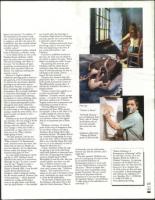
From top:
"Vermeer in Bosnia"
"M-M-My Charona,
part of Schefmans Iliad -
Series, refers to Charon,
the ferryman who col-
lects souls and takes
them across the river
Styx.
Schefmans self-portrait,
"Nothing By Mouth,"
speaks to self-censorship.
no hierarchy, just the relationship
between you and the universe, and I
relish that."
This past summer, Schefman was
part of a small group of artists invited
by the Jewish Federation of
Metropolitan Detroit to travel with
the first TEAM Mission to Israel for
educators. "There's no doubt that
there have been wonderfully strong
people living there. But you cannot
help but be impressed with the
humanity of it, not just the heroes,
the legendary figures," says Schefman.
"I relate more to the individual as an
individual."
❑
"Robert Schefman: A
Retrospective of Painting" will be
on view Sept. 10-Oct. 23 at the
Meadow Brook Art Gallery at
Oakland University. An opening
reception will be held 6-8 p.m.,
Saturday, Sept. 10. The artist will
lecture at 2 p.m. Sunday, Sept.
18. Both events are free and open
to the public. A fund-raising gala
will celebrate the exhibition at 7
p.m. Saturday, Oct. 1; $100/tick-
et. (248) 370-3005 or
www.oakland.edu/mbag.
tIN
9/ 8
2005
43