

TRAVEL
Montreal:
Then And Now
BY SY MANELLO
PHOTOGRAPHY BY DOUGLAS J. GUTH
T
ourisme Montreal and
Tourisme Quebec are mak-
ing a special effort to awak-
en Jewish tourists to one of the
largest Jewish communities in North
America.
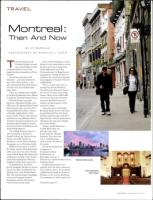
Not far from downtown Old
Montreal — and easily reached by
foot, cab or Metro subway — are
sites representing the Jewish commu-
nity that once was and that which
exists today.
There are walking tours available
of old Jewish Montreal, many offered
through the Montreal Public Library.
Much of the area was made
famous by Mordechai Richler in his
1959 novel The Apprenticeship of Duddy
Kravitz (made into a movie in 1974
starring Richard Dreyfuss). There is
a Chasidic neighborhood at Fair-
mount and St. Urbain, where the city
maintains the eruv (Shabbat district
boundary) and grants permits for con-
structing sukkot (small huts used for
the harvest festival of Sukkot) on the
street-facing balconies.
The College Francais shows its
early incarnation as the Jewish
People's School, the first Jewish day
school, circa 1940. Nearby, on
Hutchison, was the Chevra Kadisha
Synagogue, now a Ukrainian church.
Richler's former house is at 5257
St. Urbain, and the old mikvah (ritual
bath) is just down the street. Richler
went to Baron Byng High School; the
building now belongs to Sun Youth, a
youth-help organization which also
distributes kosher food to poor Jews.
On Esplanade are the former
Jewish Immigrant Aid Service and the
armory; the latter was filmed for the
opening scene in the Duddy Kravitz
film. The Chevrah Hashas Synagogue
is now the Portuguese National
Association, and the old Paperman
Funeral Home stands empty.
Many of the buildings have some
Hebrew in the cornerstone or on the
facade or show the remains of an
almost obliterated set of Ten
Commandments. On Bagg Street is
Congregation Temple Solomon, an
Orthodox shul and the last function-
ing synagogue in this part of the old
neighborhood.
There are also many sites in
modern-day Jewish Montreal.
The Holocaust Memorial Centre
Museum is on Carre Cummings
Square. Many of the 5,000-8,000
survivors living in the Montreal
area have donated letters and
artifacts and participated in the
museum's videos.
Across the street is the Saidye
Bronfman Centre for the Arts, hous-
ing the School of Fine Arts-Youth
Institute and the Leanor and Alvin
Segal Theatre with live performances
throughout the year and a Yiddish
play with subtitles.
Another worthwhile stop is
Yitzhak Rabin Park, dis-
playing a bust of the
Israeli leader by Mitchell
Kotansky. Near the sculp-
ture is a striking monu-
ment to those who died in
the camps.
One of the modern-day
synagogues is
Congregation Shaar
Hashomayim, on
Kensington Avenue in
Westmount, a traditional shul with an
Orthodox charter.
If sightseeing awakens your
appetite, there are many restaurants
from which to choose. In the Jewish
neighborhood, though not kosher, is
Moishe's, on St. Laurent Boulevard.
The steakhouse is still owned by the
Montreal skyline by night
Shaar Hashomayim's
main sanctuary
Continued on page 18
JNPLATINUM •
SEPTEMBER 2005 •
17