

Bugged
Erik Foster tracks some of the state's most
insidious infectious diseases. Just don't ask
him to swat a bee.
BY ELIZABETH APPLEBAUM
A
few years ago, a woman
in Michigan came down
with a curious ailment.
She had severe headaches and suf-
fered from photophobia, an excessive
intolerance to light.
Her physician discovered the
woman was suffering from lympho-
cytic choriomeningitis, an extremely
rare disease usually found only
among rodents. This was the only
known case of a human so affected
ever reported in Michigan.
The question: How could the
woman have contracted the disease?
It was time to call in the experts.
Step in Erik Foster, wildlife and vec-
tor ecologist/biologist with the
Michigan Department of Community
Health's division of communicable
diseases in Lansing.
Foster's first stop was the woman's
house. For many years, she and her
husband had two cats. The cats loved
mice. But one cat died, and the other
ran off. With the cats away the mice
did indeed play, running about the
house and getting into the family food.
Foster and his colleagues discovered
the woman had come into direct con-
tact with a bit of mice excrement. The
mice had lymphocytic choriomeningi-
tis — and now so did the woman.
But this story has a happy ending.
The woman got better and a report of
the case is set to appear in Atlanta's
Centers for Disease Control (CDC)
journal.
For Foster, 31, it's all in a day's
work.
HE'S NOT
THE ORKIN MAN
Raised in Huntington Woods and
Oak Park, Foster became a bar
I 0 • S l'T N113 F. 12 2 005 • J N PLATIN UM
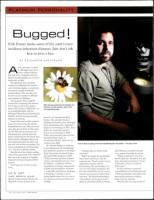
More than just a pretty face, the honeybee, one
of Foster's "all-time favorites," plays a vital
role in pollinating crops.
mitzvah at Congregation Beth
Shalom. He attended Eastern
Michigan University, then Michigan
State, graduating with a bachelor's
degree in entomology in 2001. Even
before he earned his master's
degree in entomology in 2004,
Foster had procured a job with the
Michigan Department of
Community Health, where he has
worked since 2003.
Dr. Edward Walker, a professor
in the department of microbiology
and molecular genetics at Michigan
State University, mentored Foster
during his MSc program at MSU.
"Erik's personal qualities of perse-
verance and natural curiosity," says
Dr. Walker, "combined with his
capabilities in biology, organization-
al skills and quantitative methods
— especially quantitative geograph-
ic mapping — provide a set of
strong qualifications for his work at
the interface of human health and
wildlife.
From his office in Lansing, Erik Foster helps Michiganders stay healthy — one bug at a time.
"Besides that, he simply works
very hard."
Before he caught the entomology
bug, Foster wasn't sure what he
wanted to do. Then he took a course
called Pests, Society and the
Environment. He was intrigued, he
says, by "the impact throughout his-
tory that insects have had on society,
and the way society has had to deal
with that." He liked learning about
"the evolution of the insect itself,"
about its incredible ability to change
and influence, to exploit virtually
every aspect of ecology to survive.
"When people hear what I do,
they'll often say, 'You know, I've got
these darn ants in my house.' I have
to tell them, 'Sorry, I'm not the
Orkin man.'
In fact, of Foster's numerous
responsibilities at the Department of
Community Health, none deals with
spraying for roaches or ridding a
house of pesky termites.
What he does do is stay on top of