

Dry IDED
On Gaza
West Bloomfield parents
and their Israeli children
have different views
on disengagement.
LEONARD I. WANETIK
Jewish Renaissance Media
A
round 1905, the sons of Avraham
Wanetik and Adel Klayman left
Tomashpol. Yitzchak and Meir moved to
Tel Aviv. Lev was murdered by the Germans in
Tomashpol or Odessa. Baruch stayed in Odessa.
And Herschel (my zayde) went to Pittsburgh.
Yitzchak and Meir and their children con-
tributed a great deal to the buildinab of Israel.
Ghana Wanetik married Joseph Sprinzak, the first
speaker of the Knesset. A monument in Tel Aviv
commemorates a fatal flight in 1948 by our
cousin and Yigal Yadin's brother. And so on.
We first visited Israel in 1987 and then just
about every year after. Our children went on
every United Synagogue Youth trip to Israel avail-
able. It was almost inevitable that with all of
these connections our children, and then we,
would make aliyah. Questions about disengage-
ment are very real.
For us, it's four Jews, five opinions. Shalom and
Devra are opposed. Rachel, our daughter-in-law,
is apolitical. In the battle of ribbons, she opts for
a Hershey's Kiss-colored ribbon. She supports
chocolate. Ezra reluctantly supports the govern-
ment's position on practical grounds. We support
the government but understand the opposition.
The core of the vocal mitnaged (opponent)
position is religious. We can't give up a single
square centimeter of land that has been part of
Israel. It's a violation of the very core of Jewish
beliefs — so much so that a mitnagid soldier who
went AWOL murdered four Israeli Arabs on a bus
in the north. That's how much the land was
worth to him. Murdering people.
This position was fostered by a group of rabbis
following a narrow view of Halachah (Jewish law).
In an article in Hdaretz, Kalman Neuman writes
that rabbis from Mercaz Harav Yeshiva espoused
the point of view that it was impossible, halachi-
cally, to give any territorial concessions.
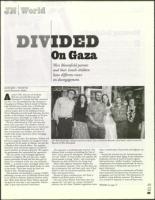
The Wanetik familiy: Shalom and Devra Stark, Ezra and Rachel Wanetik, all of Israel, and Len and Ann
Wanetik of West Bloomfield.
The argument is predominantly mystical. The
believers look to events as heralding the "end of
times" and a period of redemption. Holding sway
over the "whole" of Israel unifies and supports the
Jewish people in being "whole," and concessions
illustrate our lack of belief in the living God.
Many solid religious authorities dispute the
no-concessions" position. They see that there can
be circumstances that void laws; and, even if they
believe in the no-concessions position, they see
those circumstances here.
Because of space considerations, let's look at
Shalom's and Ezra's points of view.
Our son-in-law, Shalom Leib Stark, does not
espouse the "can't give up a square centimeter"
position, but he's close. Shalom's opposition stems
"
from a combination of practical and religious rea-
sons.
Among the practical are the expected increase
in military imports from Egypt to the Palestinian
Authority, the loss of much of Israel's organic
food production, "soldier brutality," inadequate
compensation for farmers and his lack of trust in
unilateral action to bring forth any harvest of
peace whatsoever.
From the religious view, exhumation of bodies
from cemeteries and destruction of yeshivot and
synagogues were key for him. The exhumation of
bodies is a deep halachic question. The destruc-
tion of yeshivot depends, in some of these cases,
DIVIDED on page 72
8/18
2005
69