

World
Al Qaida Approaching
After Sharm bombs, Israelis see Bin Laden terrorists getting closer.
GIL SEDAN
Jewish Telegraphic Agency
Jerusalem
111
any Israelis sighed with relief at the news
that only one citizen of the Jewish state had
been slightly wounded in Saturday's Sharm
el-Sheik terror attack while mourning those who died,
but the triple bombing at the scenic Red Sea resort
reminded Israelis that Al Qaida is getting closer.
How close? Israeli intelligence experts aren't sure.
Some suggest its only a matter of time until Al Qaida
hits targets in Israel, while others believe that global
Islamic terror groups have other priorities — at least
for the time being.
The closest that Al Qaida has struck was in Taba,
located on the Israeli-Egyptian border, and a bit farther
down the coast at Ras-a-Satan, when twin bombings
last October killed more than 30 people, including 12
Israelis. More than 160 people were wounded.
Islamic radicals long have set their sites on Jewish
targets around the world — such as the synagogue in
Djerba, Tunisia, that was hit by a truck bomb in April
2002; Jewish institutions in Morocco bombed in May
2003; and two synagogues in Istanbul, Turkey, which
were hit in November 2003.
But they haven't ignored Israeli targets either. Three
years ago, an explosion at a hotel in Kenya killed three
Israeli tourists and 10 Kenyans. At the same time, a
missile fired at an Israeli charter plane barely missed
the aircraft, which was carrying some 260 passengers.
A statement issued in Qatar in the name of Al Qaida
said the Kenya attacks aimed to "destroy the dreams of
the Judeo-Crusader alliance, which wants to preserve
their strategic interests in the region."
Shortly before the Kenya attacks, Osama bin Laden
Countries Turn To
Israel For Advice.
Washington/JTA
hen Charles Ramsey, chief
of Washington's
Metropolitan Police
Department, visited Israel last year, he
was impressed with the number of cops
he saw on Jerusalem's streets.
Mickey Levy, then chief of Jerusalem's
police force, told Ramsey that the force
actually was understaffed. But each
police cruiser had its blue lights
swirling, giving the impression of police
on every corner.
Now, blue and red lights swirl from
police cars in the American capital as
well, even when they're just on patrol.
"Unfortunately, we have a great expe-
rience of terrorism in a small arena,"
W
purportedly released a statement titled "Letter to the
American People," in which he wrote: "The creation
and continuation of Israel is one of the greatest crimes,
and you are the leaders of its criminals."
The July 23 attacks in Sharm el-Sheik — which
killed 64 people, according to the Egyptian Health
Ministry and as many as 88, according to local hospi-
tals — have increased Israel's nervousness, as the threat
is seen to be getting closer. The working supposition is
that for the time being Al Qaida is preoccupied with
Western regimes and allegedly "treacherous" Arab
countries such as Egypt rather than with Israel.
Analysts cite these reasons for Al Qaida priorities:
• It's easier to plant bombs in London or Madrid
than in Tel Aviv or Jerusalem, given the quality of
Israeli security.
• Ideologically, Al Qaida has launched a "holy war"
against Western civilization in general, not just Israel.
• Since the days of its late leader, Sheik Ahmad
Yassin, Hamas has been hesitant to cooperate with for-
eign terrorist elements because it doesn't want to allow
foreign players on its territory, while Al Qaida has seen
no reason to step on Hamas' toes. There are plenty of
targets for world terrorism as it is.
The Israeli military intelligence chief, Maj. Gen.
Aharon Ze'evi Farkash, said recently that he was con-
vinced Israel's intelligence vis-a-vis Al Qaida could
reach "similar standards to those reached in preventing
Palestinian terrorism." With this intelligence, Ze'evi
was quoted as saying, within three years, 70 percent of
international terrorist attacks could be prevented.
This might sound too good to be true, but Ze'evi
adds two stipulations: Such success can be achieved
only through the cooperation of all the major intelli-
gence agencies in the world, including those from
Egypt, Russia and other countries that remain hesitant
said Levy, now police attache at the
Israeli Embassy in Washington. "We
don't have the attitude that we want to
teach people, but to prevent the blood-
shed we suffered."
With terrorism increasingly becom-
ing a worldwide threat — as evidenced
by the July 7 bombings on London's
public transport system as well as the
July 12 suicide bombing at a shopping
mall in Netanya — numerous U.S.
police forces are turning to Israeli law
enforcement leaders to learn best prac-
tices from cops who have been facing
the threat of terrorism for decades.
Since the Sept. 11 attacks in the
United States, law enforcement officers
from Israel and America have been
sharing information on how each force
prevents, investigates and restores order
after terrorist attacks. Several American
Jewish groups have facilitated these
educational travel exchanges, aiding
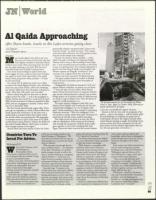
The burned remains of a car lie outside the Hilton
Hotel in Taba, Egypt, in October 2004, following an
attack attributed to Al Qaida.
to join the counteroffensive against terrorism.
Second, in Ze'evi's view, only the symptoms of ter-
rorism — that is, the attacks — will be curbed, while
the real challenge is to eradicate the grass roots of
world Islamic terrorism: the religious schools where
radical Islamist ideology is taught, the hotbeds of mis-
sionary activity that recruit youngsters into the reli-
gious system and the political organizations that nur-
ture the next generation of terrorists.
police who protect everything from the
U.S. Capitol to Disneyland.
The Israeli-aided preparation helped
U.S. law enforcement ratchet up securi-
ty after the London bombings.
While American cooperation with
Israeli law enforcement officials is
advanced, it's just getting under way in
Europe, partly because of negative atti-
tudes there toward Israel. But British
officials are expected to utilize Israeli
knowledge of Muslim terrorist groups
in its investigation of the July attacks.
"What's important to the United
Kingdom is how these operations are
organized, whether it's British-based or
whether the training, information and
materials were brought from abroad,"
said David Capitanchick, a terrorism
expert from the University of Aberdeen
in Scotland.
Israeli law enforcement officials have
more experience investigating terrorism
❑
crime scenes and have shared their
knowledge, such as how to distinguish a
suicide bomber from his or her victims,
in forums throughout the United
States.
Even veteran cops look stunned when
they see video footage from suicide-
bombing scenes, said David Friedman,
Washington regional director of the
Anti-Defamation League, which spon-
sors law-enforcement initiatives.
"These are people that have seen
everything in the world — from car
accidents to murders," Friedman said.
"But they see a whole family lying on
the floor together, and you can tell how
deeply affected they are."
Ted Sexton, a sheriff in Tuscaloosa,
Ala., and National Sheriff's Association
president, said the techniques he
learned on a trip last year sponsored by
the American Israel Public Affairs
Committee were "invaluable."
❑
7/28
2005
55