

Not Forgotten
Flint b'nai mitzvah honor memory of children slain in Holocaust.
SHELLI LIEBMAN DORFMAN
Staff Writer
W
hen Alex Kovalsky speaks from the bimah
during his bar mitzvah service this
Shabbat, he will talk about Shimon
Kheifetz, a young boy who died in the Holocaust-
before he was able to become a bar mitzvah.
Alex and five classmates at the Ivriah religious
school in Flint are the first Michigan students to
participate in the Remember Us: The Holocaust
B'nai Mitzvah Project, a program that introduces
b'nai mitzvah students to the memory of a child
who perished at a young age, like Shimon, who died
at age 3.
The project provides brief biographies of children
lost in the Holocaust and encourages b'nai mitzvah
candidates to find ways to honor their memory.
"Kids are doing everything from introducing the
name of a child at a bar or bat mitzvah and asking
for a moment of silence, to finding a connection to
their Torah portion — all the way to families put-
ting up memorial plaques and taking on the mitz-
vah of Kaddish [the prayer for the dead]," said
Gesher Calmenson, director of Remember Us.
"What's particularly interesting is that every kid
seems to understand the kavanah (intention) as soon
as they hear the invitation. They make a solemn and
spontaneous connection."
And that's what happened at the Ivriah. "We
introduced Remember Us to past and future b'nai
mitzvah students and their parents during our bar
and bat mitzvah family education program a few
months ago," said Emily Alter, director of the
Ivriah, a combined religious school of the
Conservative Congregation Beth Israel and the
Reform Temple Beth El, both in Flint.
Not only did each of the five students with
upcoming b'nai mitzvah services sign on, but Alter
said, "The one person there who had already
become a bat mitzvah a couple of months earlier
asked if it was too late for her to get in on this, too."
Another Child Remembered
That student was 13-year-old Adria Palinsky of
Grand Blanc, whose reason for participating was
simple but insightful.
"So many children died in the Holocaust and
have no one around to remember them," she said. "I
thought if I was in the same position I would want
someone to remember me."
Since Adria had become a bat mitzvah in
December 2004 at Temple Beth El in Flint, she
chose that day for her future yahrtzeit remem-
brances of Marianne Adler who died at age 10 at
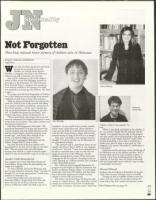
Adria Palinsky
Educator
Emily Alter
Alex Kovalsky
Auschwitz. As one would do for a family member,
Adria's mom Cyndi Mott said, "Adria wanted to
make sure the child was remembered and came up
with the idea of purchasing a plaque with her bat
mitzvah money to hang in the wall of our temple."
Adria said, "I decided to buy a plaque because I
thought it would be the best way for Marianne to
be remembered publicly.
"The yahrtzeit wall is a permanent fixture in our
temple, and I know that it will be in our congrega-
tion forever," she said. "I want future generations to
be able to remember her so that no one will ever
forget the atrocities of the Holocaust. On the
Shabbat evening that her name will be read to the
congregation for her yahrtzeit, the plaque with her
name engraved on it will be unveiled; and I will give
a dvar Torah [Bible lesson]."
The California-based nonprofit Remember Us
program was developed in 2003 by Calmenson and
project coordinator Barbara Tobin. It is now imple-
mented by more than 700 children and their fami-
lies in 40 Jewish supplemental schools and day
schools in seven states and Australia.
The project was formed from Calmenson's expe-
riences as a school director. "My whole life, I carried
around an emotional wound from the Holocaust
that I didn't even know was there until I visited Yad
Vashem, where it was exposed," he
said.
"When I came back and looked at the children in
my own school, I finally felt the enormity and the
tragedy. I was already 66 years old, so the question
was what could I do to bring healing to this place in
myself and in other adults, and how could I offer
the kids something to do so that it wouldn't be a
hidden hurt place in them as they grew up. This
program is my answer. The truth is, I think about it
as my legacy."
Calmenson said he saw how remote the history of
the Holocaust was to the children and how "real" it
became when survivors came to speak to them. "I
wanted to give them something positive that they
could do, so that they were not simply confronted
with the inexplicable horror without a way to make
a meaningful connection."
Eternal Mitzvah
Students who participate in Remember Us are pro-
vided with the name and basic history of a child.
"Usually, all that is available is three or four sen-
tences with their name, the city they lived in, the
camp where they died, maybe their parents' names,
NOT FORGOTTEN on page 70
5/ 5
2005
69