

DECOR
Continued from page 20
Actually, says Eleanor, "there is
also a piece of ceramic art I think is
grotesque, but other than that, we
agreed on all the purchases."
While Ken is hesitant to call any
his favorite, Eleanor labels one "the
most important."
"It is a 300-pound triangle that sits
on a pedestal," she said.
Created by the late Czech Republic
artist Stanislav Libensky, it was made
with molten glass cast in a sand mold.
In contrast, the tiniest piece in the
collection is a five-inch goblet with a
delicate blown-glass man with a rose
in his hand.
And in between are 101 more
pieces of every size, shape and color.
They are clear and opaque, abstract
and true to life. Some are mono-hued
while others are vibrant and multicol-
ored. Some are smooth and one even
appears to have been woven.
THE NEXT GENERATION
The couple enjoys learning about the
artists and following their careers.
"We like to watch them grow and
make bigger and better pieces,"
Eleanor said. They also enjoy visiting
art schools to watch the glass art stu-
dents create.
Ken refers to their collection as
"contemporary"
"It's only in the last 25 years that
glass became an art, rather than a
craft," he said. "That is, except for
the ancient glass, like Egyptian
glass."
In addition to their own collecting,
the Zuppkes think it's very important
to get young people involved.
"At the shows, we tend to see the
same faces, but if we see a young
couple, we try to help them get more
involved," said Ken, president of the
Michigan Glass Collectors, and on
the board of the Art Alliance for
Contemporary Glass in Evanston, Ill.
But, he said, the high price of glass
art can be prohibitive, with pieces
selling for $3,000 to $100,000.
"Our grandkids already have dibs
on their favorite pieces if we ever get
rid of any," Ken said.
But the immediate plan is to keep
adding on and enjoying what's
already there. "We put our heart and
soul into looking for the pieces for
our collection," Ken said. ❑
22 •
APRIL 201)5 •
JNPLATINUM
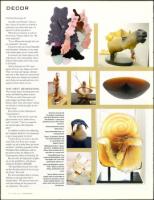
Clockwise from top left:
The Zuppkes commissioned
artist Ricky Bernstein to create
"The Big Break," a glass piece
depicting a person with a broken
shoe lace.
Artist David Bennett created
"Amber Horse."
"Apricot Bowl With Point," by
Frantisek Vizner
"Space," by Stanislav Libensky
and Jroslava Brychtova, sits
on a wood base in the
Zuppke's kitchen.
Lighting placed above "Square
and Circle," by Michael Pavlik,
allows colors to bounce off of it
and reflect on a nearby wall.
"Corvid With Gourd" was
created by William Morris, who
Ken Zuppke calls "one of the
greatest glass artists ever."
Artist Leah Wingfield's creation,
"Elder," depicts an old man
sitting, watching the world
go by.
Harvey Littleton, who Ken
Zuppke refers to as the father of
the glass art movement, created
"Amber and Blue Rotation," two
pieces, each with colors swirled
through them.