

,.eff
41151 oramt. air
aria
....Saar
s
:-. 1`
a a•di
.
: *.%
-
l r
.
a s
.
I
.11
eie
%
11.
•••••••1•'-
■
MI: 9V %
•
alL •
M IS.
•,% iVr
I! 1 1r
,
.111
4 1 •
ri
•
•
1
•
rum
r
am
•
111111131111. nit
1 1 I
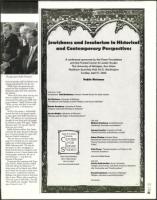
Jewishness and Secularism in Historical
and Contemporary Perspectives
•
;•
■
•
The pope greets Rabbi Schwartz.
know personally, told his holiness I was
coming and paved the way for me."
While there, the group also wit-
nessed the final acceptance of the
Holocaust paper that was created by
the Vatican.
"Most of the time when you say you
have an audience with the pope, it
means you'll be with your 2,000 near-
est and dearest," Rabbi Schwartz said.
"When we met mrith him it was with
just the 24 of us — for hours at a
time."
And for that reason, a relationship
ensued that led to the pope's request
to meet again with Rabbi Schwartz in
2001. "He asked to see me because he
thought he was dying and had people
he wanted to meet with again," Rabbi
Schwartz said. "I'm not sure why he
chose me, but I went."
Rabbi Schwartz allows that "some
criticized the pope because of his sup-
port of various people for saints who
had anti-Semitic tendencies."
"But we have to see him as the
pope who reached out in a real mean-
ingful way to the Jewish people,"
Rabbi Schwartz said. "He was the
first pope to visit a synagogue in
Rome and the first to categorize anti-
Semitism as a sin. I know priests who
heard people confess for the sin of
anti-Semitism — and that was
because of the pope."
During his first meeting with Pope
John Paul II, Rabbi Schwartz talked
with him about the Holocaust. "I
know many of his friends were killed
and I know he was able to help some
Jews survive. I asked him what his
feelings were about those he had been
able to save. Where others would say,
'Give me a pat on the back,'" he said,
`We couldn't save enough.' That's the
type of man he was."
g
e
A conference sponsored by the Posen Foundation
and the Frankel Center for Judaic Studies
The University of Michigan, Ann Arbor
Rathham Assembly Hall; 915 E. Washington
Sunday, April 17, 2005
sT
Public Welcome
1
a
9:30 a.m. 12:30
•
-
Introduction: Todd Endelman, Director, Frankel Center for Judaic Studies
Zvi Gitelman, University of Michigan
"The Nature and Viability of Jewish Religious and Secular Identities"
Martin Goodman, University of Oxford
"Judaism and Jewish Ethnicity in Antiquity"
t
11
•
•
a
Steven Nadler, University of Wisconsin
"Spinoza and the Origins of Jewish Secularism"
a
*
1:30 3:30
n
-
Michael Steinberg, Cornell University
"Modernity, Secularism and Judaism"
•
Sammy Smooha, University of Haifa
"Secular Jewishness and Ethnicity in Israel"
JEAN & SA, MUEL
FRANKEL
> 0.0
1
Adam Chalons, Assistant Dean,
International Institute for Secular Humanistic Judaism
"Secular Jewishness and Ethnicity in the United States
Today"
STUDIES
Felix Posen, "Teaching Judaism as Culture in the
American Academy"
-
• a
I
•
■
3:45 5:15
-
Calvin Goldscheider, Brown University
"Judaism, Community, and Jewish Culture in American
Life: Continuities and Transformations"
www.isa.umich.edu/judaic
•
i•
s la
3:30 3:45 Coffee Break
734-763-9047
3*
Nal
C ENTER
u FOARic
3032 Frieze Building
105 5. State Street
•
, •
•
Ronald Inglehart, University of Michigan
"Religion, Secularism and World Politics"
Conclusion
• • as
a
111111
.
• II it
" * a VC a •
at
. 4. .
a
%. air "
■
•
t
f's
a
lea
a '
• a 1113
a P % i
. a.g-
si t
ailli....
' 4 . As a m a °la a - a
a s
41 Hi I a ' ''''..
113 a
, - 31111111111111MINIO vikali 11,11111643 ..
•
$
301111111111111133,,,
3•11.111•1111619
sr
4/ 7
2005
airmen
21