

Arts Life
Jewish Film Festival
REEL JEWS from page 41
this spring's festival for all atten-
dees.
First off his reel was Back Seat
Bingo, a delightful five-minute ani-
mated documentary showcasing
frank talk about dating, compan-
ionship and sexuality by a popula-
tion not often heard from — sen-
iors (not of the high school kind
but of the Century Village kind).
The film's use of animation
strikes the perfect balance between
poignancy and lightheartedness as
interviewees discuss the kinds of
partners they are looking for: "good
tippers," "good dancers" and "no
Republicans."
"At this age," says one senior,
"there's no time for independence.
You have a few years left, and you
want togetherness."
With more than 20,000 film
attendees, Metro Detroit's Jewish
Film Festival is one of the country's
largest and is also the first to spon-
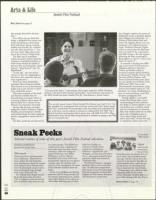
!ii Journey of the Spirit," a documentary about singer-songwriter Debbie Friedman,
sor a yearly film award.
This year's recipient of the Sarah pictured, is the Jewish Film Festival's opening film, "main attraction" and winner of
the 2005 Harold and Sarah Gottlieb Prize for Contributions to Jewish Culture.
and Harold Gottlieb Prize for
Contributions to Jewish Culture is
A Journey of Spirit, which opens the
festival April 10 at United Artists
The seventh annual Lenore Marwil Jewish Film Festival runs April 10-21. See
Theatres in Commerce Township.
the schedule that accompanies this article for venues and times. Season passes
Journey tells the story of singer-
($95 JCC members/$118 nonmembers; $54 Ann Arbor) and individual tick-
songwriter Debbie Friedman, whose
ets,
at $8 each, may be ordered in advance by calling (248) 432-5402. For a
blending of contemporary melody
festival
brochure and inquiries about group rates, call (248) 432-5577. More
with Jewish liturgy has been inspiring
information
about all the films being screened is available by going to the Web
Jewish congregations nationwide for
site
at
www.jccdet.com
.
years.
The film, produced and directed by
(
Sneak Peeks
Ann Coppel, explores the power of
Friedman's music to promote spiritu-
ality, healing and community. A
Journey of Spirit places front and
center the ongoing debate over con-
temporary and traditional prayer
music. Producer-Director Coppel
will be on hand after the film's pre-
miere on April 10 for a discussion
and Q&A session. She also appears
following the film's screenings in
Birmingham on April 11 and in Ann
Arbor on April 17.
In contrast to his first two offer-
ings at the recent NCJW preview,
Magidson showed a clip from
Prisoner of Paradise, which is
reviewed in greater detail elsewhere
in this section. Briefly, Prisoner tells
the story of Kurt Gerron, well-
known German-Jewish actor, direc-
tor and cabaret star of Berlin of the
1920s and 1930s. Sent to the
Thereisenstadt concentration camp,
Gerron was ordered (some say "vol-
unteered," in a move of self-preserva-
tion) to write and direct a pro-Nazi
Germany propaganda film.
Putting together a successful
Jewish film festival takes a keen
understanding of one's audience,
the ability to weave together a myr-
iad of films into a cohesive whole
and the commitment to choosing
films that enable audiences to stand
back and, as Magidson puts it,
"learn about being Jewish and
about [one's self], to have fun and
to experience sadness and truth." ❑
A scene from
"Watermarks"
Selected reviews of some of this year's Jewish Film Festival selections.
GEORGE ROBINSON
Special to the Jewish News
Watermarks
Directed by Israeli documentarian
Yaron Zilberman, Watermarks is a
warm, deeply felt and frequently
witty documentary about the women
of the famed Vienna Hakoah swim
club who dominated amateur swim-
ming in Central Europe through
most of the 1920s and '30s.
The Hakoah was a hugely success-
ful Jewish sports club, formed in
1909 in response to the anti-Semitic
bans enacted by other Austrian ama-
3/31
2005
42
tour sports groups. They fielded suc-
cessful men's soccer, wrestling and
water polo teams, but their women
swimmers, under the tutelage of
Zsigo Wertheimer, were fabled.
Wertheimer and Dr. Valentin
Rosenfeld, head of the club's swim-
ming section, enjoyed an even greater
triumph when the Anschluss took
place in 1938, managing to save most
of the Hakoah's members from the
Nazis.
At the time of Zilberman's filming,
there were still 13 living members of
the women's swimming team, and he
chose eight of them as the subject of
Watermarks, following them in their
daily lives, leading to a
reunion in Vienna. These
women are extraordinary
achievers — psychiatrists, psy-
chologists, art historians and educa-
tors — and possess -wonderful grace
and poise, which they bestow on
Zilberman's film.
The Hakoah became a surrogate
family for them, and it saved their
lives. The film that emerges from
their stories is one of the most grati-
fying documentaries on the Jewish
response to 20th century European
anti-Semitism in several years.
Abjad
Iran's Jewish
community
has not been
heard from since the ghastly show tri-
als of "spies" that rook place several
years ago. The few Iranian Jews who
remained in the Islamic Republic are
understandably silent, while the rest,
one presumes, are rebuilding their
lives in Israel and the United States.
Perhaps that is why Abjae4 an auto-
biographical film by the noted
Iranian filmmaker Abolfazl Jalili, is so
powerfully moving. Jalili, best known
SNEAK PEEKS on page 43