

Arts Life
In Three Dimensions
Manipulating photographic images, Huntington Woods artist
Sherry Orbach brings viewers "inside the picture."
LYNNE KONSTANTIN
Special to the Jewish News
0
ne of Sherry Gilman Orbach's
favorite memories of her
childhood in Grand Rapids is
of her father sfandirig at the window
in their home, reel-to-reel movie cam-
era in hand.
Years later, the Huntington Woods
resident and owner of the recently
closed Dexter Davison Kosher Meat
& Poultry Market in Oak Park lights
up with the thought of him recording
his children playing outside — like
the many times her sister would care-
fully craft expert mud pies, line them
up on a board, slice them and serve
them up.
"You never see that anymore," says
Orbach. "Kids don't make mud pies.
Imagination is taken out of play now
because everything is done for us."
Fortunately, however, she can still
see those images whenever she wants,
thanks to miles of film footage her
father cut; spliced — as Orbach
watched, fascinated; and then
screened for his family.
"I realized then, as a young child,
that things change. And although you
can't always recover what has changed,
you can capture it on camera, to col-
lect memories," she explains.
Since that time, when she about 10
years old, Orbach has rarely gone
without a camera in hand — and has
collected thousands of memories.
In 2004, when Dexter Davison
closed, she found herself looking for a
creative stress release. Sifting through
her photographic collections, she
selected approximately 20 photo-
graphs, to which she then added a
striking element of unique character
and dimension.
The resulting collection is on view
in an exhibition titled "Sherry
Orbach: 3 Dimensional Photography"
at the Woods Gallery, in Huntington
Woods, through April 1.
Multiple Images
3/17
2005
48
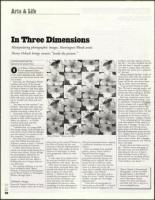
From the Tomb of Absalom in Israel
(located in Haifa, where she lived for
Sherry Orbach: "Flowers and Bees."
nine years) to the canals of Venice to
the flora of Florida and her own
back yard, Orbach's displayed photo-
graphs begin with images of various
elements of landscapes, in them-
selves gorgeously vibrant in color
and life.
"I took some of my photos from
the past and decided to do some-
thing different with them," she says.
After hours of experimentation —
"I stack them, rearrange them, play
around with them for a couple of
days to figure out where they
belong" — Orbach then spray-
mounts the photographs to foam
core of various thicknesses, cuts
them into pieces by hand and
manipulates the pieces to create
something of a three-dimensional
puzzle where all the pieces have a
distinctly intentional home, creating
a subliminal emphasis on specific
objects.
Some are created from multiple
photos, such as Venice, which is
derived from four images.
"I knew I wanted the landscape
pictured horizontally, because the
buildings are so colorful, like row
houses but all in different colors.
But I wanted to show that this has
more to it than any city by the
water, that it actually exists by boats
and bridges," says Orbach.
To emphasize this point, and to
bring the viewer "inside" the photo,
Orbach "brought up" the bridges
dimensionally.
"I have lots of photographs of
Venice that are beautiful — of build-
ings with laundry hanging out the
windows and other aspects of every-
day life — but they wouldn't have fit
with this show. I wanted to empha-
size what is unique about [the city]
and draw.the viewer into it physical-
ly," she says.
Having amassed decades' worth of
material to work with, the artist has
already begun work on what she
hopes will be her next series, focus-
ing on Judaic issues and themes.
"I was in Israel during the Gulf
War. We had to wear gas masks, and
there were tents set up for babies to
prevent gas from coming in. I'd like
to do a scene with that," she says.
She's also completed a piece from
photographs she took during a visit
to Auschwitz. "Outside of the c. P,
there's a plaque with a quote la,
Eisenhower, saying he had to view
this for himself as a witness to the
horrors that happened there. He did-
n't want for it to be written up as
propaganda in the future, which of
course it has been," explains Orbach.
"I use a photograph of that plaque
with other photos of the camp as it
looks now. I thought, 'If this is the
way it looks now, 50 years later,
grassy. green with blue skies and a
housing development going up next
to it, imagine how it's going to look
in another 50 years.' I wanted to
show a trace of that. But I thought
that was too intense for [the Woods]
show," she adds.
For this show, her focus was sim-
ple: "Nature's always changing, so
the same scene can look different
depending on the sun, if there's
snow blowing, if rain is falling. I
think nature's an unending miracle
that grows and produces," she says.
"Like children, you know?" ❑
"Sherry Orbach: 3 Dimensional
Photography" will be on exhibit
through April 1 at the Woods
Gallery, located in the lower level
of the Huntington Woods
Library. For more information,
call (248) 336-1961 or log on to
www.woodsgallery.org .
-
1