

Double Ceiling
Efforts help Israeli Arab women try to succeed in the business world.
DINA KRAFT
Jewish Telegraphic Agency
Haifa
F
or years, in the silence of mid-
night, Gamila Khir secretly
perfected her homemade olive
oil and herb soaps.
When she launched her soap-mak-
ing business, her Druze neighbors and
even her husband mocked her. Now
that she runs two factories, employs
26 workers and sells her products as
far away as the United States, Hong
Kong, Japan and the Netherlands, no
one is laughing anymore.
"People told my husband, 'What is
your wife doing? It's not natural. Take
her to a psychologist.' But now, every-
one congratulates me and says, 'Way
to go.' But at the beginning, it was
very hard," said Khir, 65, her silver
hair covered with the sheer white
headscarf worn by traditional Druze
women.
Khir, who had to drop out of
school when she was 7 to help her
parents farm, spoke at a recent confer-
ence in Haifa that highlighted the
unique challenges facing Arab women
and girls in Israel, especially in the
fields of education and employment.
In Israel, Arab girls are far less likely
to pass high school matriculation
exams than their Jewish counterparts
and Arab women are the least
employed sector in the country.
"Girls are not prepared for the work
force and later they are labeled as
women who do not want to work,
who are lazy," said Aida Touma-
Suliman, director of the organization
Women Against Violence.
In 2003, 18.5 percent of Arab
women were employed, compared to
62 percent of Jewish women, accord-
ing to a study by the Myers-JDC-
Brookdale Institute, a leading center
for applied social research in Israel.
"The gap is enormous," said Myers-
JDC-Brookdale's director, Jack Habib.
His organization helped host the
February conference with the support
of the Marshall Weinberg Fund for
Professional Collaboration and
Development.
The high levels of unemployment
among Arab women are attributed to
discrimination, large family size,
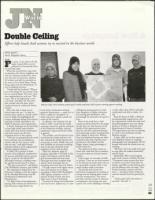
Bedouin high school students preparing for health professions hold a poster warning against smoking.
lower levels of education and geo-
graphical distribution — many live in
what is called the "periphery" in
Israel, job-scarce regions outside the
center of the country.
In addition, the recession that hit
Israel in 2001, caused by the world
economic downturn and the outbreak
of the Palestinian intifada, reduced
employment opportunities for Arabs
in general.
The intifada, and the distrust it has
sowed between Arabs and Jews, fur-
ther widened the divide between the
two groups in Israel, Habib said, and
that included an increased unwilling-
ness on the part of Jewish Israeli
employers to hire Arab workers.
There are, however, signs of
progress, especially in the field of edu
cation. The dropout rate for Arab
girls has decreased and now more
Arab girls than boys complete high
school. More Arab girls also are
attending university than ever before.
Of Arab women with higher educa-
tion, 63.4 percent are working,
according to Myers-JDC-Brookdale's
2003 figures, compared to the 5.1
percent of Arab women who have
eight years or less of schooling.
A process of change and moderniza-
tion can be seen, experts say, in a new
willingness among parents to send
their daughters to higher education
and among girls themselves, who
increasingly see themselves as equal to
boys.
Once in the work force, Arab
women are fairly limited in the range
of jobs they can take because of the
dearth of job opportunities where
they live and the traditional dictates
that discourage women traveling from
their villages to find work. Women
from less traditional homes are often
stymied by the lack of public trans-
portation in the Galilee and the
Negev, where a large percentage of
Israeli Arabs live.
The majority of Arab women in
Israel who work find jobs as teachers
or social workers or in local munici-
palities.
Arab women are virtually invisible
in politics. There are no Arab women
in the Knesset and only three who sit
on municipal councils. Only a very
small number work in business.
The Jewish-Arab Center for
Economic Cooperation is working to
change that by helping Arab women
become entrepreneurs. The center
provides training courses in financial
management, accounting and com-
puters. Part of the challenge is finding
a niche where they will be culturally
comfortable and able to make a liv-
ing.
Amal-El-Sanaa of AJIK, a Bedouin
entrepreneurship organization, said
her organization noted that male wed-
ding photographers were not taking
photos of women at Bedouin wed-
dings because of issues of modesty.
The organization saw this an opening
to create a new profession among
Bedouin women.
In July, AJIK ran its first course to
train Bedouin women in wedding
photography and videography. All the
women who took the course now are
working.
"We knew what the needs were and
we saw what the market demanded,"
said El-Sanaa.
Meanwhile, Khir is encouraging
other Arab women to follow her lead.
"If someone wants success they have
to believe in and love what they are
doing," said Khir, as she held up sam-
ples of different olive oil soaps. They
include lavender, jasmine and rose-
mary — all plants whose medicinal
uses she learned from her grandmoth-
er.
"I had a great drive and desire to
succeed," she said. ❑
'TN
3/10
2005
59