

FOR THE AGES
Max M. Fisher, 1908-2005
Art for
Detroit's Sake
Max Fisher's philanthropic largesse leaves a lasting mark on the Motor City's cultural jewels.
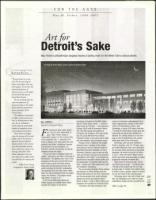
The Max M. Fisher Music Center opened in October 2003.
potables
"We pay tribute to a man
who, like the first king of
Israel, stood higher than any
of his people. He has been the
respected spokesman of
American Jewry to the leaders
of Israel from the days of
David Ben-Gurion.
"He has similarly been the
respected spokesman of
American Jewry to the leaders
of the American government
and to presidents of the
United States.
"His influence transcended
his offices and executive posi-
tions as distinguished as they
were, for he embodied a
moral authority achieved by
decades of exemplary service
and recognized everywhere.
`Max Fisher has helped
shape the destiny of the Jewish
people, and he has become a
legend in his own lifetime.
Deeply rooted in this commu-
nity which proudly claimed
him as their own, loyal to the
heritage of his faith, Max
Fisher embraced in his care
and response the welfare of his
city and state, his country and
people. -
— Rabbi Irwin Groner,
Congregation Shaarey Zedek
BILL CARROLL
Special to the Jewish News
or someone who really wasn't
an "art-for-art's sake kind of
guy," Max Fisher made a
remarkable impact on the cultural life
of his adopted city — donating mil-
lions of dollars over the years for arts
projects and other communal causes
that benefit not just members of
Detroit's Jewish community but art afi-
cionados across the region.
"It's not true that he disliked music and
culture," said son-in-law Peter Cummings of
Birmingham. "He believed very much in the
importance of the arts. It's just that he val-
ued the arts as part of the total picture,
along with the educational process, that
would contribute to Detroit's revitalization.
He supported all of the city's major institu-
tions: the Detroit Institute of Arts, the Opera
House, the theaters. If the project would
help Detroit, he was for it."
In his final philanthropic gesture to
Detroit, leaving an indelible mark, Fisher
donated $10 million to the Detroit
Symphony Orchestra for the $60 million
Max M. Fisher Music Center — affection-
ately known as The Max — that opened in
October 2003 north of downtown Detroit.
The 135,000-square-foot addition to
Orchestra Hall includes a 450-seat recital
hall, the Jacob Bernard Pincus Music
Education Center, a four-story atrium lobby
and new elevators and concession areas.
Through Fisher's influence, the project
attracted many members of the Jewish
community as donors. Samuel Frankel of
Bloomfield Township, developer of Troy's
Somerset Collection, says he and his wife,
Jean, got involved because of his business
associations with Fisher. "I just thought we
should have a beautiful cultural center, and
[the restoration of Orchestra Hall] was the
start," Frankel said. "Max made sure to get
me involved in everything."
The surrounding Orchestra Place campus
also features an office building and the
Detroit High School for the Fine, Performing
and Communication Arts, which officially
opened just three days before Fisher's
March 3 death. A total of $220 million was
invested in the creation of Orchestra Place.
"The DSO is the only orchestra in the
country to champion redevelopment of an
urban neighborhood, adding to the invest-
ment in the Woodward corridor," said
Cummings, a former DSO board chairman.
"The Max M. Fisher Music Center gave the
community the world-class facilities we
deserve. It's a fitting tribute to a man who
was an icon of philanthropy, who consis-
tently gave back to the community."
Cummings, who has been married to
Fisher's daughter, Julie, for 27 years, was
an English literature major and a journalist
for six years before becoming a real estate
developer. He recalls coming to his father-
in-law in 1994 with Detroit Mayor Dennis
Archer and others and presenting a modest
proposal to renovate Orchestra Hall.
"Max shook his head and said, 'You're
not thinking big enough, - Cummings said.
"He told us the project was not on a big
enough scale; it needed more critical mass
in order to have a greater impact on Detroit.
So, we went back to the drawing board.
"He always was a hard sell in these mat-
ters. He challenged us to make it a larger
undertaking, always pushing, prodding and
ART on page 28
3/10
2005
27