

moolleara.o.ose
irM11114
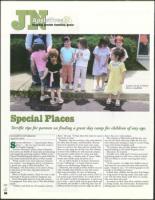
Campers line up at Yeshivat
Akiva in Southfield.
Special Places
Terrific tips for parents on finding a great day camp for children of any age.
ELIZABETH APPLEBAUM
AppleTree Editor
S
ummer afternoon ..." mused author Henry
James. "... the two most beautiful words in
the English language."
"Summer afternoon" means a kind of freedom
that comes just briefly. It means play and dreaming
and imagining and being outdoors. Which is why
Chaya Devorah Bergstein believes a good children's
day camp should provide plenty of time outside.
"Being outside is the most important thing for
the summer," says Bergstein, director of Ganeinu,
a Jewish day camp in West Bloomfield. "[In
Michigan], with this climate, we're used to being
inside most of the time, especially during the
school year."
When it's finally summer, "that's the time to take
advantage of the great outdoors" Bergstein says.
Nancy Rosenthal, director of the day camp at
Congregation Beth Ahm, also in West Bloomfield,
agrees.
"Children need fresh air, the outdoors and sun-
3/3
2005
38
shine," she says. "It helps them feel closer to nature
and closer to God."
Bergstein, who has served as a day-camp director
for more than 20 years, and Rosenthal, who has
been in her position for seven years, have camp
down to a science. For those parents sending chil-
dren to a day camp for the first time this summer,
or even if the children are well-seasoned campers,
the two have useful advice for moms and dads.
The first step — outdoor play, of course. Make
certain your child's camp has plenty of it.
Yes, an indoor facility is necessary. Sometimes,
it's just "stifling hot," so Camp Ganeinu moves
inside to air conditioning, Bergstein says.
Otherwise, the outside provides children not just
with a healthy dose of fresh air, but also renews
their sense of wonder. It's vast, it's liberating.
For adults, a rock is a rock and a leaf is a leaf. It's
not much to get excited about. To a child, howev-
er, the world is a place of exploration. A rock is not
just a rock — one is small and has green flecks and
it's smooth, and another is really big and it has all
different kinds of colors and you might be able to
draw a face on it with markers.
The outdoors is filled with stuff like that, and
you can run there and jump wildly the way you
can't when you're sitting at a desk or in your living
room with all that breakable stuff.
The outdoors also provides children with new
ways of looking at the world, Bergstein notes.
Take paint, for example.
Virtually every child aged 3-18 does some kind
of painting project at least once a week at school.
This isn't likely to involve removing their shoes,
however.
"In the summer, we might have children step in
their bare feet into paint and then walk across the
paper," Bergstein says. "Or we'll hang paper on the
outside of a building and paint."
At Beth Ahm, children can dip their little fingers
in a big bucket of shaving cream, then make a pic-
ture with the white foamy stuff. Since it's outside,
who cares about the mess?
Art projects at Beth Ahm often combine creativi-
ty, being outside, fun and function. Rosenthal lists
making paper fans ("pretty and functional"),