

that was the point for me. I thought, "I
can play this." Before that, I didn't
know how I would approach it, but I
saw a character that I could understand
and identify with.
Q: Is his tragedy that he lived during
his time?
A: I would say that, and his tragedy is
also how he dealt with these conditions.
As Michael Radford says, it's a kind of
road rage really because of what he's
come to in his life. It's sort of being vio-
lated by the conditions of his life.
I remember going into it very much
with Michael and Jeremy Irons
(Antonio) and talking about that scene
with the pound of flesh — and know-
ing that what Shylock is really doing
there is taking a risk. He doesn't know
Antonio's ships are going to sink. It's a
way of standing up to the oppressors,
his way of posturing to them.
Q: Talk about approaching the "Hath
not a Jew eyes?" monologue. Is it
about racism, and is it indicating that
Shakespeare wasn't anti-Semitic?
A: This is a real case against prejudice.
It's one of the great speeches against it.
What I liked about it, what I felt about
the way Michael set it up, and what I
finally related to, was the fact that it was
something that was happening on the
street. It wasn't a speech anymore. It was
an incident that was taking place. Of
course, it's wonderful. You get a speech
like that and you really want to give it
the old gun.
Q: Yet it seemed you low-keyed it if
anything.
A: You know, you want to be Mr.
Righteous, Mr. Right, and Michael kept
moving me away from that and saying,
"This is something that's got to do with
something that's happening inside of
him."
It's an episode that happens on a
street. You've got the whores looking at
him, and you've got those two guys that
he's talking to, and it just happened. It
might not have happened. He might've
just kept walking, but he turned around
and just said it.
You know, I'm sure that it's happened
to everyone — where we've had an
opportunity sometimes that we just
want to say, "You know, f— off."
He's earned the right in a way to
speak out like that, and he does it in
that instant and it's over. ❑
(c) 2000-2005 Featurewell.com;
all rights reserved.
'William Shakespeare's
The Merchant of Venice'
"Merchant" offers potent portrait of prejudice.
MICHAEL FOX
Special to the Jewish News
0
f all the prestigious films
released at the end of 2004
for Academy Award and Top
10 consideration, none is more
important, or more harrowing, than
William Shakespeare's The Merchant of
Venice.
An uneasy combination of moral
fable and romantic comedy, this
adaptation of Shakespeare's problem-
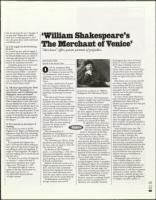
atic play is made unforgettable by an Jeremy Irons as Antonio in "William
agonizing, unrelenting courtroom
Shakespeare's The Merchant of Venice"
scene.
This eminently literate costume
Shylock's services. The businessman
drama, set in 16th-century Italy,
requires a bridge loan (until his ships
decidedly does not play like a muse-
come in) to finance his friend
um piece. It broods and crackles
Bassanio's journey to court a wealthy
with an energy and momentum that, beauty named Portia (Lynn Collins).
purely from an entertainment stand-
Shylock, holding the upper hand
point, puts it way ahead of the sea-
for once, regains a measure of pride
son's higher-profile movies.
by extracting tough terms that both
While it's a pleasure to report that
men nonetheless view as symbolic:
Merchant, scripted and directed by
Should Antonio default, Shylock is
Michael Radford (II Postino), is a
entitled to a pound of his flesh.
bravura film, the more pressing
As played by Irons, Antonio is
question for Jewish movie-
amply self-entitled but also
goers is how Shylock is
uncommonly self-aware. He
portrayed.
feels loss, rejection and lone-
The opening shots of
liness in the course of the film,
Merchant are unambiguous in their
softening the villain's edges to the
depiction of an anti-Semitic, two-
point where he is also a victim.
tier society.
Pacino imbues Shylock with enor-
The Christians run Venice, living
mous gravity, playing him as world-
decadently and habitually abusing
weary but undaunted. He knows well
the Jews, who are made to wear red
the way of the world but has never
hats and live in " getos.”
accepted it. Eminently confident in
So absolute is the Christians'
his abilities, he's nonetheless been
power — and loathing — that even a deprived of the chance to compete at
respected and dignified merchant,
the highest level. And he's disrespect-
Antonio (Jeremy Irons), thinks noth-
ed on a daily basis, to boot.
ing of spitting in the face of an elder-
Shylock is widowed but has a
ly Jewish moneylender.
teenage daughter, Jessica. A peripher-
Shylock (Al Pacino) excels at an
al, ambiguous figure, she nonetheless
illegal occupation practiced only by
makes a choice that has devastating
Jews, who have been summarily
repercussions. Late one night, she
banned from legitimate businesses.
takes a box of jewels and elopes with
From the outset, Merchant steers
her non-Jewish boyfriend, Lorenzo.
even the most callous viewer to sym-
Meanwhile, Bassanio (Joseph
pathize with the ill-treated Shylock.
Fiennes) succeeds in winning Portia's
As Shakespeare would have it,
hand. As with any production of
though, Antonio has need of
Merchant, the comically romantic
shenanigans that ensue at Portia's
estate are trivial compared to the
devil's play unfolding in the city.
We are impatient to return to
Venice where, indeed, Antonio has a
stretch of bad luck. In a turn both
far-fetched and inevitable, Shylock
seeks the legal enforcement of the
bond.
Had Jessica not run away, had she
not taken a large chunk of his for-
tune, perhaps had she not married
outside the faith, Shylock might be
reasonable. But he is mightily
injured, and in his pain and anger
does not see straight.
In court, Pacino plays Shylock as
both mercilessly rigid and tragically
self-destructive. Some will see
Shylock as an obstinate fool who gets
what he deserves.
But given the viciously anti-
Semitic society on display, a court-
room correction would make little
difference in either the short or long
run. Once Shylock dared to publicly
claim his rights against a gentile,
there could be no possible resolution
that would be good for the Jew — or
the Jews.
Some scholars assert that The
Merchant of Venice is inescapably
anti-Semitic, no matter how much
Shylock suffers. Perhaps. But
Shakespeare's great gift was an ability
to write speeches for every character
that not only conveyed personality
and moved the plot forward, but also
made convincing arguments for his
or her point of view. If the fervor of
the anti-Semites were impotent or
diluted, the story would lose its
underpinnings.
Shakespeare's plays served as a
form of public debate, as well as
drama and entertainment. This
ambitious and enlightened film cer-
tainly warrants serious discussion.
Unfortunately, it will find its greatest
audiences in urban centers, where
the citizenry is already greatly con-
cerned about the growing influence
of religion on public policy.
❑
"IN
2/17
2005
49