

•
w g
{33
-
) p io NgtniomisE
No Tidal Wave
Insurance rates here not expected to rise because of the tsunami.
ALAN AB RAMS
Special to the Jewish News
B
JIT
2/10
2005
36
usiness owners in the United States proba-
bly won't experience any aftershocks in
the form of higher insurance premiums as
a result of the Dec. 26 earthquake and tsunamis
which ravaged 10 nations and killed more than
225,000 people.
That's the opinion of two lead-
ing insurance industry experts,
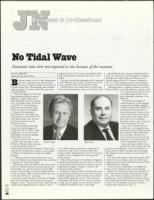
Merton J. Segal, chairman of
Meadowbrook Insurance Group,
Inc., and Allen Gross, Chairman
and CEO of Globe Midwest/
Adjusters International. Both
firms are based in Southfield.
Despite the widespread
destruction in Asia, Segal says
insured losses are expected to be
well below those from the four
hurricanes that devastated
Florida last year.
Citing estimates indicating
tsunami insured damage will
range from $3-$5 billion, Segal
compares it to the more than
$20 billion in insured damage
left behind in Florida.
Segal says there was no warn-
ing when the tsunamis struck,
Merton Segal
"while in Florida, there was plen-
ty of warning for people to
clamp down and protect themselves. Had warn-
ings of the tsunamis been issued in time, people
would have heeded them and gone to higher
ground.
"The waves did not come ashore past one or
two city blocks, or go inland more than a third or
a quarter of a mile," says Segal.
He believes most businesses in the disaster area
were not offered tsunami insurance because the
catastrophe was only the third in the last 200
years to impact large areas of the Indian Ocean.
"The last was in 1883, and there hadn't been one
in the last 120 years," says Segal.
Insurance and reinsurance rates rose in Florida
after the hurricanes, and the same thing could
happen in Asia. "Reinsurance losses could have an
impact upon global pricing. It will have some
impact on a few U.S. carriers, presumably those
with multinational companies as clients," says
Segal.
Among international companies with a presence
in the affected areas, Sofitel, the hotel and resort
chain, probably incurred the greatest losses.
Another factor that could come into play may
be business interruption clauses in insurance poli-
Allen Gross
cies. While major corporations, including the
automotive Big Three, see Asia as their next
major market, Segal maintains the U.S. insurance
industry "has no appetite for insuring in the
Asian market.
"Most Asian insurance is handled in Singapore,
London and Bermuda. Even so, there are no loss-
es incurred by any (insurance) company that are
significant enough to change or threaten the
structure of the company."
Insurance industry statistics confirm that prop-
erty insurance in that part of the world is not as
widely accepted as in the United States, with far
fewer dollars spent per capita. "The economic
and human toll of the event in the area is devas-
tating, but the impact on the casualty industry
worldwide is modest at best," says Segal.
Meadowbrook, the company Segal founded in
1955, is a full-service risk-management company
specializing in alternative risk solutions. It is
ranked among the top 20 insurance brokers in
the U.S. The company moved to new headquar-
ters near 1-696 and Franklin Road in December.
"Although there is a global economy involved,
there should be very little effect on us here in the
U.S.," agrees Gross, whose firm is
one of the largest public insur-
ance adjusting companies in the
Midwest.
He said the percentage of
insured property in the tsunami-
ravaged areas is Eirly negligible.
"Proportionately, the majority of
the amount insured involves
hotels and resorts. However, the
resorts were comprised of many
smaller places, not mega resorts
like those in the Caribbean.
Insurance will not play a big role
in the rebuilding," he says.
Gross says the Asian disaster
should carry a warning for busi-
ness owners about being prepared
for calamities with proper insur-
ance coverage. However, for
many business owners hit by the
tsunamis, it may boil down to a
case of reading the fine print.
Some insurance analysts claim
that because the tsunami was trig-
gered by an earthquake, it may be excluded in
many policies. Flood coverage alone may apply.
The argument may continue in courtrooms for
decades.
The issue will resolve around very specific defi-
nitions of an occurrence, a fact that Gross says
underscores the need for business owners to fully
understand their coverage.
Other industry leaders agree with Segal and
Gross on the ultimate impact of the disaster.
Maurice R. Greenberg, chairman and CEO of
New York-based American International Group,
Inc., told Insurance Business, the industry trade
publication, that his global firm expected "not to
have significant business exposure to losses." One
reason, cites Greenberg, is because they have
reduced their exposure in Asia. ❑