

OTHER VIEWS
The Value Of A Day School Education
A
ccording to our tradition, the
most precious gift is an educa-
tion. The Book of Proverbs
states (8:11): "Wisdom is more pre-
cious than fine gemstones."
Once given, education can never be
taken away. It has the potential to do
more to improve the world than any
other gift.
In most areas of life we Jews have
internalized this proverb. The 2000
National Jewish Population Survey
reports that more than half of all
Jewish adults (55 percent) have
received a college degree
compared to 29 percent
in the total U.S. popula-
tion. Moreover, a quarter
of all Jewish adults have
earned a graduate degree
compared to 6 percent in
the general population.
In a community that
takes education so serious-
ly, it is striking that in the
area of Jewish education
we are so impoverished.
According to a recent
study published by Marvin
Schick, the overwhelming
majority (80 percent) of
Jewish students in the
United States do not
attend Jewish day schools.
Of the approximately
200,000 students enrolled in day
schools today, 80 percent of those are
Orthodox students. Locally, leaving
aside the Orthodox community, Detroit
has one of the lowest day school affilia-
tion rates compared to other major U.S.
regions (e.g., Baltimore, Los Angeles,
San Diego, Palm Beach, Atlanta and
Orange County).
The Reasons
The fact that a majority of Jewish par-
ents do not send their children to Jewish
day schools may be due to any number
of factors.
Some parents opt out of Jewish day
school because it is expensive, and they
do not yet understand that most day
schools have robust financial aid pro-
grams. Some do not send their children
to day school out of fear that a mass
exodus from the public educational sys-
tem may be perceived as un-American.
Others maintain that Jewish day
schools are too parochial. Perhaps the
most obvious reason is that Jewish tra-
Rabbi Lee Buckman is head of schooh the
Jewish Academy of Metropolitan Detroit in
West Bloomfield. Steve Freedman is head
of schooh Hillel Day School of Metropol-
itan Detroit in Farmington Hills.
STEVE
RABBI LEE
BUCKMAN FREEDMAN
Community Perspective
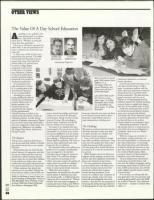
Above: At work are second-
grade Hillel students Jessica
Hoffinan, 8, of
Farmington Hills and
Lauren 'Weinberger and
Zachary Resnick, both 7,
of West Bloomfield.
LO-• JANID Bible teacher
Eric Grossman assists
Adam Luger, 16, of West
Bloomfielch. Steven Miller,
16, of Southfzele and
Simon Pinter, 17, of West
Bloomfield
dition, Jewish knowledge and Jewish
culture are not worth the financial
commitment. Being versed in Jewish
texts and living a life according to
Jewish values, traditions and Jewish
law are simply not so important.
For many of us, Judaism has emo-
tional appeal. On some level, we feel a
connection. It is bound up in memo-
ries of our childhood. It is the memo-
ry of the smell of grandmother's holi-
day cooking, a Chanukah party, the
family Passover gathering. We want to
pass on these experiences and create
memories for our children.
But memories will not be sufficient to
preserve us as a people. Grandmother
may no longer be in the kitchen.
Grandpa may no longer be around to
lead a seder. The world has changed.
The memories of yesterday do not
reflect and cannot sustain the realities of
today unless we provide our children
with the type of education that lead
them to create sacred Jewish memories.
When Jews were trying to
Americanize, the solution was the public
school system. It facilitated our entry
into American life. A child's Jewish edu-
cation was left in the hands of "Hebrew
schools" that were either synagogue- or
community-based. Today, most Hebrew
schools have gone from 10 hours to six
hours per week and now many are down
to two hours. It is now hard to find a
three-day-a-week Hebrew school in
most communities, including ours.
The Challenge
We need to confront honestly the state
of Jewish education today and what
we really want for our children and
the future Jewish community.
Two- to five-hour Hebrew schools
may offer wonderful experiences. They
may strive for quality, but little mean-
ingful learning and skill acquisition
can take place when Jewish education
is treated as if it were an extracurricu-
lar activity.
While Sunday school and afternoon
religious school programs must be sup-
ported, they have significant limitations
given such minimal contact hours.
The next generation of educated
and committed Jews will likely come
not from Sunday schools, but from
Jewish day schools that integrate
Jewish learning seamlessly in the
course of a student's day. Graduates of
Jewish day schools tend to be more
Judaically knowledgeable than their
parents, a fact that has the potential of
reversing the disheartening predictions
of demographers if only more families
committed themselves to intensive
Jewish education.
A Jewish day school education is not
only about Jewish literacy. It offers
more. It empowers students with the
skills, values and experiences to become
educated and active members of the
Jewish community. The dual and inte-
grated curriculum and the use of
Hebrew as a living language develop
children's capacity for complex learning,
connect them to a people and deepen
their love of the modern State of Israel.
Jewish day schools promote and fos-
ter ethical and moral identity develop-
ment and a strong Jewish identity.
Ultimately, day school education stands
to nurture a generation of future lead-
ers that will want to live as Jews
because Judaism has meaning to them.
Maximizing enrollment in Jewish
day schools must be a community pri-
ority. Each of us has an obligation to
contribute what it can to a vibrant
Jewish future.
With the rising cost involved in
providing a quality education, we
have the responsibility to advocate for
day school education, to encourage
day school education and ultimately
to find the financial resources to sup-
port day school education so that, in
the words of Rabbi Joshua Elkin,
executive director of Partnership for
Excellence in Jewish Education:
"By providing serious educational
connections to Jewish history and
texts and the Hebrew language, and by
nurturing relationships to Jewish tradi-
tion, beliefs and practices, day schools
make Judaism second nature, instead
of second best."
If we do that, we will provide the
next generation the most precious and
enduring gift possible and truly fulfill
the words of Proverbs: Tova chochmah
mi'peninim
Greater is wisdom than
rubies.
—
❑