

Insight Into Rashi
Scholar who discovered sage's "lost drawings" to speak at JCC.
DEBRA B. DARVICK
Special to the Jewish News
T
scripts and study them and explain the diagrams,"
Professor Gruber said.
Ultimately, the quest took him to libraries and
museums across the world.
For Professor Gruber, finding the drawings was as
fascinating as learning how they vanished in the first
place. Their disappearance from common editions
of commentary was gradual but complete until he
took up the challenge.
"Often the scribe would write the words 'like
this' or 'like this drawing' and leave space for a
graphic artist to add the drawing," Professor Gruber
said. "But the drawings were never added. Many
manuscripts still have this blank space centuries
later.
In later editions, the words were eliminated
because they made no sense without the drawing.
"Many scholars argued with me that the drawings
are not important because, for 500 years, Rashi
commentaries have been read without them. But, in
fact, Rashi's drawings of the Promised Land ... con-
tain several lines of commentary that are lost when
the drawing itself is removed. Most editions missing
the drawings are also missing the text."
Grossman showed a visitor a copy of a map, very
simplistic and as we know now, way off base. "I love
things that shock us into realizing how little we
know about the past and how much we project into
the past," Grossman says. "When you read about
geography in the Middle Ages
[when Rashi lived and wrote],
they thought of geography so dif-
ferently. They didn't know maps
as we know them. They didn't
understand what was beside Israel
so they assumed there was a line
there."
Grossman is thrilled to have
his mentor at JAMD.
"I love teaching Rashi because
Gruber
it's amazing that someone who
wrote in the 11th century can
still be exciting, can still
speak to us," he says. "The
people who wrote these texts
are long gone and yet we still
have a relationship with
them."
Arrava Lev, a junior at
JAMD, is in Grossman's
third-year Bible studies class
and is eager for Professor
Gruber's visit.
Lev called the drawings
another piece of the corn-
plexity of Rashi. Some of
what Rashi has said has been
misunderstood. No with
the pictures, we can under-
stand what he was referring
his year marks the 900th anniversary of the
death of Rashi — Rabbi Shlomo Yitzchaki
— the most important biblical commentator
of the Middle Ages. To mark the anniversary,
Professor Mayer Gruber of Ben-Gurion University
of the Negev will speak about
Rashi's lost drawings at 1 p.m.
Sunday, Feb. 6, at the Jewish
Community Center in West
Bloomfield.
Eric Grossman, head of Bible
studies at the Jewish Academy of
Metropolitan Detroit, is quite
familiar with Professor Gruber's
area of study. "When I was an
Grossman.
undergrad at Hebrew University
in Jerusalem in the early 1990s, I
attended the World Congress of Jewish Studies,
which brings together
Jewish scholars to learn
from each other,"
Grossman recalls. "One
lecture stood out —
Professor Gruber's talk on
the illustrations that once
accompanied Rashi's
commentaries. I haven't
forgotten it for 14 years."
When Grossman
began teachino Rashi to
his high school b students,
he shared with them
what he had learned from
Professor Gruber.
"1 hey seemed as excit-
ed as I was, even though
_,iey hadn't seen the pres-
entation," he says. "And
now, beyond my wildest
dreams, we've been able
to make it happen."
Professor Gruber first
learned of Rashi's lost
drawings in 1969 at
Columbia University in
New York. His mentor,
the late Professor Moshe
Held, mentioned them in
a class on the history of
biblical interpretation.
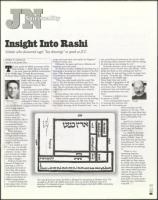
This map of Israel was drawn by Rashi to illustrate his commentary to Numbers 34:3. The
"I resolved during that
rectangle on the le ft is the Mediterranean Sea. This was the first of Rashis maps to be
class session that one day
discovered. For hu ndreds of years, it had been almost forgotten that Rashi's Bible commentary
I would find the manu-
originally contain ed drawings.
-
"
M.
"Rashi is a very
interesting character.
He weaves in things you
wouldn't think about and
sheds light on these aspects
by taking what other people
have said and bringing in his
own ideas and supports from
what others before him have
claimed. I'm part of that
chain and each link adds
something. Without the
prior links we cannot under-
stand the story. And Rashi is
a big link." D
2/ 3
2005
65