

"If your youth don't
want this connection with
Israel," he added, "we will
get lost as a people."
Bitan came to Michigan
twice in the mid-1990s,
once as part of a Central
Galilee P2K delegation.
The second time was with
25 Central Galileans who
studied for three weeks at
Michigan State University
to learn how to work
together at the grassroots
level back in Israel. The
visit was Aronson's idea
and the Kellogg
Foundation helped fiu-id
it.
"When we came back,
we started to create joint
projects and shape mutual
interests," Bitan said.
"That's why I believe our
partnership with Michigan
is a model."
"Detroit pioneered
innovative models for people-to-people programs that
reach out to broad sectors of the community, includ-
ing the academic community and local government,"
said the Jewish Agency's David Bernstein. The part-
nership also was one of the first to cultivate volunteer
leadership in Israel, linking Israeli leaders with
Michigan peers."
Today, there's a corps of 200 P2K volunteers in the
Central Galilee, significant in a state where terrorism
is more on the minds of the people than voluntarism.
Anyone who doubts the impact of P2K on the
people of the region need only consider that hun-
dreds of families now are involved in the partnership
through the pipelines of education, welfare, health
and business.
Former Detroiter Zev Davis longs for a simpler
time, but understands the march of progress. He lives
in Nazareth Illit, a city of 50,000 people; about half
are new immigrants, called ohm. You can hear
Spanish, Romanian, Russian, Arabic and Hebrew on
the busy streets. The father of four remembers when,
from his flat in 1981, "you saw the valley before you
like the palm of your hand, and you could walk on
paths between trees five minutes from where you
lived anywhere in town — and there weren't any traf-
fic lights."
With the population spurt, he said, "we lost some
of the closeness, but such is life."
The silver lining?
"Of all the municipalities in the State of Israel,"
Davis said, "Nazareth Illit is one of the few that
maintains a level of services second to none without
going into the red."
People Power
fruitful in striving to
better the partnership.
Celebrating the 10th
anniversary of the part-
nership was a watershed
moment, but the
Michigan delegation
ponders the role that
P2K will play in our
future. For starters, it's a
major financial commit-
ment at a time when
Federation campaigns
no longer have the luxu-
ry of large unrestricted
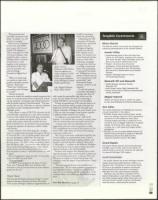
Above: Detroit
Federation CEO Robert funds. Our partnership
is among the best fund-
Aronson addresses an
ed. "Oftentimes, we are
indoor audience of 700
asked in Detroit why are
people at the 10-year
we
so committed to this
anniversary celebration
of the Michigan-Central partnership," said
Federation's Robert
Galilee partnership.
Aronson. And it's a real
question."
Left: Migdal HaEmek
It's why the steering
Mayor Eytan Broshi
committee will design a
strategic plan that not
only recaps the partnership high points over the
years, but also makes the case for continuing to
pump $700,000 a year into the Central Galilee.
To keep its momentum, P2K must get back to its
roots and rededicate itself to people-to-people ties
fashioned creatively and efficiently through trans-
Atlantic exchanges. Michigan also must benefit more.
A Web site that encourages doing business together
in different fields would be one catalyst.
'A weakness in our partnership," said David
Techner, "is in the fact that we need to connect more
with our community and work harder toward that
— connect more with our leadership, but more
importantly with our entire community to make
P2K as significant on our side of the ocean as it is in
Israel. That's really where the focus of the steering
committee needs to be."
The 10-year anniversary celebration hosted by the
Central Galilee, an unpretentious event of music,
dancing, Israeli-Arab bridge-building exhibits, and
Israeli art and food booths at kibbutz Mizra, drew
1,200 people — a tribute to the influence Michigan
Jewry has had on what is today a strong, close-knit
regional coalition in the Central Galilee.
Aronson can't imagine what Detroit Jewry could
stage this spring to draw anywhere near as many peo-
ple. The burning question for us here is, "How can
P2K leave an impact on Metro Detroit that even
nominally rivals the impact it has had on-the Central
Galilee?"
"That has consistently been our problem here,"
Aronson said. "We are under constant questioning by
our Federation board in Detroit as to what P2K is
and why we are spending all this money on it. If we
could do better, we wouldn't get those kinds of ques--
tions."
Directing the Michigan-Israel partnership is a repre-
sentative steering committee of about 40 people.
Twice-a-year meetings in Israel are argumentative yet
TWO-WAY BRIDGE on page 34
Tangible Investments
Metro Detroit
The Detroit Jewish community has donated the
following developments in the Central Galilee:
Jezreel Valley
• Hydrotherapy pool at Say Yom Day Care
Center for the Elderly. Assistance for renova-
tion from the Ben Teitel Charitable Trust and
Nora & Guy Barron Millennium Fund.
• Zippori, reconstruction of ancient
synagogue. Alfred and Bernice Deutsch.
• Zippori, archaeological dig. Bill Davidson
plus Hermelin, Blumenstein and Grosfeld
families.
• Zippori, Michigan Room in honor
of Harold Blumenstein.
Nazareth Illit and Nazareth
• Adele Mondry Women's Center,
Nazareth Illit.
• Irwin Green soccer field, Nazareth Illit.
• Green Family Early Childhood Development
Center, Nazareth.
Migdal HaEmek
Hafuch Al Hafuch drop-in center for youth
at risk, Grand Rapids and Detroit federations.
Ann Arbor
The Jewish Federation of Washtenaw County's
annual investment in the region:
• $15,000, Octane Teen Culture Center, where
teens can address culture in all its expressions
and serve as role models for their peers.
Funding helped refurbish a clubhouse in an
industrial area of Migdal HaEmek to incubate
theater of all kinds (film, plays, stand-up
comedy, etc.), rock bands and stage-related
professions.
• $26,000, for the Jerusalem-based Institute for
Jewish Family Education's support of Nahalal
Elementary School ($12,500) and the
Institute's Northern Branch ($13,500).
Grand Rapids
The Grand Rapids Jewish community allocates
$15,000 a year to P2K, half for the Hafuch Al
Hafuch drop-in center for youth at risk and half
for general Michigan P2K support.
Israel Connection
The Jewish Agency for Israel's Michigan-Central
Galilee Partnership 2000 Northern Office is in
Nazareth Illit. The director is Ziva Ohion-Recht.
Eti Oren is the people-to-people coordinator.
Batia Shimshi is the education coordinator.
Maly Bar On is the administrative assistant.
Detroiter Tova Dorfehan is director of the
Detroit Federation's Israel office in Jerusalem.
Her staff includes Naomi Miller Rockowitz, mis-
sions and Israeli camper program coordinator,
and Noa Haran, administrative assistant.
2/ 3
2005
33