
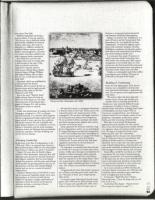

h .
#.•
ew name: New York.
Rabbinic leadership was always a
evere problem. It w as not until the
9th Century that a rabbinical school
forinally, established in America.
those early years, there were no
shiyahs or a sufficient number of
ualified Hebrew teachers, spiritual
ders, ritual slaughterers, circurncis-
'ers, cantors and others needed to sus
a vigorous Jewish community.
d while Jews arrived in the
eorgia colony just six months after
was founded in the early 1700s,
me anti-Jewish restrictions
emained in America until the
century. Rhode Island, despite
roud legacy of Roger Williams
id religious liberty, did not allow
ws to vote or hold elective office
til 1843.
aryland, which was established as
colonial haven for. Roman
tholics, did not remove Jewish vot-
restrictions and the legal necessity
swear public oaths on the New
eitament until 1826.
J ust as the name "Shearith Israel"
eaks volumes about the early set-
ers' .view of the future, so, too, does
'construction of the famous syna-
e in Newport, RI., tells us about
mindset of Jews in colonial
,,America.
.-iToday, that Jewish house of worship, the Touro
agogue, completed in 1763, is a historic
motional landmark. It is, however, often forgotten
at the congregationalleaders insisted their syna-
ogue include a secret trap door that could pro-
ide speedy escape, in the case of possible anti-
ish physical violence. In a symbolic act of con-
fidence in themselves and the newly emerging
American society, the Newport Jews permanently
covered the trap door. The days of fleeing were
America to escape government-sponsored
anti-Semitism including lethal pogroms.
Religion in America was "deregulated" as a
result of history and the Constitution's First
Amendment. So, too, Jewish life has been
"deregulated." A myriad of religious expres-
siOns, trade unionism, socialism, Zionism,
Yiddishkeit,
secularism and domestic politics
.
(both liberal and conservative) have all been
part of the American Jewish mix.
It is estimated that nearly 70 percent of
today's American Jewish community trace
their family roots to that post-1882 surge in
immigration to the United States. In more
recent years, the American Jewish community
has witnessed newcomers from such'places
the former Soviet Union, Iran and Israel.
Finally, our community's early history offers
some lessons as we celebrate 350 years of
J ewish life in this part of the world.
O
G
merging Leadership
By the time of the War of Independence in the
770S and 1780s, it is estimated that American
Jews numbered about 3,000 out of a total popula-
0on of about 3 million, one-tenth of 1, percent!
Nearly 130 years after the Recife refugees
ar rived in New Amsterdam, American Jews still
depended upon Europe for spiritual sustenance
and religious validation. But one man helped
change that situation, and his career and achieve-
mentS parallel the growing political maturity of
the American colonists who rejected English
control and set out on a course of national
independence.
Gershom Mendes Seixas (1746-1816), a mem-
ber of a prominent Sephardic family, was a trans-
forming figure in American Jewish history:
Indeed, he represents a *tulique combination of
leadership in both the Jewish and the general
American societies, a prototype of future
,American Jewish leaders.
4".
"4:14
£i
h
Building A Communiol
V•4
•
He started his career as a synagogue functionary
at Shearith Israel in NeW York. Seixas acted as the
mdonid (teacher) and chazzan (cantor) of the
congregation. He was also a self-taught rnohd (rit-
ual circumcises) and shochet (ritual slaughterer).
He was involved in births, marriages and deaths
and slowly emerged as the religious and commu-
nal leader of American Jewry.
Seixas supported the American colonists' strug-
gle for independence, and he was an invited guest
at George Washington's presidential inauguration
in 1789. Two hundred years later, descendents of
Seixas were honored guests at George H.-W. Bush's
inaugural. Sekas was a trustee of Columbia
University for 20 years and the New York State
Legislature elected him to the first Board of
Regents of the State University.
It is important to remember that from the out-
set, Jewish life in America was based upon volun-
teerism. Unlike many European communities, the
kehillah (a unified community often endowed
with government approval) never took hold in
either the colonies or in the United States. There
was no government-collected religious tax nor
were there legally established ghettoes in America's
cities. Nor is there a one-size-fits-all American
Judaisn-i.
Geographically far from older Jewish communi-
ties in Europe and other parts of the world, the -
tiny "Remnant of Israel" grew independently,
albeit slowly.
Its size grew larger following the Jewish immi-
gration after 1848 and the failed political revolu-
tions in Europe and especially after 1882, when
millions of Jews from Eastern 'Europe came to
:From the very beginning in 1654, Jews in
:‘America were compelled to develop their
own" communal institutions to guarantee sur-
vival. No one person and no government did
it for them.
We need to salute the brave men and -
women who in those early decades con-
, sciously chose to maintain Jewish life in
America as a tiny minority. I3efore the mass
immigration of millions- of Jews, GershOm
Mendes Seixas and others, including. Isaac Leeser
of Philadelphia and Isaac Mayer Wise of
Cincinnati, recognized that a new American
Judaism needed its own schools, unions of con-
gregations, newspapers, publications, prayer
books and other necessities of Jewish life.
Back then as now, Jewish life frequently
appeared fractured, divided., and even chaotic.
But, in fact,.that seeming disarray actually resulted
in a vigorous, robust and creative Jewish commu-
nity. The legacy of people like Seixas is that
American Jews must "do it themselves:"
Tragically, that fact became even clearer follow-
ing the Holocaust when the extraordinary well-
springs of Jewish creativity in Europe were
destroyed.. And it is also clear that, after nearly 60
years of Israeli independence, American Jews can-
not use the embattled and beloved Jewish state as
their surrogate for Jewish identity and continuity..
Seixasioffers a model for our future as a viable
community: He was rooted in Jewish learning,
religious Corninitment and communal leadership.
At the same time, he was an active and full Partic-
ipant in the democratic American society. Seixas
was sure-footed in his faith as a Jew andhe was
sure-footed in his identity as an American,
As we move towards our 400th birthday, the
American Jewish community, now 350 years old,
would do well to remember some words from
both an English poet and the Bible.
In his poem, "Rabbi Ben Ezra," Robert
Browning wrote : "Grow old along with me, the
best is yet to be ...
And Joshua's first chapter: "Hawk'v'ematz"
(Be strong and of good courage!").