

DECOR
BY SHELLI LIEBMAN DORFMAN NI PHOTOGRAPHY BY ANGIE BAAN
ROCKIN' AROUND
THE CLOCK
DRINI'
IN BOTTLES
Marc Manson can
relive the 1950s in
his own basement.
F
or most, going back to a simpler
time means listening to old music or
recalling a favorite memory. But for
Marc Manson, it happens just by walking
down his basement stairs into a scene right
out of the 1950s — complete with sights,
sounds and smells of the time.
"I've always liked the music of the '50s —
and extra-thick chocolate malts aren't bad
either," Manson said. "So when the time
came to make extra room in our house by
finishing the basement, we decided to make
a 1950s diner out of it."
The Manson Diner — complete with a
soda counter, Faygo pop machine and menu
board — had its beginnings with an unusual
purchase.
"It started in 1974, when I won a
telephone booth from the Channel 56
auction," Manson said.
From there, things snowballed. "I then
1 8 • JANCARY 2005 • JNPLATINUM
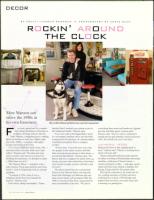
Marc and Marcia Manson and Sherlock share a spot at their basement diner.
decided that I needed a pay phone to put in
the telephone booth," Manson said.
Next came calls to Michigan Bell, a letter
to a newspaper problem solver and the final
arrangements for purchase of a chrome-plated
refurbished payphone from a company
in Ohio.
"At that time, I was told there were only
two people in the entire country that had
their own private pay phone in their house —
myself and Jack Benny," Manson said. "Mr.
Benny had one to support his shtick of beiig
cheap; everyone who visited him at his home
who wanted to make a phone call had to pay
10 cents."
The phone booth became a permanent
fixture in the Manson home, moving with
them from Michigan to California and into
their current home in Farmington Hills. By
1990, it was part of the diner, surrounded by
other memorabilia of its time. "We put in
everything from stools and booths to a lighted
pie case and little green waitress pads,"
Manson said. "On one wall is a salesman's
sample pin-up girl calendar, turned to January
1951, the month and year I was born."
AUTHENTIC 1
9 5 ❑ S
Being in the diner is like stepping back in
time," Manson said. "Mostly everything down
there is 50 years old."
Manson looked for Detroit-made stock for
his diner, including a Grinnell piano and stamp
machine, a collection of Vernor's items —
mostly purchased on eBay — and signs, memo-
rabilia and food items related to Sanders, S.S.
Kresge, Faygo and New Era potato chips.
Striving for authenticity, he made sure all
the vending machines are filled and have
working keys, as does a 1952 Kresge cash
register that involved a two-state chase and
a meeting in a parking lot.