

PUMPKIN LOGS
ARE HERE!
1) COMPANY
DA
THE OC
It is at once a distinctly Southern
. text as well as a distinctly Jewish one.
But the sad truth is it's unlikely to be
as well known in the contemporary
Jewish circles of purveyors and con-
sumers of Southern literature.
That is because the story is so root-
ed in a time and a place that is utter-
ly foreign to the modern Jewish corn-
munity that it may be unable to
engage with it.
As Hoffman noted when we spoke,
"[The book is] really [a] character
study of Morris Kleinman, who has
really vanished from the South."
That is precisely why the Jewish
community should embrace and
devour Hoffman's book. It is about
an aspect of the Jewish-American
experience we are so in danger of los-
ing because we barely knew it to
begin with.
The Jewish immigrant story may
have begun on the banks of what
became New York, but it didn't end
there. We do a disservice if we forget
the paths down which various mem-
bers of our tribe have traveled,
including the path to Mobile, Ala.
"As we move away in time from
books that move us, we tend to forget
the details and nuance in plot,"
reminds Hoffman. So, too, as we
move away in time from the places
like Dauphin Street, we tend to for-
get the details and nuance in the
Jewish-American experience. What
we hopefully keep is a memorable
),
character.
It's a great gift that Hoffman has
given us — his grandfather. In the
"aesthetic vehicle" of Morris
Kleinman, contained within the 241
pages of Chicken Dreaming Corn, a
memorable character gives us just a
little bit of a time lost to us in histo-
ry.
"[He] comes to the South and
brings with him a deep sense of his
religion. He is deeply committed to
what he believes in; he redefines him-
self in light of Alabama and America
but never strayed too far from who
he was to start with," Hoffman says
of his central character.
The book, littered with the details
and special qualities of Morris
Kleinman's world, is not just the
story of a shopkeeper. It is our story,
one part of it in any event. It accom-
plishes what Hoffman asks of the rest -
of us:
"I hope readers who drive through
these towns and see all the change
will remember the people who were
here before." II
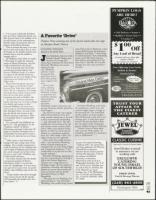
A Favorite `Drive'
Pulitzer Prize-winning tale of the Jewish South takes the stage
at Meadow Brook Theatre.
SUZANNE CHESSLER
Special to the Jewish News
jr
ohn Manfredi, director of the
Meadow Brook Theatre pro-
duction of Driving Miss
Daisy, had a nickname for Henrietta
Hermelin-Weinberg, the actress
taking the title
role. Manfredi
calls her "mom"
because he has
played her son in
four other produc-
tions staged in the
area.
Driving Miss
Daisy, running
Jan. 5-30, gives
Manfredi a chance
to step back and
mold the relation-
ship shared by
another of
Hermelin-
Weinberg's mother characters and
the son character, Boolie, played by
Paul Hopper.
The director's larger task staging
Alfred Uhry's Pulitzer Prize-win-
ning comedic drama has to do with
a more controversial relationship
— and ultimately issue. The plot
unfolds the interactions of an eld-
erly Jewish woman and her black
driver, Hoke, portrayed by James
Bowen. As the two travel around
Atlanta in a timeframe reaching
from the 1940s to the 1960s, atti-
tudes toward race are explored.
"John and I have really become
close," says Hermelin-Weinberg,
whose scripted parenting has
included roles in Torch Song Milogy
and Unexpected Tenderness. "I felt
comfortable as he directed me dur-
ing the audition."
Hermelin-Weinberg, appearing in
the year-end production Coming to
Life at the Detroit Repertory
Theatre, has a long history on
Michigan stages. She has played in
uproarious comedies and sobering
dramas in venues that include the
Gem in Detroit and the Jewish
Ensemble Theatre in West
Bloomfield.
"This play has me thinking a lot
about prejudice," says Hermelin-
Weinberg, who recalls being turned
away from a movie theater as a very
young child because the babysitter
taking her was black. "I love being
an actress because I love addressing
issues, and I like Daisy because
she's honest and mannered at the
same time. I also like the way she
changes over the years covered in
the play."
• Gift Baskets • Soups •
• Muffins • Sweet Trays •
• Cookies •
$ 1 00
Off
Any Loaf of Bread
Not good with any other offer
Expires 1/30/05
one coupon per customer
Now Offering Low-Garb,
Rolled & Panini
Sandwiches
• Soups
• Sandwiches
• Salads
24-hour notice please on
specialty items
(some exceptions)
6879 Orchard. Lake Rd.
in the i3oardwalk Plaza
924210'.
Hermelin-Weinberg, aside from
the production, wants to set the
record straight about a change in
her personal life. The Southfield
condo resident recently bought a
West Hollywood condo but is not
moving west, as some have ques-
tioned. She just decided to have
her own place while visiting her
grown children living in California.
"I know I want to keep work-
ing," says the 70ish actress. "It
would be wonderful if I could get a
part in Hollywood."
As part of its season honoring
"Celebrate 350," the nationwide,
year-long celebration of 350 years
of Jewish life in America,
Meadow Brook Theatre presents
Driving Miss Daisy Jan. 5-30 on
the campus of Oakland
University in Rochester.
Performance times are 8 p.m.
Wednesdays-Saturdays, Jan. 5-21
and 26-29; 6 p.m. Saturday, Jan.
22; and 6:30 p.m. Sundays, Jan.
9-23. Matinees are 2 p.m.
Sundays, Jan. 9-30; Wednesdays,
Jan. 19 and 26; and Saturdays,
Jan. 15 and 29. $20-$36. (248)
377-3300.
248-626-9110
TRUST YOUR
AFFAIR TO
THE FINEST
CATERER
CLASSIC CUISINE
Approved by Council of Orthodox Rabbis
Jewel Kosher is proud
to announce we are
working with
EXCLUSIVE
CATERING
YOUNG ISRAEL
OF SOUTHFIELD!
PHILIP TEWEL
Food & Beverage Director
(248) 661.4050
Farmington Hills
922560
12/31
2004
43