

Cover Story
SUDAN'S CRY from page 24
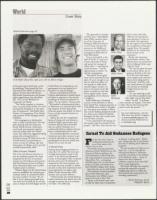
U-M HiHers David Post, right, poses with an African villager.
of the crisis and to find ways to end
the suffering. They joined the New
York-based Save Darfur Coalition, an
alliance of more than 100 diverse
faith-based, humanitarian and human
rights organizations that identified
Dec. 10-12 as the Weekend of
Conscience on Darfur.
"The Darfur situation is a human
issue, not particularly Jewish, but we're
among those bringing it to the atten-
tion of Americans," said Rabbi Elliot
Pachter of Congregation B'nai Moshe
and president of the Michigan Board
of Rabbis.
His congregation is looking for
ways to make contributions. He sug-
gests starting with the American
Jewish World Service, which part-
nered with international organiza-
tions for Sudan relief (see related
story). The rabbi also suggested taking
action, like writing letters to
President George W. Bush and to the
United Nations and insisting on
action to stop the killing, rape and
destruction of villages and to provide
needed humanitarian relief.
More Pressure Needed
The U.N. and African initiatives to
save the Sudanese people have been
hampered by the lack of sustained
pressure on the Sudanese government,
said Fred Pearson, director of Wayne
State University's Peace and Conflict
Studies Center in Detroit.
"Neither Egypt nor the United States
wants to destabilize the Sudanese gov-
ernment [which is considered behind
the mass murder]," he said. "Yes, it's
bad to have a glaring genocidal situa-
tion there; but, because of the oil-rich
areas in Sudan that both Egypt and the
12/31
2004
26
United States are interested in, our
government is not as forceful as it
should be to stop the killings."
Pearson remembered when the
Clinton administration bombed parts
of Sudan in response to the terrorist
bombings of American embassies in
Africa. It was a fiasco," Pearson said.
"We bombed a pharmaceutical plant
in Khartoum as a potential place mak-
ing weapons of mass destruction.
Innocent people were killed. So there's
been a touchy situation between us
and Sudan."
Add to the mix the complicated
layers of a long civil war between a
northern Islamic government and
Southern African clans and tribes
that are neither Christian nor a
traditionally African religion and you
have a complicated mess, he said.
He recommended that concerned
Americans press their senators to get
involved, especially in moving more
peacekeepers to the area, which may
already be too late, he said.
A Jewish Issue
Among those bringing attention to
what the U.N. called "the worst pre-
ventable humanitarian crisis in the
world" is the Holocaust Memorial
Center in Farmington Hills. In special
lectures and as part of information
imparted by the center's guides, visi-
tors learn the mass murders in Sudan
are akin to what Jews experienced and
never expected to see again, said
Rabbi Charles Rosenzveig, HMC
founder and executive director.
"Unfortunately, the United Nations
makes resolutions but doesn't have the
courage to execute them in construc-
tive ways," the rabbi said.
eled to Asia and India.
"This genocide is certainly
a Jewish issue," added Rabbi
"Africans are among the
most gracious I've met in
Jason Miller, associate direc-
tor of the University of
the world. My optimism
for the region is not without
Michigan Hillel Foundation
in Ann Arbor. He gave his
the recognition of the great
tragedy there. But people
sermon on the Shabbat of
should not be scared away
Conscience as guest rabbi at
Rabbi Miller
from interest in the
Congregation Beth Ahm in
continent.''
West Bloomfield.
Besides the important
"Just as God gifted us the
humanitarian reasons, Post
light of Torah, it is up to us
to plant the seeds of Torah
believes there are mutual ben-
efits in helping Darfur, espe-
and spread the message of
cially for Israel.
tikkun olam -- repairing the
"No one has taken the time
world situation — and of
to
care about Africa, yet it's
righteousness to others," he
oak
going
to develop in the next
told the congregation.
Rabbi Pachter
10 to 20 years with demo-
"The phrase never again'
cratic regimes and could be a
must not be reserved for Jews
friend and trading partner
alone. It is not enough to say
with Israel," said Post, who
that we will never allow our
met Israeli doctors in Uganda
own people to suffer those
atrocities again. As Jews, we
who already are building
bridges between the two
have an increased moral obli-
countries.
gation to speak out and take
"It's very inspiring to talk
action against ethnic cleans-
to the African people because
ing regardless of the ethnicity Rabbi
Rosenzve ig
they really want to help them-
or religion."
selves," he said. "It [a demo-
Rabbi Miller got a firsthand
cratic society] can happen. The desire
account of the problems in Africa
from David Post, program associate at
is there. But it's the resources they
need to start the process."
U-M Hillel and a recent U-M gradu-
ate. Post spent two months in Africa
this summer helping displaced people
For more information, visit the
in a slum in the capital of Uganda,
Web
sites: Save Darfur Coalition
Kampala. He also took a three-week
wvvw.savedarfur.org and the
at
tour of other countries.
American Jewish World Service
"I was surprised by the beauty of
at www.ajws.org
the country and the warmth of the
people," said Post, who also has tray-
Israel To Aid Sudanese Refugees
r
or the first time, Israel is
sending humanitarian aid
to an Arab nation with
which it has no ties.
The Jewish state has joined the
American Jewish World Service, the
Union for Reform Judaism, the
UJA-Federation of New York and
the United Jewish Communities of
MetroWest, N.J., in donating
$20,000 apiece for an educational
project in Chad, now home to at
least 200,000 refugees from Sudan.
Israel also has no ties with Sudan.
The Sudanese situation reminds
Jews of the Holocaust, said
Ambassador Arye Mekel, consul
general of Israel in New York.
"Israel, as the Jewish state, can't
sit idly by when such a humanitari-
an disaster is taking place," Mekel
said, adding that this is only Israel's
first step in offering aid to affected
Sudanese.
The new program in Chad, set to
begin Jan. 1, is run through the
International Rescue Committee
and offers schooling to the children
of the Kashuni camp — many of
whom have <been orphaned.
Children comprise more than half
of the camp's population.
The funds will help train teachers
and provide materials at several
neighboring schools to offset ten-
sion between the camp and its sur-
rounding community.
— Rachel Pomerance, Jewish
Telegraphic Agency