

TSUNAMI
from page 13
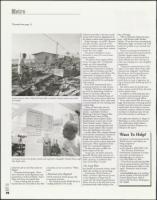
A man inspects what is left of his home after a massive tsunami swept across costal
Sri Lanka.
An Israeli checks a list of other Israelis who reported to Bangkok's Chabad House sta
that they're alive.
otherwise safe on the Thai resort of
Phuket.
"Everyone has been great. I have
been visited by Israeli diplomatic rep-
resentatives as well as Chabad," Yaron
Weiss said from his hospital bed.
"I have a feeling that the other
tourists here are a bit jealous that their
12/31
2004
14
countries are not as attentive," Weiss
said.
American Jews Respond
North American Jewish groups also
are paying attention.
The American Jewish World Service is
sending medicine to Sri Lanka,
Indonesia and India. It has been coordi-
nating with 23 partner organizations in
the region to assess needs on the ground.
Ronni Strongin, the AJWS' director
of public relations, said one of the
largest immediate needs is expected to
be water because corpses have contam-
inated the water supply.
The group is hoping to receive
donations to cover the cost of emer-
gency supplies.
"The phones keep ringing off the
hook," Strongin said. "It looks like
people are truly responding."
The American Jewish Joint
Distribution Committee is working
with its office in Bombay and else-
where to coordinate relief efforts. The
organization is hoping to provide
food, water, clothing and shelter to
countries affected by the earthquake
and tsunamis.
B'nai B'rith International also is
accepting donations to help victims.
Chabad of Thailand responded to
the crisis by dispatching a rabbi to
Phuket to aid rescue efforts and
turned the three Chabad Houses of
Thailand into crisis centers where sur-
vivors can call home, have a free meal
or receive funds for new clothing and
medical help.
"Many of those who visit the
Chabad Houses in Thailand are
Israelis," said Rabbi Avrohom
Weinberg of the Sara Tugman Bais
Chabad Torah Center in West
Bloomfield, whose nephew Rabbi
Yoseph Kantor oversees the several
Thai Chabad Centers. "Many are
Israeli tourists and backpackers and
former Israeli soldiers who vacation
there after finishing in the army."
Locally, Allan Gale, assistant director
of the Jewish Community Council of
Metropolitan Detroit, said, "The
Jewish community is shocked at the
terrible news of the massive death and
destruction. We're supportive of the
quick U.S. and Israeli responses."
He also took time to reflect on
future impact of the aid.
"Long term, the Israeli and more
generally Western help may have an
impact on the Muslim populations in
those countries, to moderate their
views of the West," he said.
The Long Wait
For families of potential victims, mean-
while, the waiting was excruciating.
At the home of Erez Katran in
Haifa, a 24-hour vigil was set up next
to the telephone in hopes that he
would call. His family hoped Katran's
silence was due to the fact that he was
incommunicado while sailing in the
Bay of Bengal.
"We are definitely feeling the pres-
sure," said Katran's older brother,
Micha. "If we don't hear something by
Wednesday night, my father and I will
head out to India to try to locate him
),
somehow.
Katran was among the hundreds of
Israelis who remained unaccounted for
Monday, despite urgent Foreign
Ministry efforts to track them down.
Israeli officials put their best face on
what was emerging as a crisis of global
proportion.
"Telephone communication in this
region is very hard. Most of the infra-
structure has collapsed," said Nissim
Ben-Sheetrit, the Foreign Ministry's
deputy director-general. "We are
working around the clock, with a
small team, to cover a huge area, try-
ing to locate Israelis and bring them to
),
safe shores.
But hearts across the Jewish state
sank as reports surfaced from the hard-
est-hit coastal resorts.
In addition to delivering bad news,
the Israeli communications industry
pitched in with the search efforts.
Every major Israeli Web site set up a
page where pictures of missing tourists
could be posted in hope that someone
would report their location, and one
cell phone company offered its Israeli
customers in Southeast Asia 10 min-
utes of free airtime to call home.
JTA staff writer Matthew E. Berger in
Washington as well as Detroit Jewish
News staff writers Shelli Liebman
Dorfman and Harry Kirsbaum con-
tributed to this report.
Want To Help?
Donations to the American Jewish
World Service's relief efforts are
being accepted at
vvvvvv.ajws.org
and by phone at (800) 889-7146.
The American Jewish Joint
Distribution Committee is accept-
ing credit card donations at
vvvvvv.jdc.org or by phone at
(212) 687-6200, ext. 889.
B'nai B'rith has allocated $5,000
from its general disaster relief fund
to help humanitarian efforts in the
region. Donations may be made
online at
www.bnaibrith.org or by sending
checks payable to the B'nai B'rith
Disaster Relief Fund, 2020 K
Street, NW,7th Floor, Washington,
DC 20006