

z
0'
7
C
C
r .
7.;
r
0
U
C
0
C.
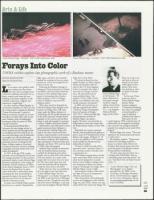
Laszlo Moholy-Nagy: Untitled," 1937-1946; Kodachrome
Laszlo Moholy-Nagy: "Untitled," 1937-1946; Kodachrome slide.
Forays Into Color
UMMA exhibit explores late photographic work of a Bauhaus master.
LYNNE KONSTANTIN
Special to the Jewish News
Ann Arbor
,. et us create a new guild of crafts-
men without the class distinc-
tions that raise an arrogant barri-
er between craftsmen and artists! Let us
desire, conceive and create the new
building of the future together. It will
combine architecture, sculpture and
painting in a single form."
So wrote architect Walter Gropius in
the Bauhaus Manifesto in 1919, the year
the young architect opened the Bauhaus
("house of architecture") school in
Weimar, Germany. Its goal was to com-
bine all arts in ideal unity, with an ulti-
mate Utopian vision of craftspeople
learning to utilise the power of 20th-
century innovation.
In devastated post-World War I
Germany, this new design school, in
which students learned through hands-
on workshops how the triad of art, sci-
ence and technology were all deliciously
co-mingled, the school's philosophy
offered a much-needed functional and
optimistic promise of change for the
future. Subjects taught at the school
included architecture, furniture making,
typography, painting, theater and, even-
tually, photography.
In 1923, at the age of 28, a quiet,
intensely curious Hungarian Jew became
the youngest professor on the controver-
sial school's faculty. Laszlo Moholy-Nagy
had been studying law at the urging of
his family until he enlisted as an officer
of the Austro-Hungarian Army in 1915.
Sent to the Russian front, he spent
much of his time in observation posts
and passed the time by sketching on
postcards he kept in his pocket. Soon
after the end of the war, he knew he
wanted to become an artist.
In many ways, Moholy-Nagy remains
best known as a teacher. Fascinated by
light, space, and form, he constantly
pushed the envelope in his own experi-
mental art, and he encouraged his stu-
dents to do so, too.
Following the Bauhaus through its
subsequent German locations in Dessau
and Berlin, where the Nazis closed the
school in 1933, Moholy-Nagy immi-
grated to Amsterdam then London
before settling in 1937 in Chicago,
where he helped to open the New
Bauhaus school.
When that closed, he founded the
School of Design, later changed to the
Institute of Design (ID). Still active
today under the Illinois Institute of
Technology, the ID quickly became one
of the most important schools of pho-
tography in the country and has been
home to such photographic luminaries
as Harry Callahan and Aaron Siskind.
Influenced by and influential in avant-
garde movements from Dadaism to
Constructivism, Moholy-Nagy, who
early in his career moved away from
Judaism, experimented in and mastered
the varied media of painting, typogra-
phy, kinetic sculpture, film, photomon-
tage, photograms, black-and-white pho-
tography, and from 1937 until his death
in 1946, color photography.
Moholy-Nagy himself was frustrated
with the limited technical processes
available for developing color photo-
graphs, and very few of his color photos
were ever printed. As a result, many
people don't even know they ever exist-
ed. They have rarely been seen and,
until now, had been all but forgotten
except by those most in the know.
Today, however, they are available for
all to see right in our own back yard.
"Laszlo Moholy-Nagy: The Late
Photographs" is on display through Feb.
20, 2005, at the University of Michigan
Museum of Art. Though the artist him-
self never lived in Michigan, it just hap-
pens that his daughter Hattula Moholy-
Nagy lives in Ann Arbor.
forces us to take a sec-
ond look at what we
Its always bothered me that
already see but don't
people thought my father stopped
taking camera photos after he
really register and to
came to the U.S. from England.
spend a little more
time looking at what
In fact, I remember him when I
we think we already
was a kid, in Chicago, with his
Laszlo Moholy-Nagy know."
Leica. He took them, but he
at the Bauhaus: "It's
never published them," she
To that end, Ulmer
always bothered me
points out that at
explains. "In the 1940s, if color
that people thought
Laszlo Moholy-Nagy's
photos were exhibited, they were
my father stopped
funeral, Walter
usually projected, not printed."
taking camera photos Gropius eulogized,
In 2002, the Art Institute of
after he came to the
"Constantly developing
Chicago organized the exhibit
U.S.," says daughter new ideas, he managed
"Taken by Design: Photographs
Hattula Moholy-
to keep himself in a
from the Institute of Design,
1937-1971," which included digi- Nagy of Ann Arbor.
stage of unbiased
curiosity from where a
tal reproductions of three of
fresh point of view
Moholy-Nagy's color photo-
could originate. With a shrewd sense of
graphs. The show was viewed by an
observation, he investigated everything
independent curator who works with
that came his way, taking nothing for
the Andrea Rosen Gallery in New York
granted, but using his acute sense of the
City.
Enthralled, the curator contacted
oraanic "
Moholy-Nagy once wrote, "The artist
Hattula, who has allowed the gallery to
represents the consciousness and memo-
print a series of 27 Kodachromes of her
ry of his time."
father's color images. Of those 27, 18
His daughter explains: "These artists
are now on exhibit at U-M's museum,
believed art and design could be a
made available by Hattula and the
means to a better world. There were
Andrea Rosen Gallery.
Utopian ideas among artists and archi-
It shows a whole new side of this
tects that good art could lead to better
innovative artist," says Sean Ulmer, U-
living and better individuals.
M's university curator of modern and
"It seems naive now, but there was a
contemporary art.
real hope after World War I that art
With subjects ranging from everyday
could help people and help society," she
street scenes taken from a bird's-eye or
says. 'And that's what my father wanted
other skewed perspective to purely
,,
abstract traces of light to images of his
to do.
own sculptures of mesh wire, plastic,
"Laszlo Moholy-Nagy: The Late
string or colored gels, the images reflect
Photographs" is on display
Moholy-Nagy's interest in light.
And seeing his works in color shed a
through Feb. 20, 2005, at the
University of Michigan Museum
new light on his use of transparency,
of Art. Free/$5 donation suggest-
reflection and distortion.
ed. For more information, log on
Most characteristic of his philosophy
as artist and pedagogue is that Moholy-
to vvww.umma.umich.edu or call
Nagy was, says Ulmer, "always very cog-
(734) 763-8662.
nizant of how the viewer sees things. He
12/24
2004
41