

TRAVEL
!IN
STORY C.
PHOTOGRAPHY BY
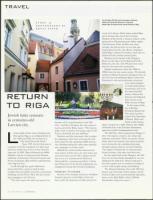
Top left: Riga's Old City boasts interesting architecture.
Bottom left: A peaceful afternoon in a Riga park.
Bottom right: A memorial at the Jewish cemetery in Riga.
RONIT PINTO
RETURN
TO RIGA
Jewish links resonate
in centuries-old
Latvian city.
atvians think of their cities as feminine and
their capital, Riga, as an undisputed lady. In
the 1920s and 1930s, she was known as
"The Little Paris of the North."
Since 1991, for the first time in
centuries (with the exception of a short span
between world wars), Latvia is free from for-
eign rule. In 2001, Riga celebrated her 800th
birthday, and she is being restored. Despite
suffering a half-century of brutal German and
Soviet occupation, Riga still has sophistication
and a big-city feel.
A walk through the aged cobblestone
streets feels like a journey back in time.
Cradled between gothic structures and ancient
buildings sits the Peitav Shul, the last remain-
ing synagogue in all of Latvia.
"The only reason this shul was spared was
16 • DECE
ER
2ou -I • J N PLATIN U M
aft:
because of its central location in the Old
City," said Zeev Shulman, the only cantor in
Latvia and all the Baltic states. "The fascists
didn't want to destroy the beauty, and it's dif-
ficult to demolish just one building."
Shulman said the community has no plans
for expansion, other than renewing the chil-
dren's choir for the upcoming 100th anniver-
sary. Building spiritually rather than spatially,
one synagogue is all they need.
Behind the central market, between the
train station and the river, are ruins and a gray
memorial stone carved with a Magen David
that serve as a monument for Holocaust
Memorial Day, commemorated July 4. More
than 90 percent of the Jewish population was
slaughtered during the German occupation.
FOREIGN INVADERS
Because of its strategic location as Northern
Europe's gateway to the Baltic, Latvia has
been under the dominion of other powers for
much of its history. Baltic tribes settled Riga,
and it became the seat of the Livonian
Brothers of the Sword, a German military order
dedicated to Christianizing the Baltic region.
The Germans, Poles, Swedes and, most
recently, the Soviets have at one time pos-
sessed this jewel of a city. Hence, Napoleon
called Riga a suburb of London, where the tra-
ditions of many nations crossed paths.
Situated in the mouth of the Daugava
River, on the shore of the Riga Gulf of the
Baltic Sea, the city with 700 parks has excel-
lent air, train and road connections.
Superb architecture, from the 1200s to
1900s, lines the city center streets. The Jewish
architect Mikhail Eisenstein designed many of
the Art Nouveau buildings Riga is known for.
Eisenstein's rich and picturesque structures
were acknowledged
as world architectural
monuments and sit on
the most beautiful
streets, Alberta Ida
(Street) and Kalkuiela
Iela, known as the
Fifth Avenue of Riga.
In the center of the
city is Brivibas
(Freedom) Boulevard.
The street has been
named after Alexander
of Russia, Hitler and
Lenin in this century
alone. Located on a traffic island in the middle
of Brivibas Iela, is the Freedom Monument,
again the symbol of independent Latvia.
The Old City, often compared to Prague, is
alive with operas, concerts, arts, shops and
intimate restaurants. There are plenty of jazz
clubs, discos and casinos, but equal entertain-
ment during the day, including browsing
through antique shops or souvenir hunting.
The capital is famous for its amber jewelr,T,
found at better value than anywhere else.
On the right bank of the Daugava, the Old
City has not been badly damaged by war nor
disfigured by high-rises. Doma Laukums is
the main square and, on summer evenings, it
is alive with people eating and drinking.
The Dome Cathedral, also in the Old City,
houses one of Europe's finest organs and the
National Opera has an international repertoire,
home to the Riga Ballet, where Mikhail
Baryshnikov began his career. Fl