
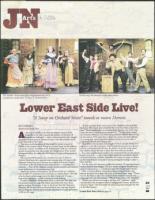

The "bubbies" kvetch about how unappreciated they are in
a production number from 'M Stoop on Orchard Street."
On the stoop, the characters confess their dreams.
Lower East Side Live!
M Stoop on Orchard Street" travels to metro Detroit.
BBL CARROT],
Specid to tb e Jewish News
t the end of Fiddler on the Roof, the popular musical about
Jewish life in the Old Country, the residents of the shtetl of
AAn atevka are disbursed — into an uncertain future. But imagine
that some of them came to America to start a new life, possibly on the
Lower East Side of New York.
That serves as the backdrop of what could be termed a sequel to
Fiddler. a new musical called A Stoop on Orchard Street. It's also billed as
a kind of a "cousin" to Fiddler on the Roof because it tells, in a sentimen-
tal and romanticized way, what might have happened to Tevye and his
beleaguered fellow Jews after they fled Eastern Europe and journeyed to
America.
Still running Off Broadway since its debut last year, A Stoop on
Orchard Street launched a national road company that will come to the
Seligman Performing Arts Center on the campus of Detroit Country
Day School in Beverly Hills for nine performances — including four
matinees — Nov. 23-28. Seligman usually features concerts and chamber
music performances (see accompanying story).
Stoop is the creation of one person, Jay Kholos (Cole-us), a Reform
Jew, ex-CBS-TV producer and a newcomer to musical theater. Not only
is he the show's producer„bie wrote the show's book and 18 songs —
both music and lyrics — with no formal musical training.
A native Californian, Kholos never lived on the Lower East Side, but
his ancestors came through Ellis Island and settled, like most immi-
grants, in lower Manhattan. A visit to the Lower East Side Tenement
Museum (90 Orchard Street at Broome Street) two years ago inspired
him to bring the physical and emotional experiences of a past generation
to life on the stage.
"If your ancestors didn't come over on the Mayflower, they probably
landed on Ellis Island, then settled on the Lower East Side, at least for a
time," Kholos explained in an interview from Toronto, one of 18 cities
where the show is playing on its current tour. "The first time I visited
the Tenement Museum, the stories my grandfather told me about living
[in the area] in 1910 came alive in those tiny rooms and dark hallways.
As a young boy, I paid respectful attention to him, but as an adult, I
understood what he was trying to say."
Stoop follows the successes and struggles of the Lomansky family as it
adjusts to a new life in America. Told through the eyes of a son, Benny,
as both a young boy and old man, the show is set on the stoop where
the residents escape the heat to share their lives with one another.
For many neighborhood residents, the tenement stoop was the hub of
social interaction — a place where adults gathered and children played,
and personal stories unfolded. Regardless of country of origin or ethnici-
ty the stoop fostered camaraderie among immigrants trying to adapt to
New York life.
On the stoop, the characters confess their dreams. The garment factory
worker sketches dress designs. "I'he fruit vendor imagines himself as an
uptown businessman — "a pushcart schlep who turned rags to riches."
After a 14-hour shift in a sweatshop, Benny's father, Hiram, who
deserts the family for a better life north of Orchard Street, sings, "There's
Got To Be More to Me." The Orchard Street residents contend with a
menacing Irish cop, who laments, "What's Happening to My America?"
Kholos rates his best two songs as the first act's "Lipschitz," which
describes how the immigrants started changing their names, and the sec-
ond act's "Sarah," the bittersweet tale of a young man pining for his love
in the Old Country.
LOWER EAST SIDE LIVE! on page 52
11/19
2004
49