

Prestigious Winners
Israelis ecstatic over first Nobel Prize for science.
RACHEL POMERANCE
Jewish Telegraphic Agency
New York
s Israel captured its first Nobel Prize in sci-
ence, Jews worldwide kvelled over the
recognition of excellence in a discipline that
has long been a hallmark of the Jewish state.
The Nobel Prize in chemistry was awarded on
Oct. 6 to two Israelis, Avram Hershko and Aaron
Ciechanover of the Technion-Israel Institute of
Technology in Haifa, and an American, Irwin Rose
of the University of California at Irvine, for a dis-
covery that advances the fight against cancer. The
three share the $1.3 million prize along with its
international acclaim.
At a news conference in Israel, Ciechanover, 57,
accepted the prize in a uniquely Israeli tone: "The
human brain is the only natural resource that Israel
possesses."
"This is proof of the kinds of things Israeli scien-
tists can achieve," Ciechanover said.
His mentor, Hungarian-born Hershko, 67, also
framed the win as a national triumph: "We're very
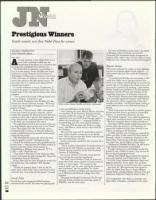
Nobel winners Avram Hershko and Aaron Ciechanover
excited and very happy to bring good news to the
people of Israel."
in the accomplishment of the Israelis.
In the late 1970s and early 1980s, the scientists
Upon hearing the news, Melvyn Bloom, executive
found and named the protein ubiquitin, which
vice president of the American Technion Society,
marks other proteins for destruction once they have
instantly recalled the image of Gal Fridman — the
carried out their task, a process that regulates the
windsurfer who won Israel's first Olympic gold in
body. Alternatively, unwanted proteins that linger
Athens two months ago — "wrapping himself in
in the body can cause disease like cancer.
the Israeli flag, and they were playing Hatikvah.
The trio's discovery led to the creation of the can-
"This one I feel the same way about in a larger
cer drug Velcade, approved last year in the United
sense," said Bloom, whose society raises funds for
States, that targets sick cells. Previously, cancer
the Technion.
treatments had a tendency to kill cells indiscrimi-
After all these years and the tremendous-achieve-
nately, a debilitating and potentially lethal compli-
ment of the scientific community in the Jewish
cation for the patient.
state, "this is the first time that Israeli scientists have
"We discovered the process by which the body
won the Nobel Prize," he said.
exercises quality control," Ciechanover said.
Jewish institutions touched by the scientists felt a
Asked if the attention on Israel overshadowed his
special glory.
honor, Rose — who said that the IsLelis worked in
"This is a mark of distinction for Israeli science in
his lab at the Fox Chase Cancer Center in
general and for the Technion in particular," said
Philadelphia at different times between 1977 to
Yitzhak Apeloig, president of the Technion-Israel
1996 — said, "absolutely not."
. Institute of Technology.
"They deserve this prize for the important obser-
For its part, Hebrew University noted that the
vation" they made, he said, stressing the "important
two scientists were among its graduates.
contribution from the Technion."
The Israel Cancer Research Fund, an American
In fact, Rose said, he never thought he would win
group that funds cancer research in Israel, stated its
the Nobel, but "was confident" that Hershko
pride in a news release. "We invested in this
would.
research early" and "are now reaping the rewards of
"There's no question about it that he did the
that investment," said its president, Dr. Yashar
major work in this field. I was a contributor, and I
Hirshaut, a medical oncologist and associate profes-
never felt that I was really the key person," he said.
sor at Weill-Cornell Medical College-New York
Hospital.
The group has funded Ciechanover for 22 years,
Israeli Pride
and both Israeli scientists are receiving a grant of
Several Jews were among the Nobel laureates
$50,000 a year for seven years.
announced this month, but there was special pride
A
311
10/22
2004
36
The news of Hershko's award made a big splash
in Hungary, where his family survived the
Holocaust. His immediate family immigrated to
Israel in 1950, when it was "the last chance to leave
before the Iron Curtain fell and closed the borders."
Boycott Answer
The award could also be a boon to those fighting
boycotts in academia against Israeli scholars — a
phenomenon that has risen amid the Palestinian
intifada.
"It certainly should help convince people in the
world who might not be paying attention that
there's a lot of great research going on in Israel, but
people who are intending to be biased, if you will,
may not be convinced by anything," said Andrew
Marks, founder and president of the International
Academic Friends of Israel and chairman of the
physiology department at Columbia University.
The scientists' discovery has major implications.
"It is extremely significant because it showed that
the destruction of the components of the cell is
actually controlled," said Richard Ikeda, health sci-
entist administrator at the National Institutes of
Health.
"Each of the pieces are there for a specific amount
of time and they have to go away in a controlled
fashion," or can become cancerous, he said.
The Velcade drug has "been useful on patients in
which other treatments haven't succeeded," he said.
"We don't necessarily know its full potential yet."
More than 8,000 scientific publications have been
written about the discovery, and thousands of
papers and conferences have been devoted to the
subject, according to the Technion.
In 2000, Hershko and Ciechanover received the
Albert and Mary Lasker Award for Basic Medical
Research, which is considered a precursor to the
Nobel Prize. They are also both past recipients of
the Israel Prize, Israel's highest civilian honor.
Ciechanover, Hershko and Rose, 78, will receive
their Nobel in Stockholm in December.
Though Ciechanover and-Hershko are the first
Israelis to win a Nobel in science, they are not the
first to win the prestigious honor.
Shmuel Yosef (Shai) Agnon shared the literature
prize with Swedish writer Nelly Sachs in 1966.
In 1978, Prime Minister Menachem Begin and
Egyptian President Anwar Sadat won the peace
prize for the historic accord between their countries.
And after the Oslo agreements were signed in
1993, the Nobel Prize went to Prime Minister
Yitzhak Rabin, Foreign Minister Shimon Peres and
Palestinian Authority Chairman Yasser Arafat. ❑
JTA correspondents Dan Baron in Jerusalem and
Agnes Bohm in Budapest contributed to this report.