

BROADWAY MELODY
from page 69
"So I kind of drifted from the world of theater to
the world of PBS documentaries — which is a nice
place to be," he says. "I basically worked under the
Ken Burns umbrella for about eight years, through
1996."
Kantor lives in New York City with his wife,
Kathy Landau, and three children, ages 4 to 9. The
family belongs to the Central Synagogue, a Reform
congregation that is the oldest synagogue in contin-
ual usage in New York City.
Although the filmmaker's own family had no con-
nection with theater, Kathy's parents were highly
respected film producers. Ely Landau, who died in
1993, and his wife, Edie, produced
some of the greatest Jewish films of
all times, Kantor says, including The
Chosen, The Pawnbroker and Man in
the Glass Booth.
Following The Dream
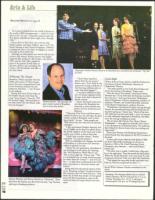
Filmmaker Michael Kantor directs a re-enactment o a scene from the Gershwins' "Tip Toes"
of 1925.
"I don't fancy myself as
Mama Rose by any means,"
Kantor says, "but I think it was
important to keep a little bit of
that burning ambition alive to
make this show happen."
It would be difficult to find
any 10-minute segment of the
six-part series that is devoid of
Jewish content.
Michael Kantor: "By and large, the
Kantor has heard many theo-
great creative minds of Broadway
ries about why Broadway has
seem to have been Jewish."
attracted so many Jewish com-
posers, lyricists, producers and
directors.
"There was Cole Porter and there were a
couple of others, but, by and large, the great
creative minds of Broadway seem to have
been Jewish," he says. "Some people say,
`Well, those were the only kind of jobs Jews
could get.'
"I also interviewed Sheldon Harnick, lyri-
cist of Fiddler on the Roof. He talked about
the Jewish tradition of the book and words,
and he sort of drew a theory from that.
"I don't have a perfect answer," Kantor
concludes. "It's a good question."
With its challenges and changes, the world
of Broadway is a microcosm for American
society in general, he says.
"I know the new generation of students is
not learning as much about the 'Roaring
20s,' the Depression, World War II, the
`60s, as they might be," Kantor says. "This
is a wonderful way of using American popu-
lar music from last century — and even ear- -
Tier — to help them understand some of the
great movements in American history and
culture."
Along with the educational aspects of the
series, Broadway includes "emotional stories
that resonate, that will stick with you." And,
above all, he feels that people of every gener-
ation will find something to enjoy in the
Marissa Winokur and Harvey Fierstein in "Hairspray": "Ifyou
nearly six hours of songs, dances and inter-
don't have the business, you don't have the show," says Fierstein, views.
Broadway, which coincides with the
100th anniversary of Times Square
and is the most comprehensive look
at the American musical ever pre-
sented on television — was 10 years
in the making.
During that time, Kantor kept on
his bulletin board a line from the
song "Some People," from the 1959
hit musical Gypsy. "Some people sit
on their butts/ Got the dream, yeah,
but not the guts."
referring to Broadway producers.
Local Angle
Within those six hours, there's a small bit of Detroit in
the person of James Nederlander, chairman of
Nederlander Theatres.
"Our sixth episode is very much about being a pro-
ducer, the business of Broadway," Kantor says.
Near the start of this episode, writer/actor Harvey
Fierstein says, "If you don't have the business, you don't
have the show" And sound bites from Nederlander,
along with glimpses of Rocco Landesman, president of
Jujamcyn Theaters, and Gerald Schoenfeld, chairman
of the Shubert Organization, reinforce this view.
"Nederlander remembered Al Jolson coming through
Detroit; he remembered being with his family and see-
ing shows going up," Kantor says. "Much of his inter-
view didn't get into the series itself — since we focused
on what ultimately happened on Broadway, and didn't
cover the touring companies as much.
"But it's places like Detroit, New Haven, Boston
Philadelphia — those places in particular were critical
to the development of Broadway shows. The audiences
there helped the director know what was working and
what wasn't."
Writer Jerry Herman told Broadway interviewers a
Detroit-based story that appears in the DVD version of
the series.
"Is there still a hotel called the Park Shelton? Well,
the show Hello Dolly was playing out of town in
Detroit in 1963 or '64. Carol Charming, Gower
Champion, Jerry Herman — they were all there,"
Kantor says.
"The show was in trouble. It didn't have a big num-
ber in the right place. They discovered this big number,
`Before the Parade Passes By,' and it was about 3 in the
morning in that hotel. They were all in their bathrobes.
"They played the song really loudly and woke every-
body up. And that song saved the show" ❑
Special Writer Suzanne Chessler contributed to this
article.
Broadway: The American Musical airs on Detroit
Public Television, WTVS-Channel 56, 9-11 p.m.
Tuesday-Thursday, Oct. 19-21. It will repeat
uninterrupted 12-6 p.m. on Thanksgiving Day.