

Blessings, Choices, Jewish Law
A scholar addresses the perplexing question of religion and contemporary American values.
ELIZABETH APPLEBAUM
AppleTree Editor
W
hen Thomas Jefferson penned the
Declaration of Independence, chances
are he never considered the rewards and
challenges the individual freedoms guaranteed in
the famous document might pose to observant
Jews.
Thanks to the Declaration of Independence,
Jews have enjoyed the right to worship in complete
freedom and the right to choose when to worship,
where to worship, how to worship — and if to
worship at all. It is an astonishing privilege, says
Rabbi Jacob Schacter.
American freedoms are "the biggest blessing of
modern times."
At the same time, Judaism is a religion of
authority, of absolute rights and wrongs. This
dichotomy — individual freedom of choice versus
complete commitment to God's directives — is
one of the great challenges facing contemporary
Jewry, the rabbi says.
Rabbi Schacter, dean of the Rabbi Joseph B.
Soloveitchik Institute, will speak on "Orthodoxy
and the 21st Century?' at 8 p.m. Sunday, Oct. 17,
at Young Israel of Southfield. The event is free.
Preceding the rabbi's lecture will be a dinner and
discussion, for which reservations are required. The
dinner begins at 6 p.m.
The institute, based in Brookline, Mass., seeks
to advance the values of the late Rabbi Joseph B.
Soloveitchik, a leading Torah scholar very involved
in contemporary American life. Founded in 1995,
the institute provides a range of programs and
publications aimed at strengthening modern
Orthodoxy.
"Because of America's idea of personal autono-
my, every individual is the arbiter of his own des-
tiny," Rabbi Schacter says. "We speak in the lan-
guage of choice; we reject the language of authori-
ty."
Witness, he says, the casual attitude many take
toward those who should deserve the most respect.
"We call parents and teachers by their first name;
we disregard our elders," he says.
Within the Jewish community, there are Jews
who reject God's authority, completely ignoring
Halachah (Jewish law), he says.
"The question is, how can we be devoted to
God, which is absolutely essential, and at the same
time participate in Western culture?" he asks.
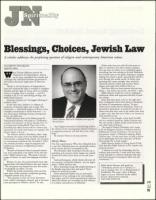
Rabbi Schacter: How to be Orthodox and enjoy the
best of culture.
"Any religion interested in maintaining itself in
the climate of the contemporary culture's insistence
on personal autonomy will find this to be a chal-
lenge."
Be warned: There are no easy answers.
Murky Waters
The first consideration: What does Halachah have
to say? But Halachah does not specifically address
every minute detail of contemporary life.
No Orthodox rabbi would give thumbs-up to
attending rock concerts where singers are scantily
dressed and where lyrics focus on sex and more
sex.
Such performances, which clearly advocate val-
ues contrary to Halachic Judaism, "are not appro-
priate," Rabbi Schacter says.
But is anything wrong with simply listening to
the Beatles sing about love and peace? Here's
where the waters get murky.
Some observant families say no rock music
whatsoever; it has nothing to do with Judaism,
they argue, and the whole entertainment industry,
where key themes are invariably sex and violence,
is in direct contradiction to Halachah.
Others take issue not with all rock music or
films or television, but their content. Judaism,
they say, does not direct us to completely ignore
everything that has nothing to do with Halachah,
but instead serves as the guide, helping us navigate
(taking that which is good, rejecting that which is
not) through the secular world. So rather than
spurning rock music outright, they watch for
"parental advisory" labels and monitor which
singers and songs their children listen to.
And then there are those parents who say any-
thing — any movie, any music, any book — goes.
Rabbi Schacter looks for a way to emphasize
traditional values and appreciate the best of mod-
ern culture.
Some Jews have gone so far to the right they
have "completely turned their back on fundamen-
tal values of contemporary culture," he says.
Others have totally rejected Halachah. They're so
absorbed in themselves, so driven by the idea of
choice and what they want to do, rather than what
is right to do, that they have little or no interest in
what God has to say.
There is a way, though, to live both Jewishly
and as a modern American, Rabbi Schacter says.
His role model is Rabbi Joseph Soloveitchik, for-
mer chief rabbi of Boston.
The head of Yeshiva_ University and a leader
with the Religious Zionists of America and the
Rabbinical Council of America, "he was one of
the greatest minds" of Halachic Judaism, Rabbi
Schacter says. "At the same time, he held a doctor-
ate in philosophy from the University of Berlin.
He lived his life in both worlds."
Rabbi Reuven Spolter of Young Israel of Oak
Park describes Rabbi Schacter as his "teacher and
personal mentor."
"I admire not only his scholarship, but his
wisdom and sensitivity. I study with him twice
yearly and plan to continue studying with him,
and look forward to sharing his ideas with the
community." II]
Rabbi Jacob Schacter will speak on
"Orthodoxy and the 21st Century" at
8 p.m. Sunday, Oct. 17, at Young Israel of
Southfield. The event is free. A dinner
begins at 6 p.m. followed by the rabbi's
lecture. Reservations required.
Call (248) 358-0154.
10/ 8
2004