

EOM
Editorials are posted and archived
on JN Online:
www.detroitjewishnews.com
Bad Faith In White House
Fourth in a series on the crucial issues American Jews
should consider in the Nov. 2 presidential election.
T
he last time religion held such an important
role in a presidential election was 1960 when
the issue was whether John E Kennedy's
Roman Catholicism would make him the pope's ser-
vant.
Just look at us now, with a born-again Christian
president who asserts that a "higher power" guides
him in major policy decisions and who plays blatant-
ly to a fundamentalist Christian right on social issues.
President George W. Bush seems not to recognize
that the religious fanaticism driving so much of the
hatred toward America is the direct result of
letting religion call the government shots.
The first target in Bush's war on terror was
the "devout" Taliban regime of Afghanistan,
yet he seems oblivious to the role that he is carving
out for Christianity in America to bring similarly
absolutist judgments on crucial policy questions.
This has never been the American way, and for
good reason. We were founded as a nation escaping
not just the British monarchy, but also an intolerant
religious rule. From the beginning, we understood
that religion is absolutely right for the individual and
absolutely wrong for the state. Leaders were expected
to acknowledge a "Creator" and to allow moral pre-
cepts to guide their thinking, but they were not to
use religion as a substitute for examination of issues
and for the to-and-fro of democracy.
Religiosity, the public displays of piety and the
invocation of the Almighty, is not morality. A moral
president would not, for example, willingly acquiesce
to the rapidly widening gulf between rich and poor
in this nation. He would not allow power plant emis-
sions that save utility companies a
few billions in clean-up costs
while imposing tens of billions in
new health costs for people who
live downwind of the toxic stacks.
He would work hard to keep
assault rifles illegal and to protect
the consumers from unsafe prod-
ucts. He would be more con-
cerned about what is best for all
Americans and not what serves
only his short-term political
interests.
It is not that religion has no
part in the public
arena. The churches
were at the heart of the
civil rights and, to a
lesser extent, the anti-war move-
a.
ments of the late 1960s. Religious
organizations, including our own synagogues, play
vital roles in education and the delivery of social serv-
ices, particularly to the poor and the elderly. And
they did so long before Bush's "faith-based initiatives"
routed more tax dollars to them.
That, however, is quite a different kettle of fish
from having the Republican National Committee
seek membership lists from churches to use for cam-
paign mailings or from sending churches 300,000
copies of a video, George W Bush: Faith in the White
House, that lauds the president for having the "moral
clarity of an old-fashioned biblical prophet." On
issues ranging from same-sex unions to teaching cre-
ationism to stem-cell research to reproductive rights,
Bush has taken absolutist positions that play to the
Christian right rather than recognize the range of
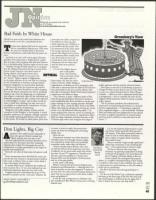
Greenberg's View
EDIT ORIAL
Dim Lights, Big City
A
question I have asked in print repeatedly of
those who govern Detroit is simply this:
"Hasn't anybody here ever seen a city?"
Do they understand the economic dynamics of suc-
cessful cities? Do they know how they constantly
replenish their vitality? Do they grasp the need for
entrepreneurs to replace government as the engine of
growth and employment?
From all I see, after all these years, the answer is still
no.
Some commentators have described the recent pro-
posal by the City Council to use government funds to
help create an African Town as racist. I don't think it
rises to that degree of seriousness.
It's merely dumb, but it underlines the mindset of
those in power. By a 7-2 vote, they indicated an over-
whelming cluelessness about the way cities work.
I suppose that part of the blame has to go to Gov.
Jennifer Granholm and her "cool cities" initiative. By
George Cantor's e mail address is
-
gcantor@thejewishnews.com
2X.7,1.11,f
Oggpittagitroaw
public opinions and the need for informed debate.
John Kerry is every bit as God-fearing a person as
George W Bush; he just doesn't wear it on his sleeve
or use it as a casual rhetorical device. He's a Roman
Catholic — albeit one with a substantial Jewish fami-
ly background — but he certainly has never let his
religious beliefs determine where he stands on public
policy matters.
The 42 previous presidents all understood the
importance of maintaining government as a bulwark
between organizations — corporations, organized
labor, organized religion — and individuals. President
Bush just doesn't get how dangerously he has opened
the door to religious interference in national policy
and how hard it could be to close that door in the
future.
❑
its name, it seems to imply that government
It is not the business of government to pick
action can foster the development of inviting,
and choose which racial and ethnic groups it
livable cities.
will support. If the black community wants to
Show me one.
create an area in which African Americans
Government intrusion into urban dynamics
have a chance to support black enterprises,
inevitably raises costs through excessive regula-
that would be nice.
tion and distorts market forces into politically
There is certainly a large enough capital pool
acceptable results, rather than real demand.
within that community to do something like
Council member Joann Watson, who came
this — if the opportunity in Detroit is right.
GEO RGE
up with the African Town brainstorm, has tried
The fact is, however, that every large
CAN TOR
to defend it on any local media outlet that would
American
city growing in population is doing
Rea lity
have her. On one TV appearance, I heard her say
so because of immigrants. To accuse these peo-
Ch eck
that this could not possibly be a divisive force
ple of "stealing" jobs from blacks, as the eco-
because Africa was the birthplace of all humanity
nomic analysis that undergirds this proposal
and, so, is the great unifier.
claims, is a complete misunderstanding of how wealth
At that point, I fell asleep.
is created in urban areas. It also underlines the need for
Watson contends that government helped create
a ward system in council elections, so that all residents
Greektown and Mexicantown — although she's a bit
of the city are represented.
short of specifics on how that happened. It seems to
But this is the same old, sad song-and-dance in
me they were the result of private business decisions by
Detroit.
those who saw an 'opportunity in the ethnic market-
On the eve of the Ryder Cup, a columnist expressed
place and grabbed it.
the hope on the front page of the Free Press that noth-
As did the Arab entrepreneurs in Dearborn who
ing would happen to embarrass the city again. But I
have transformed West Warren Avenue into a thriving
have to believe the city just can't help itself. ❑
business strip.
irTN
10/ 8
2004
47