

who proclaims, "Wherever thou goest,
I shall go."
Once on the subject of going, many
planners are moved to ask, "Where do
we go from here?" This could also be a
assassination or the events of 9-11.)
question raised if you are driving with
Sense of place is present in drama
men, since they are noted for not
also. How often over the years has a
wanting
to stop and ask for directions.
Juliet asked "Wherefore art thou,
Of course, getting lost in
Romeo?"
thought
may produce,
If the "play's the thing,"
"Where was I?" (I still
I keep six honest-serving men
then playing is the thing
maintain that many get lost
also when it comes to the
in thought because it is
(They taught me all I knew);
importance of Where.
such unfamiliar territory)
Look at the popularity of
Questioning myself is
Their names are What and Why and When
the books which ask,
something
that I've been
"Where's Waldo?" Many
and
How
and
Where
and
Who.
doing
a
lot
of lately; I think
of our children increased
it
comes
with
age, though I
their sense of geography
Rudyard Kipling like to espouse the idea that
by playing "Where in the
it is just my busy life that
World is Carmen
leads me to question,
Sandiego?" A favorite
"Where did I put ... ?" (I've told many
tion. We are quite often concerned
nursery rhyme-song game is "Where,
that I am at a time in life when I'm
with
having
the
wherewithal.
oh, where is little Thumbkin?" (I am
involved in the hereafter; I get some-
When
things
really
get
bad,
we
still concerned about early trauma
where
and ask, "Now what am I here
resort
to
prayer:
"From
whence
connected with my fingers disappear-
cometh my help ... " (For those of you after?")
ing.)
Well, before you start in on "Where
not antiquated enough, whence is an
Once our children are beyond the
does he get these ideas? Just remember
toddler stage, we continue our concern old-fashioned where.)
The idea of where expressing loyalty that "Fools rush in where angels fear
with Where as controlling parents:
to tread." 0
is best expressed by the biblical Ruth,
"Where do you're think you're going?"
(and be sure to add "dressed like that")
"Where did you learn to talk like
that?" "Where do you think the
money is coming from?"
Speaking of money, we are often
asking ourselves, "Where did all my
money go?" as our paychecks sink
slowly into the abyss caused by infla-
Where, Oh, Where?
W Nether we
are trying
to get our
bearings, give advice
or express concern
over our daily exis-
tence, the import of
Where in our lives is
great. Consider it.
SY
Kipling's poem may
MANELLO
well
have been the
Editorial
forerunner of the
Assistant
"guide" to news
reporters. Journalists
are keenly aware of the importance of
determining the answers to the five
W's. Crime reports are forever specu-
lating of the whereabouts of criminals.
What courtroom drama would be
complete without the standard,
"Where were you on the night in
question?"
Speaking of whereabouts, we often
recall our historic moments by
remembering where we were when
they occurred. (Consider the Kennedy
It's The Sukkah-Mobile!
Berel Shemtov, director of Lubavitch
of Michigan.
"If people want to learn, we'll
show them," Stein said. "Some peo-
ple are so involved, they forget it's
Sukkos. I can understand. I was
brought up with this. But others get
happy when they can do it."
Levi Stein, 16, of Oak Park is on a
mission during Sukkot — to give as
many people as possible the oppor-
tunity to perform the mitzvah of
blessing the lulav and etrog.
For the second year in a row, he's
taken responsibility for the "Sukkah-
mobile," a sukkah on a 12-foot
flatbed truck that travels through
area suburbs. The mobile sukkah has
been around for a long time. Stein
says it's the brainchild of Rabbi
— Keri Guten Cohen,
story development editor
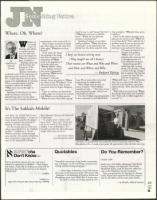
Levi Stein, 16, of Oak Park was outside the Jewish Community Center in West
Bloomfield on Oct. 3, ready to give people the opportunity to bless the lulav and etrog.
14% PLEFEE 'cha
11 Don't KnoW02004
Quotables
Do You Remember?
October 1984
Of six Jewish fast days in the year, only one is
allowed to take place on Shabbat — Yom Kippur.
All others, if they fall on Shabbat, are observed the
following day. One fast never has to be delayed.
Which one?
— Goldfein
sirej
..1QA31.1 13AU Jo
.2vqq-ells uo
tip I aiTi. Jo agej at11 LIWASUV
"Instead of converting a living Jewish community
into a museum, we are converting a museum into
a living and functioning synagogue."
— Eliezer Papo of Beersheva, Israel's Ben-Gurion
University, on the conversion of the 16th-century Old
Synagogue in his hometown of Sarajevo, Bosnia and
Herzegovina, from a post-World War II Jewish muse-
urn back to a house of worship; quoted by JTA.
Israel's two chief rabbis, Ashkenazic Chief Rabbi
Avraham Shapira and Sephardic Chief Rabbi
Mordechai Eliahu, paid the first-ever rabbinical
visit to the Histadrut Central Committee.
They were greeted by the blowing of a Yemeni
shofar. Hopes were expressed for future coopera-
tion by the rabbis and the trade union leaders.
— Sy Manello, editorial assistant
41141
10/8
2004
II