

Spirituality
Cover Story
SACRED SPACE from Page 65
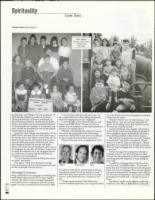
Beth Shalom
nursery school classes
50 years ago
and today.
and theology" says Salinger. "He was an adherent of
Rabbi Mordecai Kaplan [a teacher at the Jewish
Theological Seminary of America and founder of
Reconstructionist Judaism]. He believed, like Rabbi
Kaplan, that Judaism was the accumulated culture of
the Jewish people and, therefore, it was dynamic, not
static. He laid the foundation for my current attitude
toward religion in that class."
Jeremy and Vicki Salinger were married in 1972 by
Rabbi Nelson, who had arrived at Beth Shalom just a
few months earlier. The Nelsons invited them over for
Shabbat dinner and the rabbi invited them to join a
chavurah (fellowship group), which they did. Later,
three daughters became bat mitzvah with Rabbi
Nelson and Cantor Samuel Greenbaum, who came to
the synagogue the year after the Nelsons. Today, Vicki
co-chairs the sisterhood and is the synagogue's librari-
an, and Jeremy is involved with the Social Action
Committee and reads haftorot.
"To me, it illustrates the family feeling that contin-
ues today," says Jeremy.
Vicki agrees. "There have always been enough
activities and people that we enjoy being around, and
we feel comfortable with the services."
Meaningful Connections
Being comfortable at the synagogue is something that
Rabbi Nelson takes seriously. For 32 years, together
with his wife, Alicia, he has encouraged meanin
connections between congregants and with the syna-
gogue. Last year, he announced he will retire in 2006.
10/ 1
2004
68
"I want to leave while they still want more," he
says, comfortable in his office, talking energetically
about the congregation and the congregants.
"I never thought services had to be solemn at all
times," says Rabbi Nelson. "Serious, yes, but not
solemn. It is our business to create sacred experiences,
but we can be relaxed about it.
"We have a membership that wants to be innova-
tive and on the cutting edge of the Conservative
movement," Rabbi Nelson said, and it's not difficult
for him to rattle off some of those innovations.
When he first came to the congregation in 1972,
Nelson
Greenbaum
Glen
he started to make the bat mitzvah equal to the bar
mitzvah and expand the role for women in ritual. "I
didn't think there was a halachic (Jewish Law) objec-
tion to it, and I think there was a moral issue," he
said.
Though a gradual process, Beth Shalom has
.
become completely egalitarian,. and it happened before
any other local Conservative congregation and before
most across the nation.
"Ritual can be fun; you can enjoy doing it," said
Rabbi Nelson. "Jews are no longer asking why be
Jewish, we are asking how to be Jewish; how to do it.
We want lots of hands-on stuff"
Cantor Greenbaum, who, together with the Rev.
Samuel Semp, rounds out the religious leadership of
the congregation, agrees wholeheartedly. He keeps a
heavy teaching schedule to help make it happen.
"My role here has always been to involve members
in our services," says Cantor Greenbaum. "People
want to be involved. They are searching for a Jewish
spirituality and we address that through involvement.
We're not afraid of change, but we want to be sensitive
to everyone."
Twenty years ago, the congregation instituted a
"simchah moment" near the end of services where
everyone has the opportunity to tell the congregation
something good that happened to them during the
prior week.
"In addition, congregants bless each other at the
end of services," says Rabbi Nelson. "It's not quite a
group hug, but it's important that you are not ignored
when you come to synagogue. If you are not accepted
and warmly embraced in a synagogue, where will you
be? The lesson of hospitality is one we strive to fulfill,
and I think we've done well — though we can do it
better."
Dan Barth, a teacher in the religious school who
married his wife, Ellen, at Beth Shalom in the early