
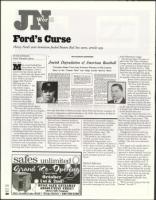

Ford's Curse
Henry Ford's anti-Semitism fueled Boston Red Sox curse, article says.
PETER EPHROSS
Jewish Telegraphic Agency
S
New York
DIE
ost casual baseball fans
know about the "Curse of
the Bambino." Nov a
sportswriter has written that the
curse — which links the Boston Red
Sox's failure to win a World Series
since 1918 to the sale of
slugger Babe Ruth the
following year to the
New York Yankees — has
anti-Semitic origins.
The publication of the
story comes as the histo-
ry of Jews in baseball is
getting unprecedented
publicity, including a
recent two-day confer- .
ence at baseball's Hall of
Fame celebrating Jewish players.
The story also comes as Shawn
Green, a player with the Los Angeles
Dodgers, made headlines with his
decision to sit out one of his team's
two games during Yom Kippur (see
Something Extra, page 10).
As writer Glenn Stout tells it, the
"curse" story revolves around the anti-
Semitic attitudes of pre-World War II
America — and some previously
unchallenged historical inaccuracies.
In the September issue of Boston
Baseball magazine, Stout writes that
the roots of the animus against Harry
Frazee, then the Red Sox owner, lie in
his battles with the president of the
American League, Ban Johnson.
Knowing that Frazee was from New
nem loisAntmoran mutepiamsavit
Jewish Degradation of American Baseball
Corruption Began Years Ago; Burlesque Managers in Big Leagues;
Story of the "Lasker Plan" and Judge Landis' Shrewd Move
E
VERY titan-Jewish baseball manager in the 'United
States lives between IWO ream and they arc
both destrable In the Biblical terra .'the fear
of the Jews." The first fear concerns what the Jews
arc doing to baaettall; the second fear concerns what
the Jew would do to the manager if he complained
about it. lismee, in coifs of the fact that the rowdyism
that has afflicted baseball especially in the East Is ail
ning of umpires, hurling of
of profane insults; in spite
It!, of player. had to be con-
of the tendency of individual
igglt up to individual play ,
idea. that even the gate re-
sod with—the managers, and
sibs have been ohltged to keep
oust fear they have not dared
one manager arid, "Go
' od Sod,
rk if i told your
and in the ..eifelleet game"!
Is to begin to !sink round.
imam been !oohing round. The
s only knew hew much the
might feel more certain of
Itee, toward a clean - no.
rrs.ake h ins eligible to has,
t on the saute term, with other
people. is to demlop a mottaseatee spirit. The jr,
spits., but only on
hfts
seldom it ever in erne
VOLUME two of this series of Jew.
ids Studies Is now off the rases,
It is entitled "Jewish Adds-Ides In the
United States," being the second vol.
lame of "The international Jew,"
twenty-two articles, Iee pages, Seat
to assy Address et the cost of printing
and ensiling, which Is ZS soots.
and lender, The sport aspect of the game was be-
ginning to give tray :0 the "show" aspect. There
were nnmerons algus that an attempt was be-
ing made to "star" certain PC41083, to reset "iseatIliticm,"
.d to puB off a s ame with a sensational cildiug—ittst
like a ballet is tined, or a meant. Thrill, wore be•
ing nanrcd—not as Om give acrd take of lint gait, the
accident of tensest action, let et practiced acting.
That is. haseboll was slowly behrg hrottalit under
the level of the boar ottlee idea.
There were fortes agaiiim this metatimrphaai, of
the game. Certain men raw what was COMeT. There
were also forces favoring the change, and wantime it
to come. Curiously ratough, the form, that favored
turning base-bull into aftern.o veadesille were Jews,
and ant, wire saystmtl ki.epinK the. gent, as part of
American outdoor assorts were nem-Jews.
There was mom itmoto,cf fe thaf
silat-
that curious medley of Jewish defendants, tvantsres,
tbey
York and was a theatrical producer,
Johnson assumed he was Jewish. But
he was wrong — Frazee was
Protestant, Stout writes.
Further, Stout writes, the popularly
understood "facts" behind the curse
are not true: the sale of Ruth was not
necessary to finance the Broadway
show No, No, Nanette, and many
sportswriters at the time thought the
Ruth sale was a good move.
But the Frazee-was-Jewish story
gained further traction when Frazee
4 Doors North
10/ 1
2004
30
It may be stilted also that this which follow. is the
mr.ecosus of Jewish opinion as regards baseholt:
"Tau can't left baitball a, a busine
It will always
draw a gang on an afternoon,
after... It mu he `pepped' up
war' the, will nuke it smite a she
probably right,
be kilted as a bus:nest Pet h can
A lei the American baseball fine
as a sport ahostld with its atter de
cotimut that it imenine a reside:yin
now fat the Ice•eonlrollerl burly
hali ce a business will become a
life, a mob-males, a hang-rest a
criminal cats.
There is another peculiar jr
baseball teltich hae not o oh':: at
bring, is the name or Judge Lam!
right man with a wise head, wi
better not try to fool,
Elea the story is told, how
will attree that judge Landis is t
The Genesis of the "Ags
From left. Babe Ruth in Yankee pinstripes; Hen7y Ford's anti-Semitic newspaper; the
Dearborn Independent, published diatribes in the 1920s; Harry Frazee, the Red Sox
owner who sold Ruth in 1919 to the Yankees.
safes unlimite
---,„
mein. he simply got rid of them one by one, and the
next seas*. he It td practically 'rebuilt" hlt team. That
was not Mete than ten and not leas than ft. year,
before, the 1919 1.Vorld Series which formed the basis
of the Chicago ,caudal.
October
1 st &
HUGE SAIFE GIVEAWAY
ABSOLUTELY FREE!!
Adesco Safe Company
3361 Orchard Lake Road • Keego Harbor • 248-738-1500
was blasted in automobile magnate
Henry Ford's anti-Semitic newspaper,
the Dearborn Independent. Frazee's
tenure as owner of the Red Sox
amounted to "the smothering influ-
ences of the 'chosen race,'" the
Independent railed in 1921.
The problem, the Independent
decided, was that Frazee was an
unprincipled businessman, not a
baseball purist. "Baseball was about as
much a sport to Frazee as selling tick-
ets to a merry-go-round would be,"
an article in the paper said, adding
that "baseball was to be 'promoted' as
Jewish managers promote Coney
Island."
Shylock Reference
The caricature was furthered by a
sportswriter named Fred Lieb, who
wrote histories of several teams,
including the Red Sox. Published in
1947, Lieb's history paints a portrait
of Frazee that is "as pointed as that of
the Shakespearean character Shylock,"
writes Stout, who donated his pay for
the article examining the curse to the
Anti-Defamation League.
Fast forward about 40 years, to
when New York Times columnist
George Vecsey indirectly referred to a
curse connected to Frazee's sale of
Ruth after the Red Sox let a 1986
World Series victory against the New
York Mets slip through their grasp.
The curse was further etched onto
the popular mind a few years later by
Boston Globe columnist Dan
Shaughnessy in his book,
The Curse of the Bambino.
Stout made sure to
emphasize that neither
Vecsey nor Shaughnessy is
guilty of anti-Semitism. To
some, the link between
anti-Jewish sentiments and
the curse may seem tenu-
ous. But to Stout, the anti-
Semitism of Ford and Lieb
set the stage for later interpretations
of Frazee's sale of Ruth as the onset
of this decades-old curse.
For his part, Vecsey has since writ-
ten a mea culpa. In a column printed
in the Times, Vecsey wrote, "The
Red Sox may indeed be haunted by
some miasma dating from the sale of
Babe Ruth," but "it is time, however,
to exorcise any image perpetuated by
Henry Ford and his lot."
Shaughnessy, however, isn't con-
vinced by the entire argument. "I
don't see what this has to do with the
history of the Red Sox," he said,
adding, "The story is an enormous
Stretch. "
Fans appear to be equally split on
how much time they want to give
Stout's article. Since the piece
appeared in Boston Baseball, Stout has
received several e-mails from readers.
One man wrote him it was OK to
read the article during Yom Kippur
since it dealt with Jewish issues. "I
got a kick out of that," Stout said.
But Martin Abramowitz, a Red Sox
fan and the force behind the recently
published set of Jewish baseball cards,
has his eyes more fixed on worrying
about the present, especially the
upcoming baseball playoffs, than
about baseball's past.
"We're too busy trying to beat the
Yankees," he said. ❑