

THE ART OF RITUAL
from page 89
Kahn's imprint also is seen in the book's design, care-
fully assembled and handsomely produced. The book
jacket features a golden-hued Elijah's cup, set majesti-
cally and simply against a pale gray background.
"I think I speak best visually," says Kahn, who
repeatedly apologizes for being inarticulate with words,
when in fact he's quite eloquent. The energetic artist,
52, divides his time between painting, sculpting, creat-
ing sacred spaces, teaching and lecturing — "all part of
the language that I speak.'
"So much of the Torah is given to the visual," Kahn
says, citing such dramatic scenes as the twelve tribes of
Israel leaving Egypt in their groupings. "We have not
given enough attention to the visual," he says. "I
believe that we are meant to see it when we read it."
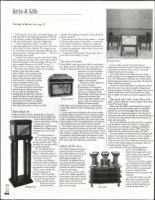
The book covers 20 years of his work, including
familiar ritual objects like candle-
sticks, kiddush cups and spice boxes
light enough to be held by children,
along with a yahrtzeit candle holder,
chairs used for a shalom bat (celebra-
tion of a daughter's birth) and a
sculpture for counting the Omer.
His multi-tiered seder plate features
stylized Egyptian figures supporting
the tiers and, on the highest tier,
holding aloft the dishes for symbolic
foods. For Kahn, the seder plate sym-
bolizes the Passover theme of going
from slavery to freedom. An adjacent
photograph shows a similarly tiered
silver seder plate made in Vienna in 1807.
Home Made Art
9/10
2004
104
Kahn, the father of three, explains that he began by
making objects for his family, and then branched out
to do work for public use
and as commissions. Among
his first pieces was a
tzedekah box, inspired by the
Altneuschul in Prague, and a
traveling ark for the Torah
scroll.
"So much attention is
given to selecting an etrog,
the citron used at Sukkot,
he says, and then asks, "Why
shouldn't the case that holds it
be equally beautiful?"
"I'm very blessed to have
grown up in the tradition.
When I make these pieces, I
know how they are used, how
they feel in the hand."
For Kahn, who eschews
labels and describes himself as
an observant Jew, three things
are essential in these objects:
"That it works visually, that
it's functional, that it's
halachic." When he makes
something new, he begins the
process by doing research,
looking into the reasons
behind the practice
and at historical
Tzedakah box
models, often calling on his father to learn all about
the laws involved.
His work has none of the usual symbols — no Stars
of David, tablets, lions or lines of text — connected
with Jewish ceremonial art. Rather, the imagery in
these works — some in wood, others cast in metal —
is inspired by landscapes, celestial views, flowers and
trees, and cell biology
"I hope they look like they've always been there. I
want them to be timeless," he says.
The Artist In Context
Emily Bilski's major essay places Kahn's ritual objects
in a larger context, reflecting on his career. She writes
that his ceremonial objects are "the embodiment of
more than 20 years of creative
passions and practices filtered
through family history and a
powerful personal, spiritual and
religious commitment."
Among the artistic influences
she cites are German
Romanticism, the American
abstract landscape tradition, the
architect and designers Frank
Lloyd Wright and Charles Rennie
Mackintosh and New York
School artist Mark Rothko, meet-
Etrog container
ing up "with the aesthetic sensi-
bilities of German-Jewish
Orthodoxy and the freedom found on Manhattan's
Upper West Side for Jewish self-expression and rein-
vention."
In her essay, Leora Auslander, who teaches modern
European history, material culture and gender studies
at the University of Chicago, points out that Kahn's
work in ritual objects expresses, like much of his work,
"preoccupations with the passage of time and with the
relationship between the human and the natural."
The work of casting metals, a labor-intensive process
Auslander describes as between art and craft, "may be
seen as a process mirroring Jewish ritual practice, which
also involves a melding of individual and collective acts,
of singularity and commonality, and repetition. Each
lighting of the Sabbath candles, for example, is unique,
but each recalls other lightings and blessings."
Objects Of The Spirit
The child of parents and grand-
parents who fled Germany in
the 1930s, Kahn grew up in the
New York City conclaves of
Washington Heights and
Riverdale. He explains that he
was surrounded by people who
followed the concept of hiddur
mitzvah, the idea of imbuing a
mitzvah with beauty.
His mother's parents would
make their sukkah magnificent,
covering the walls with crushed
velvet. He credits his late mother
Ellen Kahn, who filled their
home with beauty and inspired
him to do the same.
Meditative Room
In June, Kahn received the Jewish Cultural
Achievement Award in visual arts from the National
Foundation for Jewish Culture, which is currently
chaired by Detroiter Jim August.
Since 1985, when he was selected as one of nine
artists included in the Guggenheim Museum's exhibi-
tion "New Horizons in American Art," he has shown
his paintings and sculptures in more than 40 solo exhi-
bitions and 60 group shows.
There was a time when Kahn was reluctant to show
this work, as he was most interested in being known
for his paintings and sculpture. He explains that he was
influenced by two art critics and friends who urged
him to exhibit the work, as it's such a large part of his
life.
Kahn agreed, and in 1999, "Avoda: Objects of the
Spirit" opened at Hebrew Union College in New York,
curated by Laura Kruger.
Kahn chose the Hebrew work avoda for its layered
meanings of work and worship. After the exhibition
opened, he and Carol Brennglass Spinner founded
Avoda Arts, an educational program with the goal of
teaching Jewish tradition through art, demonstrating in
concrete terms the powerful connections between art,
ritual and community.
The Avoda exhibition has now traveled to museums
and universities around the country, in conjunction
with hands-on workshops in making ceremonial art
and seminars for educators. Since 1999, more than
3,000 university students have studied with Kahn.
From his students, he has learned that making ritual
objects is very personal, and that it can be a transfor-
mative process. He urges everyone to make objects.
"Not every piece has to be bound for a museum, just as
everyone who enjoys singing is not going to debut at
the Metropolitan Opera," he says.
More recently, he has been building meditative
spaces. On the difference
between these large-scale works
and his ritual art, he responds,
"Some objects fit into your hand.
Some you fit into."
Recent work includes a perma-
nent installation for the Health
Chare Chaplaincy of New York,
and he has been commissioned
to create a chapel in New
Harmony, Ind., for people of all
traditions.
In all media, Kahn's art is life
affirming. As Jonathan Rosen
writes, his work is "anchored
among earthly things but end-
lessly pointing upward." ❑