

L
4 4-W af,%.,
ar St
Modigliani exhibit, at the Jewish Museum in New York
and coming to Toronto next month, casts new eye
on the work of an early modernist.
FRAN HELLER
Special to the Jewish News
I
ITN
9/ 3
2004
48
talian Jewish sculptor and painter Amedeo
Modigliani was only 35 when he died of tuber-
culosis in Paris in 1920. His extreme poverty,
chronic ill health and profligate lifestyle, including
wine, women and drug addiction, fueled the myth
surrounding his bohemian ways, which overshad-
owed his art.
The exhibit "Modigliani: Beyond the Myth", at
the Jewish Museum in New York through Sept. 19,
looks beyond the artist's life, focusing instead on his
art in the broader context of his Sephardic Jewish
roots and the prevailing social, political and cultural
climate of his time. It moves to the Art Gallery of
Ontario in Toronto from Oct. 23-Jan. 23, 2005,
and then to the Phillips Collection in Washington,
D.C., from Feb. 28-May 29.
Best known for his paintings of reclining nudes
and portraits with elegantly elongated features,
Modigliani's work is represented in the exhibit by
more than 100 paintings, sculptures and drawings,
culled from collections and museums worldwide,
including Israel. They affirm his place in the pan-
theon of early European modernism.
Modigliani was born in Livorno, Italy, in 1884.
The Modigliani family, Sephardic Jews, had left
Rome for Livorno in Tuscany, a political and reli-
gious haven, around the middle of the century.
Unlike Rome and Venice, Livorno did not have a
ghetto.
Modigliani had an intellectual upbringing, mainly
due to his mother, whose lineage traces back to the
17th century Dutch-born Jewish philosopher
Baruch Spinoza.
Spinoza and others contributed mightily to the
secularization of Judaism and cultural assimilation.
It was in this climate of universal tolerance and
Judeo-Christian inclusiveness that Modigliani was
raised and which infused his values and his art, said
exhibit organizer Mason Klein, a curator in the fine
arts department at the Jewish Museum.
Modigliani, a sickly child, was stricken with
pleurisy in 1895 and with tuberculosis — then an
incurable disease — three years later. Two small and
extremely rare extant works from childhood reveal
the young artist's precocious maturity as well as his
preoccupation with death.
In the 1896 drawing Young Male Nude, created by
Modigliani when he was 12, a young boy is pictured
standing upright, while another lies supine below
him. A space between the two figures, obscuring the
legs of the standing figure, emphasizes the artist's
uncertainty about life and death.
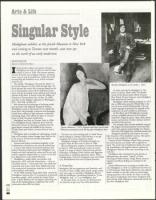
Amadeo Modigliani in his studio, c. 1915
An early painting by Modigliani is The
Jewess (La juive), dated 1908. The doleful
mood of this femme fatale reflects Picasso's
Blue Period, Picasso being an artist Modigliani
both admired and envied.
Modigliani ceased making sculpture in 1915
due to difficulties posed by World War I, the
cost of stone and his failing health. The uni-
versal language of geometry he applied to his
sculptures was now wedded to portraiture.
At first flush, all of Modigliani's portraits
convey a palpable sameness in his subjects'
mask-like, enigmatic gazes. Upon closer exami-
nation, each portrait reveals a distinct individ-
ual behind the persona.
For example, Jean Cocteau perfectly conveys
the
elegant and aloof painter, writer and film
Jeanne Hebuterne," 1919: Pregnant with their second chile4
critic who appears seated upright in a throne-
Hebuterne committed suicide the day after Modigliani died.
like chair. His angled face, pinched mouth and
elongated cylindrical neck capture the snob-
The lone tree and wending path in Small Tuscan
bish
character
of the dandyish Cocteau, who sports
Road, leading to a distant, hazy horizon, is an apt
a
bow
tie
and
a
hankie in his pocket.
metaphor for a future cloaked in doubt.
Portrait
of
Paul
Guillaume (Nova Pilota) portrays
Modigliani thought of himself principally as a
the
artist's
parvenu
art dealer with a cigarette in
sculptor when he first came to Paris in 1906.
hand.
The
cocky
tilt
of Guillaume's head, the stud-
He met Romanian sculptor Constantin Brancusi
ied
nonchalance
and
foppish manner underscore
in Paris in 1909 and produced a series of carved
Modigliani's distrust of the man, according to the
heads in a range of ancient historical and cultural
wall-text.
archetypes, including Greek, African and Egyptian,
Modigliani often sketched his artist friends at
giving them a modernist geometric idiom. These
Montparnasse,
the artists' "colony" of Paris.
striking heads, with their elongated noses and veiled
Drawings
of
Pablo
Picasso, Diego Rivera, Jacques
eyes, foreshadowed the artist's stylized portraits.
Lipchitz and Moise Kisling are included in the
exhibit.
Jeanne Hebuterne was a young art student who
A Proud Jew
met Modigliani in 1916-17 and became his lover. In
Modigliani did not experience anti-Semitism until
a 1919 portrait, titled Jeanne Hebuterne, the subject's
he came to Paris. Unlike other Jewish emigre artists
head
is cocked to one side, with one index finger
who were eager to assimilate, Modigliani did not
resting
squarely on her cheek, the other on her lap.
hide his Jewishness, introducing himself as "Je suis
She
appears
melancholy and remote. Pregnant with
Modigliani, Juif" or "I am Modigliani, Jew."
their
second
child, Hebuterne committed suicide the
At the same time, he was not an observant Jew,
day
after
Modigliani
died.
nor does his art give any hint of his Jewishness.