

World
The Invisibles
Largely Russian, young and educated, Israel's homeless coping with street life.
GIL SEDAN
Jewish Telegraphic Agency
•
Tel Aviv
A
;374
8/13
2004
28
s evening falls on Tel Aviv, the
city vibrates with an energy
unlike anywhere else in Israel.
But nestled among the blissful crowd,
amid the eating, drinking and general
merriment, is a group that often goes
ignored: Israel's homeless. Welfare
authorities have registered some 1,200
homeless in Israel, but there are no hard
numbers. Some estimates run as high as
10,000 Israelis living without homes.
Half of the 1,200 registered homeless
live in Tel Aviv, 300 in Jerusalem and
the remainder scattered throughout the
country, according to welfare authori-
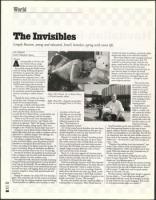
Above: Miri Hatuel, 18, at Shanti House,
ties.
a Tel Aviv homeless shelter.
Though the exact numbers are fuzzy,
one thing is clear: Younger and younger Right: Shaul Nir, a homeless Israeli father
people are becoming homeless.
of six, sits at Dizengoff Circle in Tel Aviv.
A year ago, a family crisis forced Miri
Hatuel, 18, onto the streets. After sever-
al days wandering, sleeping on the
streets and the beach, she found shelter
countries, in that by and
at south Tel Aviv's Shanti House, a youth shelter just
large they are not mentally
minutes from the pedestrian mall by the beach.
affected," says Dr. Avi Uri
"Never in my life would I have dreamed that I
of the Golden Tower reha-
would not be wanted at home," says Hamel, who
bilitation hospital in Bat
declined to elaborate. 'After I left home; I sometimes
Yam. "Their behavior is
had suicidal thoughts, asking myself, Why was I
usually considered normal."
brought to the world if my family didn't want me?'
Dr. Uri has treated several homeless who were heavy
During her year at Shanti House, Hatuel has com-
drinkers. During their hospitalizations they gave up
pleted high school and now works as a waitress and an
alcohol altogether, he said, but they returned to the
apprentice to a fashion designer. She will begin her
bottle as soon as they were released.
compulsory military service shortly.
However, he noted, few of Israel's homeless go hun-
According to statistics from the Israel Ministry of
gry. If they want food, he says, they can go to restau-
Labor and Social Affairs, some 80 percent of Israel's
rants where someone often will help them out. Some
homeless are immigrants from the former Soviet
live on social security and some have bank accounts.
Union. According to the figures, most have at least 10
And some, like Nir Shaul, even own mobile phones —
years of schooling. Many are alcoholics, an affliction
though budget concerns allow him only to receive
that is more prevalent than it was 10 to 15 years ago.
calls, a service that is free in Israel.
Among the homeless are hundreds of runaways and . Shaul, 51, is the exact opposite of common stereo-
other youngsters who have left youth dormitories for
types about the-homeless: He is neatly dressed and the
summer vacation, but have nowhere to go.
beard on his face is hardly a day old. Yet he is never
One night last week, thousands of people streaming
sure where he will spend the next night.
along the beach promenade ignored a young, bearded
Until six months ago, he never would have dreamed
man lying on the sidewalk. He was asleep or drunk or
that he might find himself living on the street. But last
on drugs. His head rested on his outstretched arm and
February, he discovered "within a matter of 24 sec-
his hand was open, still begging. Every now and then
onds" just how easy it is to lose everything. Until the
someone stopped to drop a coin into his small card-
death of his wife Nicole nine years ago, Shaul, a mem-
board box.
ber of the haredi community in Bnei Brak, somehow
During the summer, the ranks of Tel Aviv homeless
made do. "We adjusted to the culture of poverty in the
grow. They come from all over the country to try their
haredi community," he says. "We managed."
luck in the big city, seeking company, booze and drugs •
He took every possible job, from repairing tefillin to
"Israeli homeless are different than homeless in other
washing dishes in restaurants. When Nicole died, he
4.- was left with their six children, until local welfare
services sent them to live with foster families.
When Shaul failed to make mortgage payments
on his apartment, the bank took it over. He
worked at a local grocery shop, where he was
given a small room to live. But last February he
was fired and found himself on the street.
Shaul says the community turned its back on
him when he began to criticize the haredi
lifestyle, and he moved to the other end of the
Israeli social spectrum, Dizengoff Square, the
heart of secular Tel Aviv — though he retains
some religious practices.
This area has been
his home for the past
six months, during
which he has spent
nights in buildings
under construction, on
street benches and in a
local synagogue where
he sneaks in after
evening prayers.
Shaul does not pity
himself He bathes
daily at a nearby mik-
vah, washes his clothes
regularly at the laun-
dromat and hopes the
municipality soon will
find him some sort of
temporary housing.
Israel's homeless can be seen everywhere — covered
with disintegrating blankets on the steps of syna-
gogues, asleep on benches in public gardens, living in
tunnels or panhandling on city sidewalks. The Tel Aviv
city department that cares for street dwellers strives to
keep track of the homeless, offering them medical care,
shelter and — for those fit to cope with the rigors of
work — jobs.
"However, the problem is not just economic," says
Asnat Cohen, director of the municipality's street
dwellers department. "Often the problem lies in their
mind: Often they adopt not only a homeless way of
life but a homeless state of mind."
Asked about the dangerssif slipping into such a
frame of mind, Shaul said: "Yes, I am aware of the
danger and I am fighting against it."
As evening falls and he watches the summer evening
crowd, Shaul notes that last night the sun set later, and
that tomorrow the day will be slightly shorter. Soon it
will be winter. "I really don't want. to spend another
winter in the street," he says.
He then entered a sidewalk kiosk, bought a cigarette
for one shekel — "I can't afford the whole pack" —
and mingled with the crowd. By midnight, he would
try and sneak into the nearby synagogue. If he could-
n't, he'd spend another night on a bench.
❑