

Momentary Delay
Sharon defisses settlement crisis, but real test remains down the road.
LESLIE SUSSER
Jewish Telegraphic Agency
Jerusalem
or a day or two in early
August, Israel and the United
States seemed to be heading
for a showdown neither side wanted.
Quick action by Israeli Prime
Minister Ariel Sharon managed to
avert a looming crisis over Israeli set-
tlement-building in the West Bank,
but the tension could resume as Israel
comes under pressure to meet its
commitments to dismantle illegal set-
tlement outposts and not to expand
existing settlements.
Tension between Washington and
Jerusalem was triggered by reports of
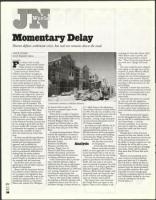
massive Israeli construction in and
around the settlement of Ma'aleh
Adumim, a bedroom community
three miles east of Jerusalem. The
Americans also wanted to know why
Israel hadn't removed dozens of "ille-
gal" or "unauthorized" West Bank
outposts, despite earlier promises.
In early August talks in Jerusalem,
Sharon was able to convince a high-
level American envoy, Elliot Abrams
of the National Security Council, that
he was acting in good faith and that
he soon would take extensive action
to dismantle the outposts. In parallel,
Sharon took a number of steps to
show the Americans he meant busi-
ness:
He froze several Housing Ministry
projects despite the fact that they
already had received government
approval, and he offered the
Americans detailed explanations of
what was happening on the ground
and his government's difficulties in
dealing with the settler problem.
Israeli officials also went to unprece-
dented lengths to coordinate data on
the outposts with the Americans.
For the first time, the two sides
agreed upon a list of which outposts
should be dismantled.
Sharon told the Americans that he
had ordered a Justice Ministry attor-
ney to prepare new legislation that
would make it easier for Israel to dis-
mantle the outposts before the U.S.
presidential election in November.
Sharon also ordered Dov Weisglass,
F
. 8/13
2004
26
Construction continues at Ma'aleh Adumim.
his bureau chief, to give the
Americans a progress report in the
next few weeks.
Sharon froze a number of projects
approved by former Housing Minister
Effie Eitam, the hawkish leader of the
National Religious Party, who
resigned over Sharon's plan to with-
draw Israeli troops and settlers from
the Gaza Strip and part of the West
Bank.
As acting housing minister, Sharon
ordered the suspension of construc-
tion bids for 1,300 housing units in
Ariel, Kiryat Arba, Betar Elit, Geva
Binyamin, Karnei
Shomron and Ma'aleh
Adumim, until the new
minister, Tzippi Livni of
Sharon's Likud Party, examines
whether the projects contravene
understandings with the Americans
on halting settlement expansion.
As for construction that is proceed-
ing in Ma'aleh Adumim, Sharon
explained that this was an old project,
approved by former Prime Minster
Ehud Barak's government in 1999 and
now nearing completion. It was not
something his government had
approved or could stop, Sharon said.
Some in the Israeli media confused
the building in Ma'aleh Adumim with
a significant plan to join the city to
Jerusalem through a scheme known as
A-1, which dates to the administra-
tion of Prime Minister Yitzhak Rabin
in 1994. The idea was to build a com-
plex of residential and tourist areas all
the way from Ma'aleh Adumim to
Jerusalem, creating a huge metropoli-
tan area and ensuring Israeli control
of "Greater Jerusalem."
According to Israeli officials, the A-
1 plan was designed to preempt an
opposing Palestinian scheme to cut
Ma'aleh Adumim off from Jerusalem
by continuous north-south building,
connecting the villages of Abu Dis,
Issawiya and Anata. So far, neither
side has done very much
'SiS on the ground.
In his talks with Abrams,
Sharon noted that the plan
hadn't yet been approved in its entire-
ty and maintained that it was not on
the agenda, at least for the time being.
For now, the Americans seem pre-
pared to give Sharon the benefit of the
doubt, but they want to see action
soon on removal of outposts. As a first
step to show it is acting in good faith,
Israel has charged a senior Defense
Ministry official, Baruch Spiegel, with
comparing Israeli and American data
on the outposts and reaching agree-
ment on numbers and locations.
The bottom line is that Israel and
the United States now agree on the
figures: There are 82 outposts in all,
Anal y
including 23 built after March 2001,
when Sharon came to power, and
which he has promised to remove
first. "These 23 are the main focus of
our work now," Spiegel told Israel
TV.
The same model has been adopted
with regard to the legal issues of the
outposts: A Justice Ministry official,
attorney Talia Sasson, has been
assigned the task of formulating new
legislation to ease removal. The old
laws, based on Jordanian and Turkish
precedents, afford protection for ille-
gal buildings.
Ironically, a system that successive
Israeli governments exploited to build
settlements is now being used to pre-
vent the government from taking
them down.
Sasson has been given two months
to come up with new legislation.
Sharon has promised the Americans
to act quickly once the legislation is
in place, and to start evacuating out-
posts well before the presidential elec-
tion.
As he seeks international support
for his disengagement plan, Sharon
has no wish for a confrontation with
the United States — and the
American president, in an election
year; has no wish for a clash with
Israel that could cost him crucial
Jewish votes.
Though there is little American
pressure on him now, Sharon is well
aware that the Americans and the rest
of the international community see
his ability to remove outposts as a test
of whether he will be able to carry
out his far more ambitious disengage-
ment plan, which calls for disman-
tling more than 20 bona fide settle-
ments.
Sharon's accommodating tactics
seem to have won him breathing
space until after the U.S. election.
But if he fails to deliver by then or
soon afterwards, he will face - strong
pressure from the elected president
and a possible escalation that could
jeopardize his main strategic goal:
achieving a separation between Israelis
and Palestinians, backed by the inter-
national community, led by the
United States.
❑