

OTHER VIEWS
Sharing The Experience
RACHEL SILVER
Community Perspective
A
s a Jew growing up in metro
Detroit, I have always been
taught to remember the
Holocaust. In religious school, I
learned about Yom Hashoah. On my
student trip to Israel I visited Yad
Vashem, and in high school my
peers and I viewed films during
Holocaust Remembrance Week.
Although I have been exposed to a
plethora of Holocaust knowledge, it
was not until I recently visited the
new Holocaust Memorial Center in
Farmington Hills with my fellow
interns from the Jeanette and Oscar
Cook Jewish Occupational Intern
Program and service corps members
from the City Year Detroit program
that I learned how non-Jews react to
the Holocaust.
After speaking with some City
Year corps members and observing
their reactions, it became clear to me
that people of all races and ethnic
backgrounds are affected on a•er-
sonal level by the horror of the
Holocaust. The appalling images and
articles on display at the memorial
center remind visitors not only of
Rachel Silver is a Project JOIN Intern
at the Jewish Community Council of
Metropolitan Detroit. She is a junior at
Michigan State University and a gradu-
ate of Berkley High School.
FALBAUM
the persecution of the Jews but also
for non-Jews, a time in history when
their ancestors may have been perse-
cuted because of their race, ethnicity
or faith.
City Year Detroit is a program that
brings together 17- to 24-year-olds
of different backgrounds for a 10-
month commitment to community
service. These young people volun-
teer at different middle and elemen-
tary schools, tutoring children and
running after-school programs. They
also participate in physical service
jobs such as cleaning and rebuilding
within the city of Detroit.
City Year Detroit sponsors include
the Jewish community with funding
from the Jewish Fund and the Jewish
Federation of Metropolitan Detroit.
The Detroit Jewish Initiative of the
Jewish Community Council serves as
liaison to City Year Detroit.
Throughout the morning of June
18, I asked the City Year corps
members about their reactions to the
Holocaust memorial. "Today, I real-
ized that Jewish people went
through the same kinds of things in
the Holocaust that Africans experi
enced when they were kidnapped
and sent into slavery," said Leslie
Banks of Southfield, an Eastern
Michigan University student.
"Although Jews were sent on boxcars
to the concentration camps and
Africans were sent on ships, the sto-
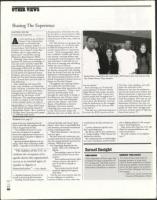
Rachel Silver, second from left, with Project JOIN Intern Sara Levy and two City
Year Detroit Service Corps members.
ries are similar."
Barry Jennings, an 18-year-old
recent graduate of Detroit Denby
High School, had similar reactions,
"Before I came today, I knew that
Jewish people had struggled, but I
did not realize how much. I learned
more about the Holocaust and real-
ized the similarities to the struggles
and hardships of the Africans sold -
into slavery."
That day was a learning experience
for both the JOIN interns and the
City Year corps members, not only
about the atrocities of the
Holocaust, but also the similarities
between the persecution of Jews and
African-Americans. I appreciate that
the Jewish community has chosen to
fund this program. Not only are the
corps members working toward the
betterment of Detroit, but also cre-
ating relationships between Jews and
people of other ethnic backgrounds
who have common goals of fighting
hatred and racism. ❑
would destroy the State of Israel, say
no.
A pretty substantive agenda; more
than a good beginning.
She did not call for more conferences
or "bridge building." Why? Because the
solutions are obvious.
She understands that to build bridges
you need a foundation and the founda-
tion in fighting bigotry is: No compro-
mise in moral imperatives.
Does anyone have hope the U.N. will
adopt her recommendations or even
work toward them?
No need to answer. It's too depress-
ing. ❑
from page 27
of Israel, Bayefsky said Annan "chose
silence" when others in the Middle East
and elsewhere committed humanitarian
crimes, including genocide.
"That's discrimination," she said over
and over again.
We don't need such conferences, par-
ticularly when the very ones who should
hear the message basically boycotted the
meeting. What do we need?
Not surprisingly, Bayefsky has the
answer. Here is the challenge she
offered:
"The inability of the U.N. to
"Start putting a name on the ter-
confront the corruption of its
rorists that kill Jews because they
are Jews.
agenda dooms this organization's
"Start condemning human rights
violators wherever they dwell —
success as an essential agent of
even if they live in Riyadh or
equality or dignity or
Damascus.
"Stop condemning the Jewish
democratization." Anne Bayefsky
people for fighting back against
their killers.
'And the next time someone asks you
— Bayefsky lambasted Annan for his
or your colleagues to stand for a
record in promoting discrimination.
moment of silence to honor those who
Detailing Annan's frequent criticism
•applaud the host, forgetting that the
cancer which kills the organism will take_
with it the good and the bad.
"The inability of the U.N. to con-
front the corruption of its agenda
dooms this organization's success as an
essential agent of equality or dignity or
democratization."
Ignoring accepted diplomacy of not
using a name when criticizing a public
official —especially on his home court
•
Israel Insight
,•.
",
.t_iitc.: e n r a t
oneps.p IrE
it000a
n erdart,s gei,
ecteui
e l vr SS
pl 0. a rrg
°
rrem
a proportion
i tnSo
TilE
w th little received
U.S. foreign
In reality th e U . 5
.
i beneficial to America.
relationship is
BEHIND 'TEC ISSUE
The United States and Israel are
strategic partners in many areas.
There is broad cooperation on home-
land s ecurity, ballistic missile defense
and in the fight against the prolifera-
tion of nuclear, biological and chemi-
cal weapons.
— Allan Gale, Jewish Community
Council ofAiletropolit.an Detroit