
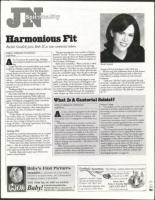

Harmonious Fit
Rachel Gottlieb joins Beth El as new cantorial soloist
SHELLI LIEBMAN DORFMAN
StaffWriter
A
fter 13 years on the musical stage, Michigan
native Rachel Gottlieb has come back home to
stay.
Temple Beth El's new cantorial soloist most recently
worked as a freelance musician in New York City.
"I really enjoyed my life in New York doing opera,
musical theater, a lot of concert work," the soprano
said. "But my life was very scattered there. What's excit-
ing about being at Beth El is that I am a part of a com-
munity -- and that matters very much to me. I know
that here, if someone asks me to sing at their son's bar
mitzvah, it is not just because of my voice — it's
because it's me."
- Working at Beth El as a cantorial soloist is a full-time
position for Gottlieb.
She works with Beth El's religious and nursery
schools, community programs, Friday night and
Saturday services as well as with groups within the syna-
gogue, including the congregation's music committee.
She also tutors b'nai mitzvah students.
Although there is no cantor at Beth El since David
Montefiore's recent departure, other music-related per-
sonnel also are active, including new organist Dr.
Timothy Huth.
"Caitlin Klaper will continue to lead the youth choir,
but I will be there, too," Gottlieb said. "Elsie Inselman
will keep on leading the adult choir, but I'll work with
her, too. I'm in charge of things I've never been in
charge of before — like piano maintenance. Everything
musical goes through my office."
Getting Here
Gottlieb's first cantorial soloist position was as a student
at Eastman School of Music in Rochester, N.Y. "My
classmates were being given church jobs, but I asked if
there was something I could do in a temple," she said.
"That's when Sam Adler, Eastman's head of compo-
sition — who also is Jewish and writes liturgical musical
— told me his temple had just lost its cantorial soloist
and I ended up serving them for three years."
Gottlieb, whose parents grew up in Detroit, was
raised in Grand Rapids.
"My great-grandparents were members of Temple
Beth El," she said. "In fact, it was at my grandfather's
funeral two years ago that I met Rabbi [Daniel] Syme.
He and my father had been in a fraternity together at
the University of Michigan."
Rabbi Syme remembers, "When I met her, I asked
her to send me a tape so I Could hear how she sings.
When I heard it, it just blew me away. Usually, when a
soprano hits high notes, they can shatter glass. But she
has such a remarkable range, when she gets to the high
notes, she can just touch them. It's really beautiful to
hear."
Gottlieb holds a master's of music degree in voice
performance from the University of Michigan in Ann
Arbor, is a member of the American Conference of
Cantors' Guild of Temple Musicians in New York and
has served congregations in New York, Illinois and in
Grand Rapids at Temple Emanuel, the congregation
where she grew up. Most recently, she served at the
SHELLI LIEBMAN DORFMAN
Staff Writer
A
t a least a dozen congregations in the Detroit
area employ cantorial soloists. Most are part-
time and work in Reform synagogues, and
the majority work in congregations where there is no
cantor.
While they typically have extensive musical train-
ing, a new program at the Jewish Music Institute
UMI) at Hebrew College in Massachusetts may be the
first to offer a cantorial soloist curriculum. The Jewish
Cantorial Arts program is available as a 30-credit cer-
tificate course or as part of a bachelor's or master's
degree program. It focuses on education and training
that includes cantillation; liturgy, Jewish music history,
Hebrew language and Jewish law — all relevant to the
leading of prayer.
Most cantorial soloists are, more often than not,
musicians with little knowledge of cantorial arts,"
said DE Scott Sokol, director of JMI and associate
professor of Jewish music and Jewish education at
before it is born! Now, 3D Ultrasound
Imaging makes it possible.
Call, stop by, or visit us online
Rd.
Plaza
loR omfield
d j
In th
the
hae rW
West k Bloomfield
.7:
us t sou th o f
wvvw.myfirstpicture.us
1655
•
248 855
-
-
Temple of Universal Judaism in New York City.
She has sung with professional choirs at Park Avenue
Synagogue and Temple Emanuel, both in New York
City, and her recordings include solo and choral per-
formances.
"Until now, I felt like I hadn't quite found the path
of my life," Gottlieb said. "I'm 33 and feel ready to find
it, and to be somewhere where I can put down roots
and be closer to my family and be part of a community.
I really picture my life here. This feels like a very good
fit." ❑
What Is A Cantorial Soloist?
Baby's First Pictures
Imagine ...pictures of your baby
Bab,f •
Rachel Gottlieb
Hebrew College.
"Our program, in fact, was designed to counter this
trend and to provide a solid foundation to those who
are serving as cantorial soloists in communities with-
out cantors."
He cautioned that although some cantorial soloists
title themselves "cantor," "in the Reform and
Conservative movements 'cantor' is reserved for people
who are either invested [graduated from an accredited
cantorial school] or certified [engaged in private
study]," he said
"The Conservative Jewish Theological Seminary
and Reform Hebrew Union College-Jewish Institute
of Religion offer programs to fully train Jewish singers
to become cantors," said Cantor Stephen Dubov of
Congregation Chaye Olam, president of the Michigan
Board of Cantors. "They spend five years towards a
master's degree in sacred music, and then bring a
range of skills to their synagogues. They are trained in
all areas including Hebrew, Torah, rabbinic literature,
liturgy, troppe (cantillation), lifecycles, Yiddish, holi
CANTORIAL SOLOIST on page 44
uct's Ristorante•
Fine Dining • Authentic Italian Menu & Atmosphere
Elegant Banquet Facility
(Capacity up to 200)
Appetizers • Insalata • Zuppa
Specialty &Traditional Pastas
Chicken • Veal • Beef • Fish
Reservations Accepted
Dinner Music
Friday c Saturday Nigh
Our Personafized Signature Series
248-360-9671
Large Selection of Fine Wines
7110 Cooley Lake Road
858760