

The Graying Of Jewish America
As the Jewish community ages, some hope to tap the elderly as a resource.
JOE BERKOFSKY
Jewish Telegraphic Agency
Philadelphia
ernice Bricklin has retired
as a family law attorney,
but at 75 she remains active
on several organizational
boards and attends Mishkan Shalom,
a Reconstructionist synagogue.
But there's a problem: When
Bricklin attends Torah study classes
with her daughter, people all but
ignore her.
"I'm invisible," she said, shaking
her fist.
On paper, however, she's not: As
Jewish fertility rates drop and life
expectancy rises, Bricklin and mil-
lions of other elderly Jews represent a
growing slice of American Jewry.
The recent National Jewish -
Population Survey 2000-01. estimated
that a quarter of America's 5.2 mil-
lion Jews are 60 or older, and that the
very old are growing as a percentage
of the Jewish population.
Of all Jews, 19 percent are 65 or
older — compared to only 12 per-
cent in the general population — a
marked increase since the last study
in 1990 when they comprised 17 per-
cent of the general Jewish population.
Their median age is 75, up from 71
in 1990.
"That's a big change. We've got an
aging population," said Allen
Glicksman, director of research and
evaluation at the Philadelphia
Corporation for Aging and one of the
foremost experts on the demograph-
ics of Jewish aging.
B
Growing Concern
For the first time, the community is
beginning to respond to the graying
of American Jewry.
This week, more than two dozen
academics, gerontologists, rabbis and
social service professionals gathered
in Philadelphia for an unusual one-
day event dubbed "Aging and the
21st Century Synagogue: A Think-
Tank for Creating Positive Futures."
Other responses are cropping up
as well. The Philadelphia forum was
preceded by a summit on the loom-
ing "age wave," and it emerged from
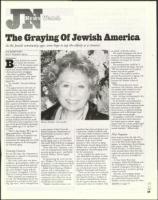
Bernice Bricklin: "Ibri invisible."
a new project of the Union for
Reform Judaism's Department of
Jewish" Family Concerns, called
"Sacred Aging."
The effort to raise the profile of
Jewish aging came as surveys show
that nearly half of Reform synagogue
members are 50 years old or above.
These older Jews "represent a new
wave of congregational entities that
are only going to grow," said Rabbi
Richard Address, Sacred Aging's
director.
Co-sponsoring the event was the
new "Hiddur: The Center for Aging
& Judaism," at the Reconstructionist
Rabbinical College in Wyncote, Pa.
Rabbi Dayle Friedman; Hiddur's
director and a leading figure in
Jewish chaplaincy and pastoral care,
said Hiddur aims to convince the
community that older Jews are an
untapped resource that can enrich
Jewish life, not a liability.
"Hiddur's humble mission is to
transform the vision of aging in our
community," Rabbi Friedman said.
For years, Rabbi Friedman worked
in and taught geriatric chaplaincy at
RRC, which so far remains the only
seminary of the major Jewish
streams to offer courses on aging.
Like Reform's Sacred Aging project,
Hiddur also is striving to become a
clearinghouse of Jewish aging tools
for the community.
So far, Hiddur has raised more
than $490,000 in funding. In addi-
tion to training rabbinical students,
the center is producing kits that
non-Jewish staffers in senior-care
facilities with only a few Jews can
use to help those seniors celebrate
Shabbat, Chanukah and Passover.
Those on the front lines of Jewish
aging welcome these moves. Rabbi
Sara Paasche-Orlow, a chaplain at
the Hebrew Rehabilitation Center
for the Aged in Boston, feels the
community treats its residents "like
an island" of Jewish culture.
She urged synagogues and others
to run programs involving seniors,
especially at nursing homes where
residents are hungry for spiritual
nourishment.
The nursing home could be "a
center for Jewish learning," she said.
"We have perpetual care for grave-
stones, but not for people."
Much of the problem revolves
around the perception of aging, said
Rick Moody, director for the
Institute for Human Values in
Aging.
While being old once meant
retirement and infirmity, many eld-
erly people today embark on new
careers, tackle new pursuits and
remain healthier longer.
Still, "we have no meaning for this
latter - part of life," he said.
In the Jewish world, philanthro-
pists and communal leaders long
have focused on other pressing needs
like Israel and Jews in the former
Soviet Union, or identity-building
programs such as Birthright Israel,
which target young people.
Synagogues, meanwhile, build pre-
schools and fund adult education
but largely ignore seniors, aging
experts said. As a result, people aged
55-60 are "deserting synagogues in
record numbers," Address said.
Pilot Programs
Some hope to stem this tide. San
Francisco's Congregation Emanu-El,
one of the Bay Area's largest syna-
gogues, is conducting a Sacred Aging
pilot project called "My Life As a
Sacred Journey," in which seniors
write journals about their lives that
explore the spiritual paths they have
taken and can serve as models for
others.
At New York's West End
Synagogue, Rabbi Yael Ridberg said,
the congregation is beginning to
integrate congregants of all ages in a
step experts say is crucial to getting
seniors involved.
Recently, the synagogue began
holding a pot-luck Kiddush and din-
ner sandwiched between family
Shabbat services and those for older
GRAYING on page 19
5/ 7
2004
17