

OTHER VIEWS
BEST from page 27
tions of these first volunteers.
My travel group lived in barracks
divided into three-cot rooms. Men
and women are separated, including
us and one other married couple From
Toronto. Bathrooms are in nearby
buildings.
We were required to wear Army
fatigue uniforms while on base, but it
was not permitted off base when we
might walk into Ramle and when we
left for the weekend.
Army Life
Breakfast began at 7 a.m., followed by
a meeting at the barracks at 7:50 with
the madrichah, an almost 19-year-old
woman soldier responsible for being
the leader, instructor, troubleshooter
and hand-holder, if necessary. Our
madrichah was Tamar, whose home is
Kibbutz Mevo Hamma in the Golan
Heights.
She did a remarkable job of pulling
together the needs - and occasional
demands of a diverse group that, for
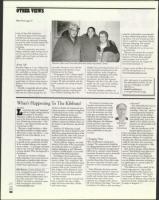
Volunteers Albert and Vivian Best flank their Israeli army adviser, Tamar.
two weeks, became a team with the
sole function and objective of per-
forming service for Israel.
The purpose of the 7:50 get-togeth-
er was for Tamar to make announce-
ments and bring the latest news to her
charges. We then assembled with the
base's troops for the raising of Israel's
flag.
As a personal note, it was a doubly
_thrilling few minutes: watching the
Star of David climbing above the
What's Happening To The Kibbutz?
Jerusalem
ong before the word "settlement"
took on a highly charged political
connotation in the Israeli-
Palestinian conflict, the settlement enter-
prise in the State of Israel was marked by
over 250 thriving communities — kib-
butzim — that represented the best the
country had to offer.
But now, a simple decision — allow-
ing kibbutz members to legally register
their homes in their own names — may
signify the end of the kibbutz, as we
know it.
The old system — whereby all proper-
ty and all income earned from the labor
of the members belong to the coopera-
tive as a whole — is no longer necessarily
valid on the "renewed" kibbutz, the gov-
ernment decided. What has happened to
the kibbutz?
Recently, the members of Kibbutz
Ayelet Hashahar in the north voted over-
whelmingly to transform their commu-
nity into a moshay. Two kibbutzim —
Gesher Haziv and Kedarim — became
L
Ellis Shuman, a native of Sioux City,
4/30
2004
28
Iowa, immigrated to Israel in 1972, served
in the Israel Defense Forces and was a
founding member of Kibbutz Yahel. He is
the author of the book "The Virtual
Kibbutz" and editor-in-chiefof the online
daily newsmagazine _Israel Insider,
wwvv.israelinsider.com
the first to finalize the bureaucratic pro-
cedure necessary to transfer the legal title
of individual homes to their members.
Kibbutz Mishmar David, near
Rehovot, became the first kibbutz to
decide to dismantle itself and become an
ordinary community. Kibbutz Haon, on
the shores of Lake Kinneret, has also dis-
banded.
Israel has 257 kibbutzim, located
throughout the country. Except for a few
kibbutzim resting along the shores of the
northern Dead Sea, none of the commu-
nities are located over the 1967 Green
Line in Palestinian territories.
The first kibbutz, Degania, was estab-
lished in 1910; most of the communities
are secular, but there are a number of
religious kibbutzim as well. Kibbutzim
comprise 110,000 people, or just under
2 percent of the Israeli population.
According to the new government
decision, there will be two types of kib-
butzim in Israel. The "cooperative" kib-
butz will be the traditional kibbutz based
on communal ownership of assets and
property, while on the "renewed" kib-
butz, budgets will be allocated to mem-
bers in accordance with their contribu-
tion to the community, their position
and their seniority.
In other words, on the "renewed" kib-
butz, a member who earns a higher
salary will receive more than a worker
with a lower salary.
Middle East and seeing the faces of so
many beautiful young Israelis in the
nation's uniform, many brought as
children from throughout the world.
An especially striking sight, not
uncommon, was the dark-skinned
Ethiopian with his or her rifle. A yar-
mulke was also a part of the uniform
of virtually every Ethiopian young
man we saw.
Our first Tuesday's workday was
shortened by an hour for a tour on an
The notions of members own-
ing their own homes and some
earning more than others would
have been considered an anathe-
ma in the movement just a few
years ago, yet already some 140
kibbutzim have adopted varying
degrees of capitalist reforms.
Other kibbutzim, like Mishmar
David and Haon, have aban-
doned all traces of their coopera-
tive identities and other commu-
nities could follow in the years
to come.
army bus to Jerusalem, accompanied
by three rifle-bearing soldiers, includ-
ing Tamar. The tour wound up with a
visit to a mall for a non-Army dinner
and some shopping. Our second
Tuesday's tour took us to Jaffa.
The weekends sent us on our own
out of the base.
Whatever the reasons for so much
of the world's bias against and mis-
treatment of Israel, these attitudes
make programs such as Sar-El
extremely important for support of
the Jewish homeland. ❑
A longer version of Albert Best's account
of his Sar-El experience is at
vvvvw.detroitjewishnews.corn
More information is available from
West Bloomfield's Ed Kohl, Sar-El
associate in Michigan, at (248)
788-0551 or
sekohl@earthlink.net
or through wwvv.sar-el.org
to his need"?
Even those kibbutzim that are
making radical changes are
retaining a "safety net," which is
a mutual guarantee funded by
community taxes the kibbutz
members pay to help members
with special needs, such as the
ELLIS
elderly or sick. Health care and
SHUMAN
education are still provided to all
Special
by the community.
Commentary
After the introduction of dif-
ferential salaries and private
home ownership, this mutual responsi-
bility is the final red line defining what
constitutes a kibbutz. If a community
Changing Times
abandons this, allowing members to fend
Why are kibbutzim making these
totally for themselves, the community
changes? The communities' dwindling
would no longer be recognized as a kib-
and aging populations and the failures of butz, even by the government.
many of their industries and agricultural
After all these changes, will the kibbutz
efforts led to a situation where financial
survive? "Each kibbutz must draft up its
necessities dictated the need to drastically own code of rules," United Kibbutz
change course in the social realm.
Movement secretary Gavri Bargil said.
Changes were needed immediately;
"This is going to take a while. But I envi-
members feared that if they didn't make
sion the kibbutz movement returning to
the moves voluntarily, the banks could
its rightful place as a central molder of
foreclose on their communities arbitrari-
Israeli society," he said.
ly.
"The kibbutz as it was is dead. It's fin-
Many kibbutzim that have retained
ished. Forget about it," said an older
their traditional "cooperative" nature are
member of Kibbutz Kfar Hanassi in a
communities that were financially suc-
recent newspaper article. "The country
cessful, and therefore their members were has changed, for better or worse. The
immune from most of the social
culture is one of Western values, both the
upheaval. In a changed society, what is
good and the bad. And basically, we have
left of the kibbutz's old adage, "from each to adapt or disappear." ❑
according to his ability, to each according