

Rabbi Levin's Legacy
A historically significant collection dating back more than 100 years
finds a home at the University of Michigan.
KAREN SCHWARTZ
Special to the Jewish News
Ann Arbor
A
century after Rabbi Judah Leib Levin
received patents for his invention of an
adding machine and later a calculating
machine, his papers have found a home.
The collection — two books, 22 handwritten
notebooks and patent materials — was recently given
to the University of Michigan Special Collections
Library in Ann Arbor by Rabbi Levin's granddaugh-
ter Judy Levin Cantor, along with her brother, Dr.
Joseph H. Levin of Boston and her sister, Miriam
Levin Friedman of Southfield.
"These papers will be opened to the public at the
university during the national celebration of 350
years of Jewish people in America," said Cantor, a
Bloomfield Hills resident and Michigan Jewish histo-
ry expert.
"He's certainly one to celebrate, he's a milestone
man — his life was a milestone in the life of Jewish
people in Michigan," she said.
The public can view some of Rabbi Levin's papers
at the Harlan Hatcher Graduate Library on U-M's
central campus, where they are included in an exhi-
bition tided "Spotlight on New Arrivals."
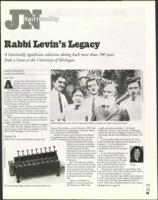
Rabbi Judah Leib Levin with his wife, Esther Rhoda, and their sons Isadore, Abe and Samuel
Pho to cour tesy Smithsonian
eastern United States, came to Detroit in 1897, after
the United Jewish Congregations of Detroit offered
him the position of Chief Rabbi.
Locally, he took an active role in several Detroit
Family Ties
congregations and established a Hebrew education
Rabbi Levin, a native of Lithuania serving in the
system, including a school that later became the
Yeshivah Beth Yehudah. He also
helped set up kashrut authorities
and Jewish cemeteries and helped
provide meals for the poor.
Nationally, he was involved in the
Hamizrahi Zionist movement and
participated in the establishment
of the Union of Orthodox Rabbis -
of America.
The U-M collection includes
Rabbi Levin's notes, drafts of texts,
lectures and sermons as well as the
patent papers for his calculating
machine. The material was written
in pen and pencil in notebooks
and ledgers of all sizes, Cantor
said.
"Some are in Hebrew or
Yiddish so it seemed important
that they go to a library that
The calculating adding machine invented by Rabbi Levin
-
would make them accessible — the Special
Collections Library at the University of Michigan
makes this material accessible to researchers around
the world, and that's the fulfillment_of a dream," she
said.
Cantor said her father, Prof. Samuel M. Levin,
had considered the papers his most significant pos-
sessions — he even carried them
on his lap in the car when he
moved from his house to an apart-
ment.
As an archivist herself and a stu-
dent of regional Jewish history,
Cantor said she was intrigued by
Rabbi Levin's story and, although
he died the year before she was
born, she feels linked to the man
Cantor
she said was ahead of his time.
"Having been named after my grandfather after
his death, I have always felt an interest and a connec-
tion to this fascinating man," she said.
The family decided to give Rabbi Levin's papers to
U-M in part because of their legacy at the university,
Cantor said. Her father graduated from U-M in
1912. His brother Abraham, known as "A.J.," gradu-
RABBI LEVIN on page 52
tk
2/13
2004
51