

lives," he said.
"The greatest mistake the Jewish
community makes is seeing it as win-
ning families. It's not a question of
winning families, it's a question of
serving people."
Rabbi Levy sees categorizing the
intermarried as a problem. "This
means on one hand we want to serve
them and on the other hand we're
treating them differently," he said.
say they have the holiday situation
fairly sorted out.
"We've thought a lot about this,"
said Bonnie Keen. "Basically, we're
raising the kids Jewish, so Jim helps
us celebrate Chanukah and we help
him and his family celebrate
Christmas.
"When it's time for Christmas,
Jim does get a tree — something that
was really important to him and tied
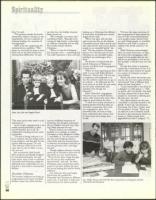
Alan, Ian, Jack and Angela Harris
"The main service they need is to be
welcomed in."
At his temple, programming is not
usually aimed specifically at inter-
married families, but to all. He
emphasized including and not isolat-
ing families.
"The key to being inclusive is to
be so inclusive that you forget you're
being inclusive, and that goes for the
various different groups," he said.
"The welcome needs to be so wel-
come that it's not an effort, it's just
who you are." -
But occasionally, Beth Emeth
offers programs specifically designed
for intermarried families. He said
some issues, such as how to celebrate
Chanukah and Christmas, might be
addressed more comfortably in a set-
ting that is restricted to intermarried
families.
December Dilemma
This month, traditions can bring up,
tough questions for many interfaith
families. Some Ann Arbor families
12/19
2003
58
into-his childhood memories of
Christmas, but the girls understand
that it's Daddy's tree and we're help-
ing Daddy decorate his tree."
Bonnie and Jim use celebrating a
birthday as an analogy to explain
Christmas to their daughters, Gabby,
7, and Molly, 4. "It's not your birth-
day, but you're helping someone
enjoy theirs and you can participate
in whatever the birthday activities are
and you go home with a loot bag,
she said.
Though religious identity certainly
comes up in December, Keen sees the
discussion as a year-round project.
"We do all the other things through-
out the year so they understand
they're Jewish," she said. "So when
Christmas comes around they under-
stand it's not their holiday but they
feel secure helping Jim and his family
celebrate.
Ann Arborites Alan and Angela
Harris keep the symbols for
Chanukah and Christmas in different
rooms. Ian, 5, and Jack, 3, help their
mom decorate her advent calendar
leading up to Christmas but definite-
ly know they are Jewish year-round,
Angela Harris said.
"We're very open with the kids
and we just say that we all celebrate
Chanukah because they're Jewish and
their dad's Jewish and we have Jewish
people in our extended family," she
said. "We also celebrate Christmas
because I'm Christian and we have
Christians in our extended family,
and that's not confusing at all to
them. "
The family is involved with the
Jewish Federation of Washtenaw
County and Beth Israel Congregation
(Conservative).
"When we were expecting our first
child, we met with Rabbi [Robert]
Dobrusin," Harris said. "He was just
so supportive and explained to us
that the children would have to go to
the mikvah — he officiated that for
us for both of our kids. He just made
me feel really comfortable and
included, even though I'm
Christian."
Rabbi Dobrusin's congregation
welcomes many interfaith families
and he talks with people about what
might be good choices for them.
`I think we're clearly interested in
helping families find their place in
the Jewish community. If it's with
our congregation, great. If it's
somewhere else, we want to help
them understand their choices and
let them know we're always here
to talk.
"It's been the major intention of
the congregation to hope people see
that we want to be welcoming and
serve people's needs, whoever they
are, and I think people, in interfaith
families as well, find us a place to
celebrate the Jewish tradition," he
said.
Rabbi Dobrusin acknowledged
there are ritual restrictions, as with
all Conservative synagogues, with
regard to how people who are not
Jewish can participate in the service.
For example, a non-Jew may not read
Torah.
He said Ann Arbor is somewhat
unique for a community its size. It is
able to offer many choices for people
in a variety of situations to experi-
ence Judaism.
Harris said within the Jewish com-
munity, she isn't even aware of who is
intermarried. This is different from
places she has lived before.
"It just seemed like it was more of
a dialogue" in other places — "Oh,
so and so, she's not Jewish,' that kind
of thing, whereas here I don't think
people are interested in defining peo-
ple that way," she said.
Alan Harris doesn't use the term
"interfaith" to describe himself or his
family. "I don't say: I'm American.
I'm Jewish. I'm 5 feet 7 inches. And
I'm interfaith," he said. "That's not
an adjective I use to identify myself
because in this community there's no
reason to. [Here] people don't
pigeonhole you into a category." ❑
"
Jim, Molly, Bonnie and Gabrielle Keen wrap presents and prepare cards for
Chanukah and Christmas.