

Election 2004
The Outsider
As a youth, a general and now a candidate, Wesley Clark is the perennial outsider.
RON KAMPEAS
Jewish Teleg,raphic Agency
Boca Raton, Fla.
IIAT esley Clark pats the yar-
mulke on his head,
telling the congregants
of
0
Temple Emeth, "It feels
really good to be here and to wear this."
Then, with unbridled enthusiasm, he
stuns the room by explaining why he
became a Roman Catholic.
Gen. Clark, the Reagan voter running
as a Democrat, the soldier who waged
diplomacy, the peacemaker who loves a
good scrap, enjoys nothing better than
confounding expectations. He is doing
just that by creeping up through the
ranks of nine Democratic presidential
candidates to reach second in the polls
in some states, and raising enough
money to keep him comfortable
through March.
The latecomer, whose candidacy
some dismissed as a vanity bid, now is
jockeying with Rep. Richard Gephardt
of Missouri as the likeliest candidate to
challenge front-runner Howard Dean in
the February stretch.
Jewish supporters say Clark is best
positioned to stanch what some fear
might be a massive Jewish defection to
President Bush's camp in November
2004. Clark's solid pro-Israel pro-
nouncements and history in uniform,
they say, are the best Democratic bet
against Bush's tough-on-terror image
and his rapport with Israeli Prime
Minister Ariel Sharon.
While there are no poll numbers
identifying the level of Jewish support
for individual candidates, Clark has had
successful fund-raisers among Jewish
supporters in New York, California,
Florida and Chicago.
"There wasn't a candidate that could
beat Bush until Clark," says Michael
Hoffman, a Chicago Web designer who
started Jews for Clark. "He has a niche.
Some of the other candidates, especially
Dean, worry a lot of people, especially
when it comes to fighting terrorism."
Clark reportedly is former President
Bill Clinton's anointed favorite: Two of
Clark's top campaign advisers, Eli Segal
and Ron Klain, are Jewish veterans of
the Clinton administration.
12/19
2003
32
Yet Clark carefully has cultivated his
image as an outsider, priding himself on
never having held political office. That
has led some to dismiss Clark as a politi-
cal lightweight. But supporters say it's
key to understanding the candidate's rise.
"Most of us like Clark because he was
not a politician," says Denyse Rackel of
Cleveland, who founded Women for
Clark.
Clark links his outsider status at least
tangentially to his Jewish background.
His Jewish father, Benjamin Kanne,
died in 1948 when Clark was 4. Within
months, his non-Jewish mother, Veneta,
moved back to her hometown of Little
Rock, Ark, from Chicago.
Clark was a stranger in Little Rock
and says that at first he was miserable,
distinguished by his Chicago accent and
his unusual last name, Kanne (pro-
nounced KAY-nee, apparently a varia-
don of Cohen). His mother feared that
Clark's Jewish background would com-
pound his alienation — so she never
told him about it.
"We were Austrian, she kept on say-
ing," Clark recalled, "I don't know much
about your father's family," she told him.
"We never talked much about it."
Jewish Connection
When Clark was 24 and he found out
about his Jewish connection — through
his father's relatives, who contacted him
while he was studying in England — he
confronted his mother. She broke down
crying, he said.
Clark said the prejudice against his
father, which his mother had witnessed,
affected her. She said, When your
father and I were married, or when we
dated before we were married, there
were restaurants we didn't go to, there
were clubs we couldn't belong to, there
were vacation resorts we weren't wel-
come at,'" Clark said.
Compounding the alienation he felt
in Little Rock were Clark's early memo-
ries of the warm embrace of his extend-
ed Jewish family in Chicago. "His first
.four years, there was a lot of warmth,"
recalls his cousin Harriet Salk, who is
16 years Clark's senior. "We used to all
get together Friday afternoon. Men
would play pinochle, women would sit
and talk."
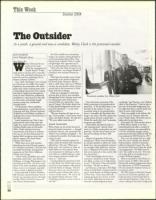
Presidential candidate Gen. Wesley Clark
Clark still retains memories of the
Friday gatherings at his grandmother's
apartment. "I was the baby there. I was
the baby of the cousins," he says. "I
remember being in my grandmother's
house, I remember the big salami that
hung in the closet. She had a piano that
people played, she had a candy dish —
I liked the candy dish. And I remember
the grown-ups talked."
Clark's father, described by Salk as a
"tall, imposing man," died of a heart
attack on a Friday evening after one such
gathering. "He had had a check-up that
day and everything was fine," Salk
recalls.
Despite his ignorance of his own
background, Clark's sense of himself as
an outsider sparked an affinity for Little
Rock's Jews. An accomplished swimmer,
the teenaged Clark preferred a summer
job as a lifeguard at the Jewish country
club to the same job at the country club
that barred Jews.
Clark acknowledges that he has a
contrarian, mischievous streak. He got
into fights as a boy, and in high school,
he says, "I did some of the usual prank-
ish things." He also was dtiven.
Jay Heyman, a classmate at Hall High
School in Little Rock, remembers that by
age 14 Clark already was talking of going
to West Point. "Even when there was
nothing going on, he was busy at work
with books, while those of us less aca- •
demically inclined might have been
socializing," says Heyman, now a Reform
rabbi in San Francisco. "I had no idea at
the time of his Jewish background, but
he might have been a yeshiva bocher (stu-
dent) in terms of his intensity"
Clark rose rapidly in the military fol-
lowing a tour in Vietnam, where he
won a Purple Heart. He led his men to
safety after he had been shot.
In his early 30s, Clark served a stint as
a White House adviser in the Ford
administration and, after a number of
command positions, was responsible by
1994 for worldwide strategic military
planning for the Joint Chiefs of Staff. He
was promoted to NATO chief in 1997.
Even now, his energy level is so high
that he's active nonstop, says Jeanette
Schnurmacher, a Jewish community
official in Broward County, Fla., who
has hosted Clark several times for speak-
ing engagements. He didn't want to
rest," she recalls of one visit. He want-
ed to play golf, so my husband got a
couple of friends together."
After he returned to Little Rock as a
private citizen in 2000, Clark started
doing, paid speaking engagements about
his experiences as NATO commander.
He also joined the Stephens Group, an
investment outfit.
His 2001 lecture in Broward County
was one of Clark's first speeches, and
Schnurmacher recommended him to
other Jewish federations. Clark ran the
circuit, talking of his Jewish background