
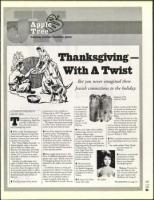

Bet you never imagined these
Jewish connections to the holiday.
Fragments of the
Dead Sea Scrolls
ELIZABETH APPLEBAUM
AppleTree Editor
T
his month, in honor of
Thanksgiving, AppleTree
provides a collection of
facts that link Judaism
and Thanksgiving words:
d What would Thanksgiving be
without the Pilgrims? Long before
those men and women set foot in
America, however, Jews were mak-
ing their own journeys.
The "Three Pilgrim Festivals," or
Shalosh Regelim, refer to the holi-
days of Passover, Sukkot and
Shavuot. On these days, the Torah
states, (in Deuteronomy 16:16 and
Exodus 23:17), Jews are to travel
and make a donation to charity in
God's honor.
Initially, the pilgrimages were
made to Shiloh, then to Jerusalem.
The tradition continues to this day
as travelers from throughout Israel,
and even the world, make an effort
to visit Jerusalem (and especially the
Kotel) during Pesach, Sukkot or
Shavuot.
I The first census of the Jewish
community in the republic of
Turkey was in 1927. The popula-
tion: 81,454 (in a nation of some
13.5 million citizens), the vast
majority of whom lived in Istanbul.
This figure decreased dramatically
in 1948, when Turkish Jews rushed
to live in the new State of Israel.
I One of the Dead Sea Scrolls also
is known as the "Thanksgiving
Psalms." The theme is, of course,
gratitude to God, and it is written
in the form of a poem. Scholars do
not believe that this was part of a
service in the Holy Temple, but
rather that the material was used in
a more private manner.
Most people don't know it, but
there is a difference between a sweet
potato and a yam. Which is best for
Thanksgiving dinner has yet to be
debated by the rabbis, but consider
this:
In Hebrew, there is a word yam
(pronounced "yahm"). It means sea,
and the most popular seas in Israel,
like the sweet potato and the yam,
offer a bit of confusion when it
comes to exactly what they are.
Yam HaMelach is literally "the sea
of salt," though
we know it as
the Dead Sea;
Yam Sufis lit-
erally "the sea
of reeds,"
though we
know it as the
Red Sea.
You can't make turkey stuffing
without sage, and you can't have
Judaism without sages.
Sages, in Hebrew, is chachamim,
and while we use it loosely to refer
to any wise Jewish scholar, the
greatest time of sages was from the
beginning of the Second Temple to
its destruction. The
term "sage" from this
period includes every-
one from-scribes to
mystics to heads of
Jewish academies.
I The first Jewish
newspaper printed in
the Spanish language
was Puerta del Oriente,
published in 1846 in
Turkey.
I If you're one of the
many who enjoy
today's version of the B-film
(or worse), no doubt you're
familiar with the works of
the incomparable Meshulim
Riklis.
Riklis got his start as a fin-
ancier in the business world,
then branched out into the
movie industry, where he met and
married and divorced the actress Pia
Zadora, who appeared in some of
his unforgettable films. Riklis was
born in Turkey in 1923.
g Want to thank someone who has
done something nice for you recent-
ly?
Say todah rabbah. That's "thank
you very much" in
Hebrew.
And now, some Jewish
connections to those
food extras you might
find in your favorite
Thanksgiving fare:
Walnuts: If You're the
type who likes to add
nuts to your turkey stuff-
ing, take a look at Shir
HaShirim, the Song of
THANKSGIVING on page 42
11 / 21
2003
41