
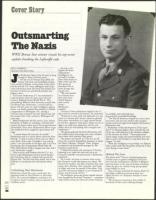

Outsmarting
The Nazis
WWII Bronze Star winner reveals his top-secret
exploits breaking the Luftwaffe code.
BILL CARROLL
Special to the Jewish News
oe Beckerman figures that 58 years is long
enough to keep a military secret.
On the eve of Veterans Day 2003, the
former Oak Park and Southfield resident,
now retired in Florida, reveals some of the meth-
ods he and his U.S. Army colleagues used to get
vital information from the Nazis that helped save
the lives of American and British bomber and
fighter crews.
Until now, Beckerman, 87, has maintained a
code of silence about his three years of secret
work in England during World War II. This
painstaking, difficult work ultimately earned him
the Bronze Star. Beckerman, a retired staff ser-
geant with the army air corps intelligence depart-
ment, was finally awarded the medal by a Florida
congressman in Wellington, Fla., during a
Veterans Day ceremony last year. Beckerman and
his second wife, Celia, retired to Wellington 20
years ago.
Before Beckerman left the service, Gen. Jimmy
Doolittle, of Tokyo air raid fame, told him he'd ,
receive the honor when and if his project became
declassified. Since then, Beckerman's efforts to get
the medal have been tangled in government red
tape.
"I waited almost 60 years for the medal,"
Beckerman said in a recent phone interview from
Florida. "I tried to track it down, but my efforts
were futile. Every time I thought I was coming
close, I ran into stacks of red tape, and it was very
frustrating. But Congressman Mark Foley [R-
West Palm Beach] made it happen last year, and I
can't thank him enough."
Foley and his staff worked with the U.S.-Air
Force to get Beckerman's service record declassi-
fied and prove that he, indeed, had earned the
Bronze Star. The files had been sealed, and it was
difficult to corroborate the information about
him.
.
Calculating Nazi Movements
JN
11/7
2003
66
Beckerman joined the army a week after the
Japanese attack on Pearl Harbor in December
1941. He received intelligence training at the
Citadel in South Carolina, where he passed with
excellent scores.
Serving in the
Eighth Air Force
Operational
Intelligence, he
arrived in London
from Nova Scotia in
May 1942 with the
first group of
American GIs to
enter Europe dur-
ing the war.
"We were herded
in a banana boat
that came from
South America
and it really .
stunk,"
Beckerman
recalled.
"German U-boat submarines chased us for 21
days until we arrived in Liverpool," he continued.
"Several of us then took over desk jobs in a war
room in a former girls' school, where we plotted
Nazi plane movements on a large control board.
It was like a gigantic chess game, where you try to
figure out what your opponents will do, and
defeat them by anticipating their strengths and
weaknesses."
The group gathered detailed information with
less sophisticated technology than most children
have today while playing video games.
The project was known as Y Service, an off-
shoot of a recently declassified operation to break
the Nazis' infamous "Enigma" Code. Enigma
enciphered and deciphered messages for the
German armed forces.
"I helped formulate and instrument Y Service,
allowing us to crack the code and cut in on
German Luftwaffe communications," Beckerman
explained.
"As a result, we knew in advance what action
the Germans would take against our planes. We
learned the number and types of planes they were
using, their altitudes, their capacities, their bases
of origin and even the morale of the pilots. I fig-
ured the information helped us save hundreds of -
planes and thousands of lives. "
The intelligence group also gained valuable informa-
tion through what he termed "insertions" — parachute
drops behind enemy lines where the chutist would spy
on air fields, work with local parti-
sans and pick up valuable knowledge.
"The French Resistance helped us a lot at their
own peril, and our own soldiers who escaped
enemy prisons brought back helpful information,"
Beckerman said.
Beckerman credits development of the super-
fast P-51 Mustang fighter plane towards the end
of the war with assisting in the ultimate collapse
of the German Air Force. "Those planes had
much longer range and maneuverability and were
able to escort our bombers to and back from the
targets," he said.
"With the intelligence we provided, our fighters
often could catch the Nazi pilots off guard as they
were flying to meet them."
Behind The Lines
His duties with Y Service included going into
combat zones to gather intelligence and scout
new sites for reconaissance. He flew to Belgium
and was driven to the area of Aachen, Germany,
where he spent six months using spying equip-
ment hidden in caves.
Then Germany launched the famous Battle of
the Bulge, suddenly penetrating deep into
Allied territory in a desperate attempt to stave
off defeat.
"We awoke one morning to the rumble of
hundreds of Nazi tanks crashing through